Wild (field) black cumin | Medicinal plant in the Akhdar Encyclopedia
The essential oil possesses antibacterial and antifungal properties. The seeds are used traditionally for their tonic, diuretic, purifying, and carminative properties, and are also believed to promote lactation and menstruation. A paste made from the seeds is used to treat scorpion stings.
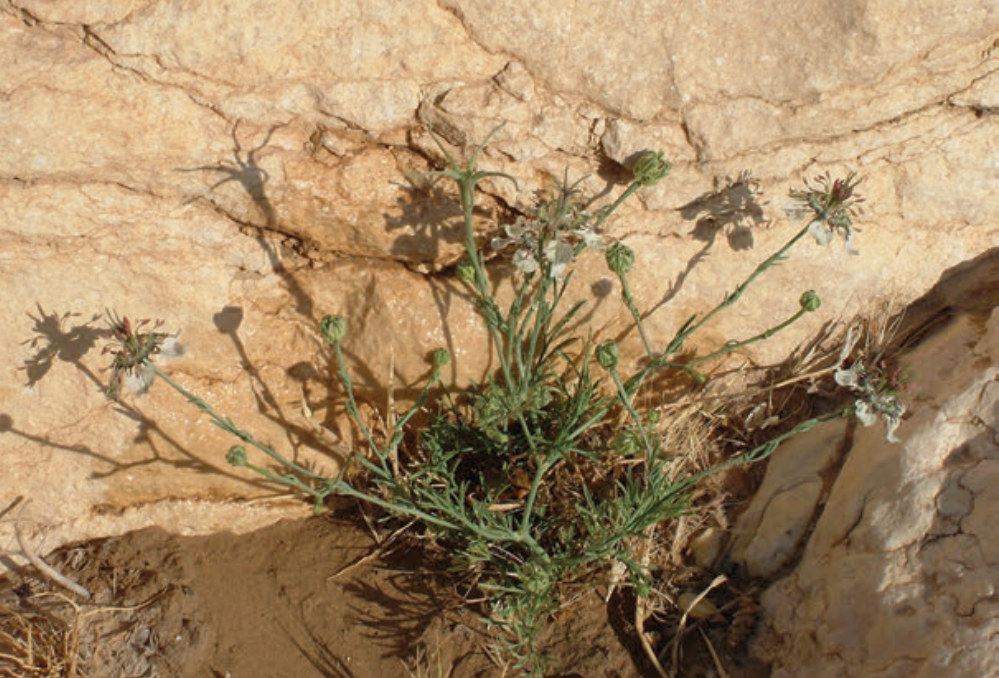
Plant name
Wild (field) black cumin
Latin name
Nigella arvensis L
Common names
Wild (field) black cumin
foreign names
Eng. Love-in-a-mist, Fr. Nigelle des champs
The group
The buttercup
Habitat and Geographic Distribution
Haw: The Mediterranean and Asia Minor
Botanical description
50 - A perennial herb, usually erect, reaching a height of 1 cm.
The stem is simple or angularly branched or notched, green or bluish-green, smooth or rough.
The leaves are simple, alternate, the lower petiolate divided into linear or uterine lobes, the upper sessile trilobes or unilobes, with smooth or rough margins.
The flowers are hermaphroditic, 1 cm in diameter, with long pedicels, 2.5 mm in diameter, and are arranged singly at branch ends.
The sepals are five, free, 10 - petalized, pink, white or bluish in color, perennial, mm long, ovate, heart-shaped at the base, pointed or acuminate at the apex, and glabrous.
The petals are five, consisting of a blade and a short nail.
The blade consists of two lips, the lower of which is often hairy and has dark bands, ending in two long, linear lobes.
The upper lip is half the size of the lower and is broadly linear at the base.
The stamens are numerous; the anthers are initially erect, then curve downwards, with apical, acuminate, or truncated tips.
The ovary is composed of carpels, fused in the lower third, and their posterior surface bears three prominent elongated ribs.
The fruit is a capsule, obovate, smooth or tuberous (partially 3-5), composed of the fusion of several carpels, each ending in a long beak.
The seeds are angular, rough, and granular. Flowering occurs from April to July.
Used part
seeds
chemical components
Oleic acid (36-15%), composed mainly of unsaturated fatty acids (40% oleic acid - fixed oil).
Linoleic acid (70-30%), carvacrol methyl ether (25%), α-β-pinene (27%), composed mainly of mono- and 0.4% volatile oil.
Kaempferol, quercetin. Glycoside flavonoids, including quercetin (13%), n-undecane.
Properties and medical uses
The essential oil possesses antibacterial and antifungal properties.
The seeds are used traditionally for their tonic, diuretic, purifying, and carminative properties, and are also believed to promote lactation and menstruation. A paste made from the seeds is used to treat scorpion stings.
Side effects and precautions
Allergic reactions or drug interactions may occur; self-use should be avoided by pregnant and breastfeeding women, children, and patients with chronic diseases.
Other uses
The seeds are used in small quantities as a spice due to their toxicity when used in large amounts.
Raw seeds were used in the past as a substitute for pepper (which causes sneezing).
Cooked seeds are used to flavor all kinds of pastries. Bees are attracted to flowers during their blooming season.
the environment
The plant spreads in neglected fields or fields planted with grains.
Agriculture and productivity
The plant grows wild and reproduces by seed. Nigella sativa L. N. cretica Mil. l
History and Heritage
It is noted that the scientific name of the genus is derived from the Latin word niger, meaning "black," referring to the color of the seeds.
The species name arvensis means "field." The ancient Egyptians used it as an ivory for coughs and chest ailments, and it is mentioned in their papyri.
It was also mentioned by al-Antaki, Ibn al-Baytar, and Abu al-Qasim al-Ghassani.
It is narrated from the Prophet (peace and blessings be upon him) that black seed is a cure for every disease except death.
Medical note
This information is for educational purposes only and does not constitute medical advice.
Poisonous or potent plants should only be used under the supervision of a qualified physician or pharmacist.
Related images


