Fennel | Medicinal plant in the Akhdar Encyclopedia
Salicylic acid alkaloid is used to lower blood pressure due to its vasodilatory properties. The sap of the fresh plant is used traditionally for its diuretic properties and in the treatment of liver and gallbladder diseases, urinary tract infections, and as a vermifuge. The plant's ash is used topi…
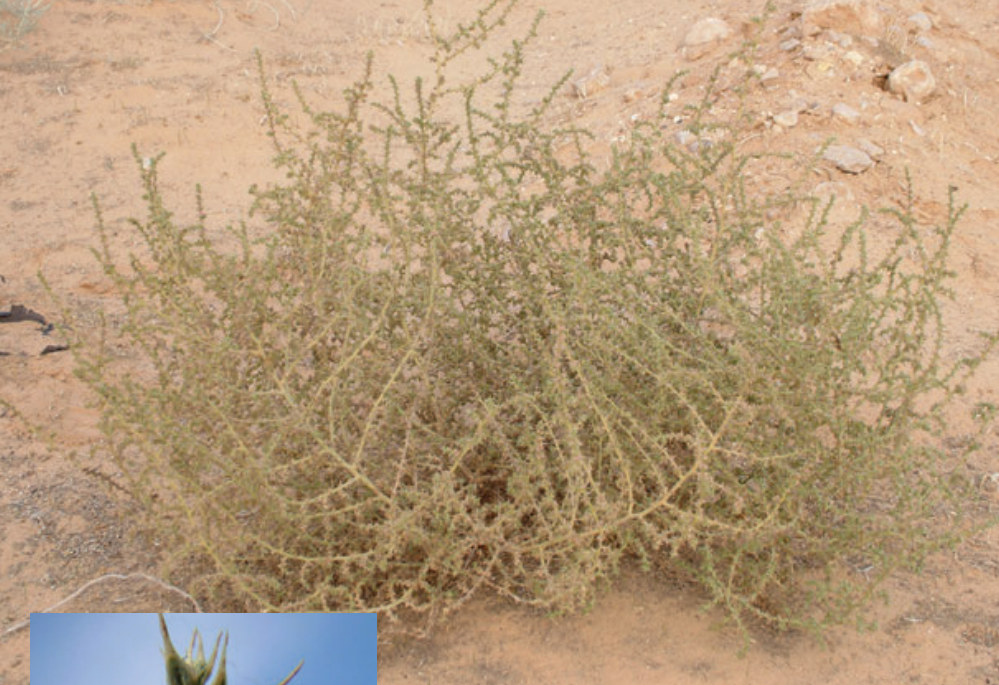
Plant name
frying pan
Latin name
Salsola kali L
Common names
Frying shoe, thorny shoe, frying
foreign names
Eng. Prickly saltwort, Russian thistle، Fr. Soude brulee
The group
The official
Habitat and Geographic Distribution
Native to Asia, it has spread widely throughout the world and become an invasive plant in some countries – the plant is native to Europe, such as the United States and Australia.
Botanical description
The grass is a dreamlike herb, especially in its early stages of growth, covered with a hairy sheath.
The stems are simple or 70 mm long, downy and hairy, becoming almost hairless, spreading or ascending, angular, dichotomously branching, especially from the base.
The lower leaves are opposite, and the upper ones are 2 x 30 mm.
The leaves are simple, spiny in shape, alternate, hairy, linear, acuminate at the tips, with ovate to triangular sepals, slightly longer than the pubescent segments.
The bracts are oblong and terminate in a pricking spine.
The flowers are hermaphroditic, solitary or clustered, axillary, forming a dense, leafy spike.
The calyx has free stamens.
The female flowers are bicarpal, free, membranous, oblong, and dull at the apex.
Male 4 - simple, segments 10 mm long (including 10), long, thread-like.
Fruit: umbel (acine), 3 mm in diameter, ovary superior, solitary, stigmas the length of wings), wings ovoid obovate to kidney-shaped, striated, sometimes reduced. Seeds horizontal. Flowering from July to October.
Used part
Plant chemical constituents: Alkaloids 0.2–0.3%, the most important of which are salsolin and salsolidin; oxalic acid 5%; fatty oils, the most important fatty acids being linolenic acid (linseed oil), oleic acid, arachidic acid (peanut), and palmitic acid (date palm); sodium, potassium, calcium, magnesium, ammonium, and iron salts; sugars (glucose, fructose, arabinose, rhamnose); flavonoids; and tannins.
chemical components
Oxalic acid.
Salsolidin, salsolidin, and alsoline are important components, including: salsolinic acid (0.2-0.3%), alkaloids, arachidic acid, oleic acid, and linolenic acid.
Fatty oils, the most important fatty acids of which are: linolenic acid (linseed oil), sodium and potassium salts, sugars (glucose, fructose), palmitic acid (palm), arachidic acid (pistachio), arabinose, rhamnose.
Properties and medical uses
Salicylic acid alkaloid is used to lower blood pressure due to its vasodilatory properties.
The sap of the young plant is used traditionally for its diuretic properties and in the treatment of liver and gallbladder diseases, urinary tract infections, and for expelling worms.
The plant's ash is used topically to treat skin diseases such as scabies, vitiligo, and warts.
It has anticancer, laxative, emollient, anti-ulcer, anti-inflammatory, antibacterial, and antioxidant properties.
Other uses include its use in glassmaking, and the ash was historically used as a type of soap that, when dry, is highly flammable and suitable for cooking and heating.
Precautions for use: This plant is poisonous and should be used with extreme caution.
Consuming large quantities (oxalic acid) leads to the binding of many nutrients in the body, rendering them useless and causing deficiencies.
It should be avoided by individuals predisposed to kidney stones, those with excessive acidity, or those suffering from rheumatism, arthritis, or gout, as it may worsen their conditions.
The pollen of the common wildflower can cause some respiratory allergies in some people.
The plant's thorns cause allergies in both humans and animals.
Oxalic acid or potassium nitrate (KNO3) may be behind cases of poisoning in animals that graze on it.
(Nitrate NO3 is converted in the animals' stomachs to nitrate NO2, which reacts with hemoglobin in the blood, converting it to methemoglobin.
This prevents oxygen from being transported to the body's organs and tissues, leading to respiratory and cardiac disorders.)
Side effects and precautions
This poisonous plant should be used with extreme caution.
Large quantities of oxalic acid can bind many nutrients in the body, rendering them useless and causing deficiencies.
It should be avoided by people prone to kidney stones, those with hyperacidity, and those suffering from rheumatism, arthritis, or gout, as it may worsen their conditions.
The pollen of this plant can trigger respiratory allergies in some individuals.
The plant's thorns can cause allergic reactions in both humans and animals.
Oxalic acid or potassium nitrate (KNO3) may be responsible for poisoning in animals that graze on it.
In the animal's stomach, nitrate (NO3) is converted to nitrite (NO2), which reacts with hemoglobin in the blood, converting it to methemoglobin.
This prevents oxygen from reaching the body's organs and tissues, leading to respiratory and cardiac problems.
Other uses
The plant was used in glassmaking. The ash was used in ancient times as a type of soap.
the environment
An invasive plant, it spreads in well-drained loamy and sandy soils and can grow in saline and alkaline conditions (it tolerates drought).
It prefers sunny locations and does not tolerate shade; moderate temperatures (pH 7-7.9) suit it. It can be found in sandy, saline soils.
Agriculture and productivity
It is propagated by seeds scattered in the permanent ground in spring.
The seeds do not retain their viability for long, therefore they must be stored in cool winter conditions.
Calotropis procera (Aiton) W.T.Aiton.
Asclepias procera Ait., Calotropis procera subsp.
hamiltonii (Wight) Ali., Asclepias pro cera Aiton, Hort., Madorius procerus (Aiton).
Kuntze., Calotropis gigantea var. procera (Aiton) P.T.Li.. (Aclepidiaceae formerly Apocynaceae)
History and Heritage
From the Arabic word *qali* or *kali*, meaning salty, and the descriptive name for the species *salsus*, the scientific name for the genus, comes from the Latin word *alkali*.
Ibn Sina mentioned the benefits of its seeds as a stone-dissolving and diuretic agent, while al-Antaki mentioned the benefits of its ash in stopping hemorrhoidal bleeding and drying sores.
Medical note
This information is for educational purposes only and does not constitute medical advice.
Poisonous or potent plants should only be used under the supervision of a qualified physician or pharmacist.
Related images


