Field rocket | Medicinal plant in the Akhdar encyclopedia
The seed powder possesses antioxidant and antibacterial properties. The leaves are used traditionally for their appetite-stimulating, expectorant, digestive, hypoglycemic, and diuretic properties, and are also used to treat scurvy. Topically, it is used as a skin reddening agent, promotes hair grow…
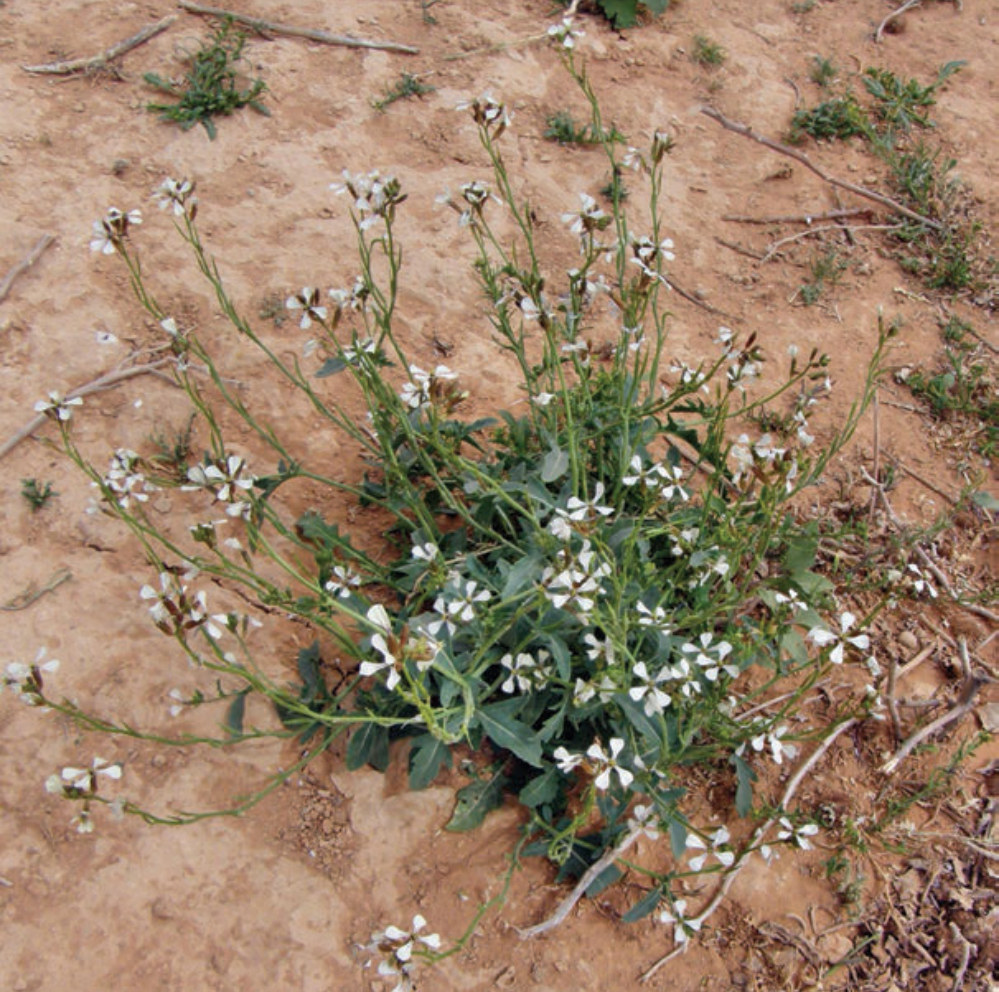
Plant name
Field gerger
Latin name
Eruca vesicaria (L.) Cav.
Common names
Field gerger
foreign names
Eng. Garden Rocket, Fr. Garden Rocket
The group
cabbage
Habitat and Geographic Distribution
Mediterranean, Iranian-Turanian, widespread in Syria, Palestine, Jordan and Lebanon, and cultivated in many countries around the world
Botanical description
The plant is typically solitary, covered with varying degrees of hair.
The basal leaves are rosette-shaped, petiolate, lobed, and the terminal lobe is larger.
The upper and lower stem leaves are smaller, and all have a somewhat dreamy texture.
The inflorescence is racemose, leafless, and somewhat compact, but not comb-like.
The flowers are sparse, then elongate after the sepals, free, and in the fruit.
The calyx is sessile, erect, and pubescent.
The corolla is free, yellowish-white, and veined with violet, consisting of a blade and a nail.
The male stamens are 4 + 2 in length.
The female is bicarpal, with a superior ovary and a single stone, which is laterally divided by a false septum into two stones.
The fruit is a mustard seed, erect, swollen, attached to the stem to varying degrees, oblong to ellipsoidal, with a circular to square cross-section, ending abruptly in a tightly compressed, sword-shaped beak.
The kernel has a leathery texture and a rounded, boat-shaped apex.
The seeds are arranged in rows, compressed, brown, and have a reticulated surface. Flowering occurs from December to June.
Used part
Seeds and leaves
chemical components
It is hydrolyzed by the presence of the enzyme myrosin and water, producing glucoerucin.
The seeds contain a glycoside, glucoerucin, a volatile glycoside with a strong odor (irritating to respiratory membranes).
C, cellulose compounds, a high percentage of vitamin C, 2.5% fatty oil. The leaves contain a glycoside similar to that found in the seeds.
Properties and medical uses
The seed powder possesses antioxidant and antibacterial properties.
The leaves are used traditionally for their appetite-stimulating, expectorant, digestive, hypoglycemic, and diuretic properties, and are also used to treat scurvy.
Topically, it is used as a skin reddening agent, promotes hair growth, and is beneficial in treating burns.
The leaves are diuretic and gastric stimulant.
The seed is a stimulant.
Dried seeds possess antibacterial activity and have inhibitory properties against alpha-amylase and alpha-glucosidase enzymes.
Watercress is rich in antioxidants and contains glucosinolates, which give it its bitter taste and strong aroma.
These compounds may protect the body from certain types of cancer, including breast, prostate, lung, and colon cancer.
It also contains a significant amount of vitamin K and may help reduce the risk of osteoporosis.
Culinary Uses: The leaves are eaten raw, and a edible oil is extracted from the seeds, which can be used as a substitute for rapeseed oil.
The seed residue, after the extraction of the volatile and fatty oils, is used in the production of mustard, known for its pungent aroma.
The flowers and tender leaves are used as a dressing in salads.
Precautions: Caution should be taken due to its irritating properties to the respiratory membranes.
Side effects and precautions
Allergic reactions or drug interactions may occur; self-use should be avoided by pregnant and breastfeeding women, children, and patients with chronic diseases.
the environment
Watercress grows wild in agricultural lands and fields, and along the banks of streams and clean watercourses in arid and semi-arid regions with moderate temperatures.
It can tolerate temperatures as low as 20-27°C.
Suitable temperatures for vegetative growth range between 20°C and 4°C.
Watercress needs dim light during its initial growth stages, but requires partial shade during the midday hours when grown in the hot summer.
The plant's drought tolerance is weak, requiring regular irrigation and clean water.
It can be cultivated in all soil types, even the most fertile, and produces good yields in medium-fertility soils.
Agriculture and productivity
It is propagated by seeds sown in early spring or autumn in rows or lines within beds.
It is preferable to cover them immediately after sowing with a thin layer of fine soil and water them directly.
Watering continues after germination at a rate of once every 10 days.
The seeds begin to germinate at a temperature of 3-4°C, and germination is slow at this temperature, but it accelerates at 18-20°C and is completed within 5-6 days.
This plant requires organic and nitrogen fertilization in particular, as well as hoeing and weeding.
Lepidium sativum L., Cardamon sativum (L.) Fourr., Lepia sativa (L.) Desv., Nasturtium sativum (L.) Moench, Thlaspidium sativum (L.) Crantz, Thlaspidium sativum (L.) Spach
History and Heritage
The scientific name of the genus is the ancient Latin name for this plant.
Watercress has been used since Roman times in Italy, where raw watercress was added to salads.
Arabs also knew the benefits of watercress from ancient times, using it as an appetite stimulant, a diuretic, and in the treatment of burns and skin diseases.
Medical note
This information is for educational purposes only and does not constitute medical advice.
Poisonous or potent plants should only be used under the supervision of a qualified physician or pharmacist.
Related images


