Bongardia | Medicinal plant in the Akhdar Encyclopedia
A decoction of the tubers is traditionally used to treat urinary tract infections, prostate enlargement, hemorrhoids, and as an antispasmodic. It is also used to treat some cases of epilepsy. Several encouraging studies on mice have shown the effectiveness of the saponin compounds found in the tube…
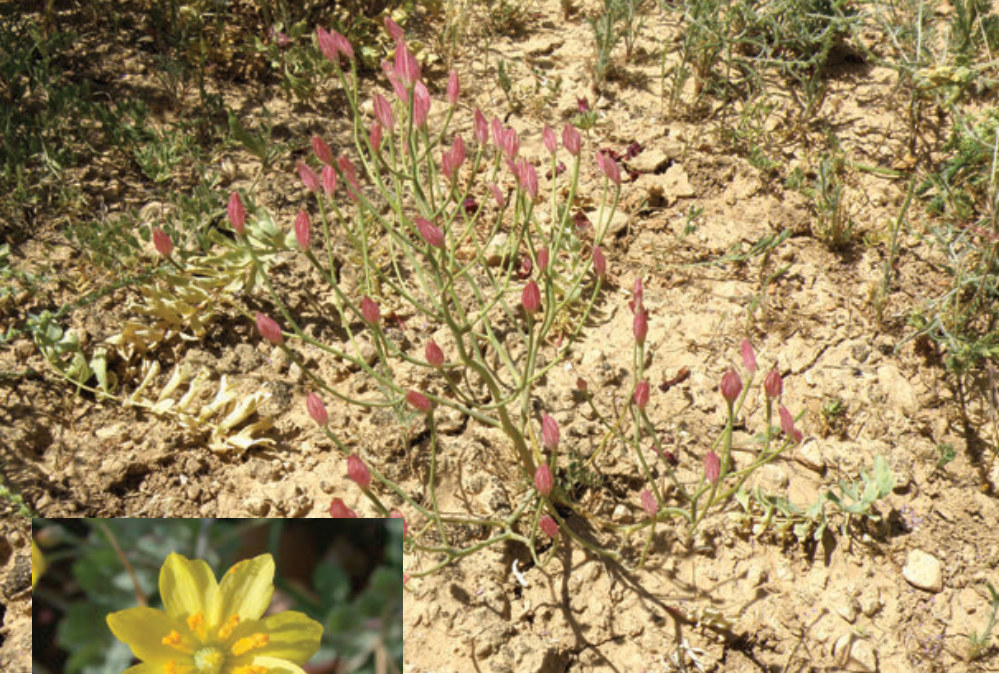
Plant name
Bongardia
Latin name
Bongardia chrysogonum (L.) Griseb
Common names
Bongardia, the golden oud
foreign names
What. Golden road, Fr. Bongardie
The group
The rabberis
Habitat and Geographic Distribution
The plant's native habitat is North Africa and Western Asia, where it naturally spreads in Syria, Turkey, the Caucasus, Iraq, Iran, and even as far south as Pakistan.
Botanical description
A perennial herb with tubers located deep within the order, spherical, 10 cm - compact in shape, large in size, with a width of: bearing multiple leaf-like buds.
From it emerges a bare, reddish-white, erect aerial stem, branching from its center, 1 cm.
The leaves are all basal, lying on the surface of the order or slightly raised, divided into lobes (60 - olivine, lobed), obovate to pedicel (6 - 3) deep into opposite lobes, thick, toothed to lobed margin (cm).
The flowers are hermaphroditic, radially symmetrical, 4 - basal, often bearing a dark spot at its base, the lobes are yellow (including the sepals), the peduncles are long, gathered in a raceme, dichotomously branched, and bear leaves about 1 cm long.
The male is petal, the petal is about 6 cm long, scaly, below the branches.
The calyx is petal-shaped, six-segmented.
The corolla is ovule-like, ending in a squamous style and a broad stigma.
The stamens are six-six.
The ovary is solitary, containing the fruit: a membranous capsule, swollen, ovoid to nearly spherical, reddish in color, with a scarfaced apex.
4-1 (Olongate.
The seeds are few - cm, oval - regular, length. Flowering from February to March.
Used part
The tubers contain triterpenoid saponins (triterpenoid sapogenols 12%), alkaloids (0.011%), including lupine, bongardamine, bongardine, and isoquinoline.
chemical components
Of these: 0.011%, alkaloids; 12% triterpenoid sapogenols.
The tubers contain triterpenoid saponins such as bongardine, lupine, and bongardamine.
Properties and medical uses
A decoction of the tubers is traditionally used to treat urinary tract infections, prostate enlargement, and hemorrhoids, as well as being an antispasmodic and used to treat some cases of epilepsy.
Several encouraging studies on mice have demonstrated the effectiveness of saponin compounds found in the tubers in treating obesity, hypertension, and diabetes.
Tuber extracts possess antioxidant, free radical scavenging, and antispasmodic properties.
Side effects and precautions
Allergic reactions or drug interactions may occur; self-use should be avoided by pregnant and breastfeeding women, children, and patients with chronic diseases.
Other uses
The leaves are consumed raw or cooked, like the leaves of the sorrel plant (Rumex sp.).
the environment
It grows in neglected lands, degraded steppes and pastures, on sunny, rocky slopes, and in agricultural areas among crops.
The plant requires hot, dry summer conditions.
It can grow in dry, sandy soils, but prefers light, well-drained sandy soils.
It does not tolerate wet conditions and is affected by excessive moisture in winter, which can lead to tuber rot.
Agriculture and productivity
It is propagated by seed, preferably grown in a greenhouse before transplanting to the permanent field.
The seeds are sown as soon as they mature in relatively deep pots, as the seedlings develop roots that pull them downwards at a rate of 10-15 cm before their first leaves appear.
Three to four seeds are placed in each pot.
(Borago officinalis L., Borago advena Gilib., Borago aspera Gilib., Borago hortensis L., Borago officinalis var. alba Gray, Borago officinalis var. coerulea Alef)
History and Heritage
The scientific name of the genus is attributed to the botanist who first named it, H.G.
Bongard (1753).
Linnaeus mentioned it in his book on plant species, and he adopted the name Leontice chrysogonum from ancient authors, including Tournefort.
This species was collected by the scientist Rauwolf, who found it during his voyage in the Aegean region in 1573.
The name was later changed to Bongardia in 1702.
It is known as a medicinal and edible plant in its natural range.
Its leaves are used to treat eye inflammation in horses, and its tubers are eaten cooked.
Medical note
This information is for educational purposes only and does not constitute medical advice.
Poisonous or potent plants should only be used under the supervision of a qualified physician or pharmacist.
Related images


