Desert date | A medicinal plant in the Akhdar encyclopedia
The juice of the Balanites aegyptiaca fruit is traditionally used to increase milk production in nursing mothers, treat diabetes, intestinal colic, as a laxative, to expel intestinal worms, and to treat sore throats and yellow fever. The seed oil is used topically to treat skin diseases, wounds, an…
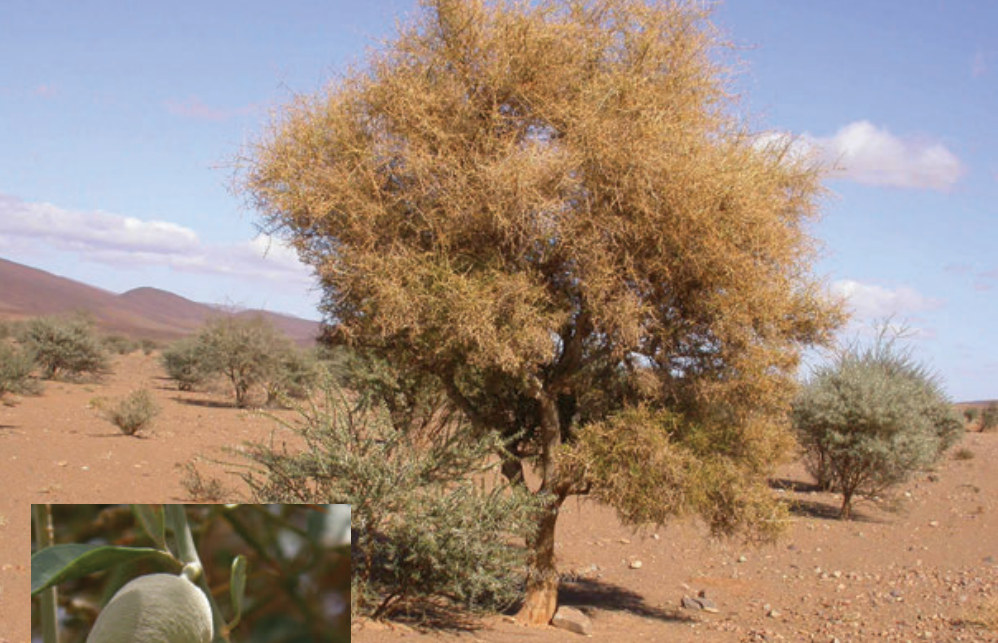
Plant name
desert dates
Latin name
Balanites aegyptiaca (L.) Del.
Common names
Desert dates, Heglig, Meter of slaves, Ehleelij, Hegli'a, Zaqoum, Haqliq, Abu Raghan
foreign names
Eng. esert date, Fr. attier du désert
The group
The ratratiah
Habitat and Geographic Distribution
The Sudanese region.
It is found in the deserts of North Africa, Sudan, Yemen, the Arabian Gulf, tropical Africa, India, and Latin America.
Botanical description
(Sometimes deciduous trees or shrubs, reaching up to - cm in height, yellowish foliage 45 m).
The stem is notched, may reach a diameter of - cm, gray to brown in stature, splitting into thick scales.
The crown is semi-spherical.
The main branches are erect with abrupt bends, drooping, branching heavily into twigs, with a drooping appearance (puck).
These twigs have strong thorns that can reach 1 cm, and are alternate and usually opposite the leaf petioles.
The leaves consist of pairs of leaflets, 9 - up to 1 cm long, semi-plying, 1.5 - 0.5 cm long, 4 - 4 cm wide.
The leaflet is ovate to elliptical or rounded, 1.5 - 1 cm long, semi-plying, gathered in cymose inflorescences, 1.2 - 0.8 cm long.
The underside of young leaves is hairy, leathery in texture.
The flowers are 1 mm long, hairy.
The petals are five, longer than the rhizome, and bear five flowers in the leaf axils or on thorns.
The sepals are five, about 1 cm long, elliptical, and covered with 2-1 x 4 stamens.
The fruit is a drupe, 10 sepals in size, reddish-yellow, and glabrous.
The male fruit is bluish-gray, initially green, then turns yellow and glabrous upon ripening. Flowering occurs from February to July.
Used part
The bark of the dalkhy tree, its leaves, fruits, seeds, and roots.
chemical components
Of its weight, it contains fatty oil and furocoumarin compounds.
40% - The seeds contain proteins and amino acids, organic acids.
The fruit pulp contains sugars.
The sap of the branches and stems contains saponins.
The leaves and the plant in general contain the glycoside betinin, whose breakdown results in aglycone yamogenin. It also contains diosgenin. 5.6% of the plant contains what is proportional to
Properties and medical uses
The juice of the fruit of the desert date (Balghulij) is traditionally used to increase milk production in nursing mothers, to treat diabetes, intestinal colic, as a laxative, to expel intestinal worms, to treat sore throats, and yellow fever.
The seed oil is used topically to treat skin diseases, wounds, and rheumatism.
It is also traditionally used to treat various ailments such as jaundice, intestinal worm infections, wounds, malaria, syphilis, epilepsy, dysentery, constipation, diarrhea, hemorrhoids, stomach aches, asthma, and fever.
It was found that the methanol extract prepared from the pulp inhibits the growth of the fungi Microsporum gypseum and Trichophytonrubrum
Side effects and precautions
No contraindications or precautions for the use of this plant are known to date.
Other uses
The fruit and seeds are a source of steroidal compounds used in the semi-synthesis of certain medications, such as contraceptives, some sex hormones, and cortisone.
The oil from the seeds is used in soap making, and some parts of the plant are used as soap substitutes.
The fruit is edible.
The wood is used to produce high-quality charcoal.
The tree is a good source of grazing, especially during its vegetative growth stage.
Young trees are used as hedges due to their flexibility and thorns, and they also fix nitrogen.
No known contraindications or precautions for the use of this plant have been identified to date.
the environment
The plant grows in valleys with clay soils and on various types of soil, but it does not tolerate salinity or waterlogged soils.
It tolerates temperatures up to 380 mm/year and is drought-tolerant, and is found in areas with high annual rainfall, reaching temperatures exceeding 1000 meters above sea level. It thrives at altitudes of 1000 meters above sea level.
Agriculture and productivity
It propagates by seeds, suckers, and root cuttings.
The best treatment for seed germination is soaking in hot water for 10 minutes.
It regenerates vigorously after being cut.
The tree is important in arid regions as it produces fruit even during droughts.
It is cultivated in agroforestry systems in Africa along irrigation canals. Tribulus terrestris L
History and Heritage
The scientific source of the toxin for the genus *Green* is unknown, but the species name *Mercy*, meaning "Egyptian Heglig," is used to describe the plant.
It has been used in traditional medicine since ancient times to treat gum disease and headaches, and African peoples have used the juice of its fruit as food for women after childbirth.
Medical note
This information is for educational purposes only and does not constitute medical advice.
Poisonous or potent plants should only be used under the supervision of a qualified physician or pharmacist.
Related images


