Anise | A medicinal plant in the Akhdar encyclopedia
The fruit, containing anethole, possesses properties that act as a general tonic, appetite stimulant, expectorant, and antifungal, antibacterial, and antiviral agent. The essential oil is used to treat respiratory ailments (rhinitis, laryngitis, pharyngitis, bronchitis, dry cough), and is also used…
Plant name
Anise
Latin name
Pimpinella anisum L
Common names
Anise, sweet cumin
foreign names
Eng. Anise, Fr. Anese
The group
celery
Habitat and Geographic Distribution
Its origin is unknown, but it is likely native to the Middle East.
It grows wild in Cyprus and is cultivated in southern European countries, Turkey, Syria, Central Asia, India, China, and Central and South America.
Cyprus and Morocco are among the largest producers in the Arab world, and it is also cultivated in Syria and Tunisia.
Botanical description
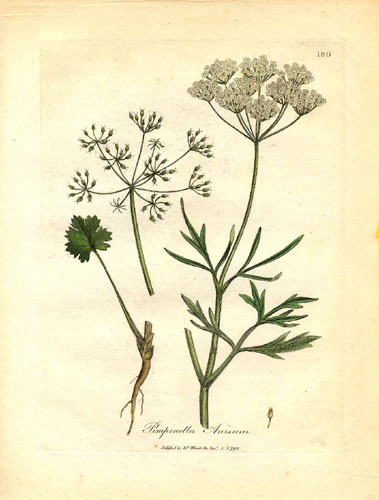
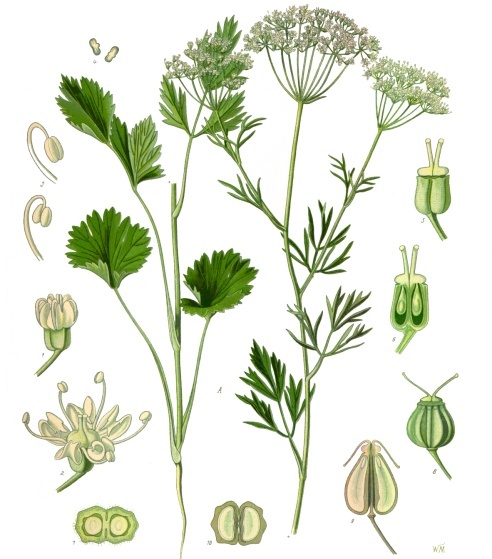
60 - A perennial herb, aromatic, downy, 1 cm long.
The stem is erect, branching from the base, and lobed.
The basal leaves are petiolate, kidney-shaped, toothed to lobed, with undivided margins.
The stem leaves are generally rounded, the lower ones ovate, trilobed or trifoliate, the leaflets ovate or obovate and toothed.
The upper leaves are squamous or pedunculated, with a narrow sheath, deeply divided into linear uterine lobes.
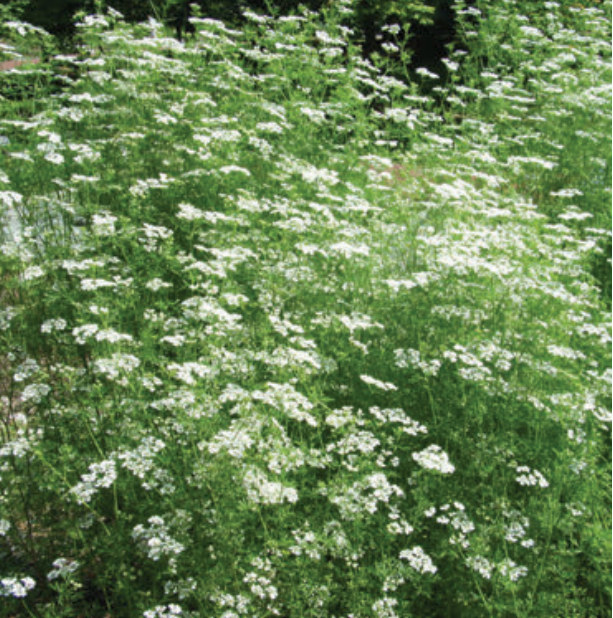
The inflorescence is umbel-like, lacking bracts at either the level of the compound or simple umbel.
The calyx is reduced.
The corolla has five petals, is white, fringed at the margin, and is hairy below.
The male has five stamens.
The female has two carpels, and the ovary is inferior.
The fruit is an oblong acinus, prominent and hairy, 5 mm long, ovate, with a distinctive aroma. Flowering occurs from April to June.
Used part
Dried fruits (with a sweet and distinctive taste), and the essential oil extracted from the fruits
chemical components
Its main components: 6% - The plant contains volatile oil, the percentage of which varies according to the variety and climate, and generally ranges from brown.
1% anisaldehyde, 2% estragole, 80-90% anethole (ethylphenyl ether): caffeic acid.
It also contains organic acids derived from caffeic acid: alpha-terpineol, alpha-terpineol, linalool, isovitexin, and flavonoids: apigenin glycosides, caffeoylquinic acid, chlorogenic acid, quercetin, and rutin.
Additionally, quercetin is present in its free forms.
It also contains fixed oil, isoorientin, luteolin, sugars, gums, and fibers. Proteins.
Properties and medical uses
The fruits, due to the anethole compound they contain, possess properties that are a general stimulant, appetite stimulant, expectorant, antifungal, antibacterial and antiviral.
The essential oil is used to treat respiratory ailments (rhinitis, laryngitis, pharyngitis, bronchitis, dry cough), and is also used as a carminative and antispasmodic.
It is beneficial in cases of indigestion, colic, and intestinal sluggishness.
The flavonoid compounds enhance the effects of anise oil, in addition to their antioxidant properties.
The alcoholic tincture of aniseed fruit and its oil are used in the formulation of many pharmaceutical preparations, such as cough medicines and expectorants, giving them a more palatable taste.
The oil is also used in...
Anise is used in the formulation of ointments for treating acne and pimples.
It is used in traditional medicine for its medicinal properties, including its effects on the cardiovascular system.
Aniseed fruits are used as a decoction, or an alcoholic tincture is prepared from them. The aqueous extract (AE) reduces blood pressure.
pharmaceutical forms
Anise oil is used in cough medicines and expectorants, giving them a more palatable taste.
It is also an ingredient in ointments used to treat acne and pimples.
Anise is used in traditional medicine for its medicinal properties, including those that benefit the cardiovascular system.
Anise seeds are used as a decoction or to prepare an alcoholic tincture. The aqueous extract (AE) is known to lower blood pressure.
Side effects and precautions
It should not be used by pregnant women, nor by people allergic to anethole.
In high doses, the oil has a sedative effect and slows blood circulation. It should not be given to children. A decoction of aniseed seeds is a sedative.
Other uses
Anise seeds are used to flavor some sweets and perfumes and soaps.
Precautions: It should not be used by pregnant women, nor by people allergic to anethole.
In high doses, the oil has a sedative effect and slows blood circulation.
It should not be given to children, and a decoction of anise seeds is a sedative.
the environment
The plant thrives in cool and temperate regions.
Cooler temperatures are conducive to vegetative and flowering growth during winter and spring, while moderate temperatures are suitable for fruit set, development, and seed maturation.
High temperatures and low humidity lead to rapid flowering, early ripening, and reduced fruit size and essential oil content.
The critical temperature period extends from the beginning of flowering until ripening.
It is cultivated in various soil types, preferably heavy (8) and fertile, well-drained soils with a moderate pH (pH 6.8-7.4), and tolerates salinity.
Cultivation and Productivity: The plant is propagated by direct seeding, which is sown in autumn in temperate regions and in spring in colder regions, in seed rows.
Seedlings are thinned when they reach 4 meters: Place 1 kg of fresh, healthy seeds in a 20-4 x 10 cm hole or in beds with dimensions of 50 cm.
Two seedlings are left in each hole.
Irrigation is required per hectare, and various maintenance practices (weeding and fertilization) are important for achieving high productivity.
Harvesting: The plant is harvested from the foliage or the fruit.
The foliage is harvested during the flowering stage and the beginning of fruit formation, and the fruit is harvested when ripe and before it is completely dry. 1.5 tons of ripe fruit. Akhdar grass yields approximately 25 tons per hectare.
Agriculture and productivity
The plant is propagated directly from seed.
Sow in autumn in temperate regions and in spring in colder regions, either in rows spaced 40-50 cm apart or in beds 20-4 x 10⁻³ m apart, placing 3-4 seeds in each hole.
Thin the seedlings when they reach 6-8 cm in length, leaving two seedlings per hole.
One hectare requires 15-20 kg of fresh, healthy seeds.
The plant requires 3-4 irrigations, and various maintenance practices (weeding and fertilization) are important for high productivity.
The plant is harvested for its foliage or fruits.
The foliage is cut or harvested during flowering and the beginning of fruit formation, and the fruits are collected when ripe but before they are completely dry.
One hectare yields approximately 25 tons of foliage and 1-1.5 tons of ripe fruit.
(Atriplex halimus L., Atriplex halimoides Tineo, Atriplex capensis Moq., Obione halimus) L.( G.L.Chu, Schizotheca halimus L.( Fourr
History and Heritage
The scientific name for the genus is *Anisum anisum*, which is the ancient Arabic name for the species, meaning "winged," referring to its feathery leaves.
The species name is *Anise*.
The properties of anise have been known since the earliest times of Egyptian civilization.
The parts used are the dried fruits (which have a sweet and distinctive taste) and the essential oil extracted from the fruits. The Latin name is Pimpinella anisum L.
Medical note
This information is for educational purposes only and does not constitute medical advice.
Poisonous or potent plants should only be used under the supervision of a qualified physician or pharmacist.
Related images