Peppermint | Medicinal plant in the Akhdar Encyclopedia
The essential oil possesses antispasmodic, antibacterial, and antiviral properties. It is used for its soothing properties and in the treatment of liver and gallbladder diseases, digestive disorders, spasms affecting the upper digestive tract and biliary tract, and irritable bowel syndrome. It is a…
Plant name
peppermint
Latin name
Mentha piperita L
Common names
Peppermint, garden mint
foreign names
Eng. Peppermint, Fr. Menthe poivrée
The group
oral
Habitat and Geographic Distribution
Taurine.
Native to the Americas, and cultivated throughout the world – Siberian, Mediterranean, and Western European.
Botanical description
A perennial herb supported by strong tendrils.
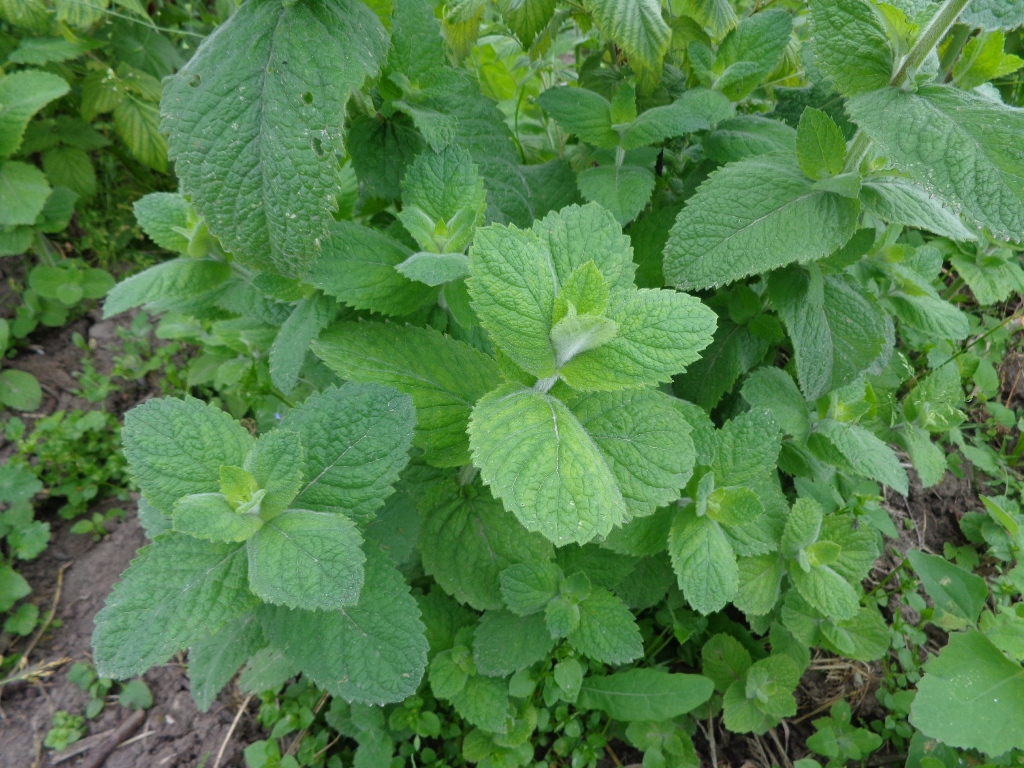
The stem is erect, branching, square in cross-section, and reddish in color.
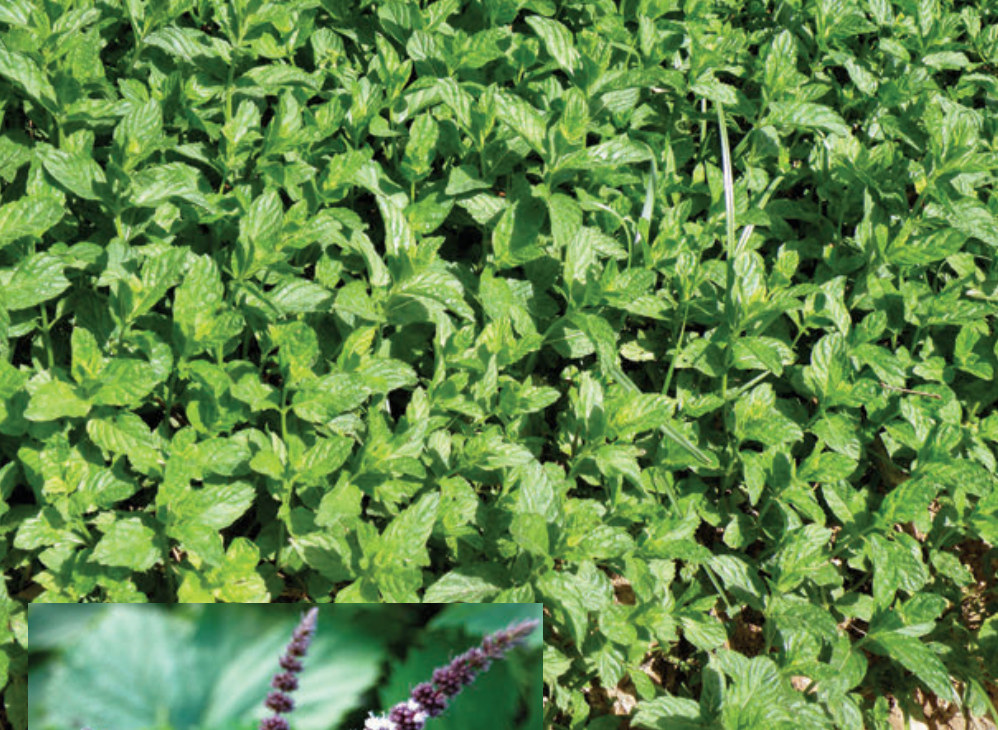
The leaves are simple, purple, opposite, ovate, petiolate, toothed, and bear meristems filled with an aromatic oil.
The flowers are blue-violet, clustered in dense stamens which in turn cluster in terminal spikes.
The calyx is tubular, nearly equal in length, and protrudes from equal or nearly equal lobes.
The stamens have teeth.
The corolla is funnel-shaped, ending in a tube, and widely spaced.
The plant rarely produces fruit, and when it does, the fruit is sterile.
This species is a hybrid of several mint varieties.
There are several commercial cultivars, including the brown or black variety, and the white variety, *Mentha peperita var. vulgaris*.
Used part
The flowering plant and the oil extracted from it. Latin name: Mentha piperita L.
chemical components
3-5% menthyl acetate, 15-20% menthone, 35-45% menthol (volatile oil, the main components of which are menthol and other compounds), alpha-beta pinene, pulegone, 2.5-3.5% neomenthol, rosmaric acid (derivatives of caffeic acid, including diosmetin), apigenine (valvonoids: apigenine glycosides), xanthomicrol, gardenine (valvones)
Properties and medical uses
The essential oil possesses antispasmodic, antibacterial, and antiviral properties.
It is used for its soothing properties and in the treatment of liver and gallbladder diseases, digestive disorders, spasms affecting the upper digestive tract and biliary tract, and irritable bowel syndrome.
It is antimicrobial and effective against bacteria, particularly Gram-positive bacteria.
It is used to treat inflammation of the mucous membranes of the mouth and pharynx, bronchitis, and respiratory tract infections.
The essential oil has a cooling effect on the skin and is an antioxidant.
It has anticancer properties, particularly against colorectal cancer.
The ethanolic extract of the plant is beneficial in controlling mosquito larvae due to the presence of active components such as alkaloids, carbohydrates, and flavonoids.
Precautions: Peppermint is not recommended for gallstones or kidney stones, nor for bile duct obstruction or cholecystitis.
It may cause colic in those with gallstones due to its cholagogue effect.
The essential oil should not be applied to the faces of infants and children, especially near the nose and mouth.
Side effects and precautions
Allergic reactions or drug interactions may occur; self-use should be avoided by pregnant and breastfeeding women, children, and patients with chronic diseases.
the environment
Mint thrives in all highly fertile, well-drained, and aerated soils, but prefers sandy soils. It also tolerates pH levels up to 5.2.
Agriculture and productivity
Mint is propagated vegetatively by means of creeping stems and rhizomes, which are divided into sections 5-8 cm long, each section bearing two nodes.
Organic and mineral fertilizers are added, the land is plowed twice, and then the seedlings are planted at a distance of 2-52 cm in the presence of water.
(Mentha pulegium L., Melissa pulegium (L.) Griseb., Mentha aromatica Salisb., Mentha pulegium subsp.
vulgaris (Mill.) Briq., Mentha pulegium var. vulgaris (Mill.) Briq., Minthe pulegia (L.) St.-Lag., Pulegium vulgare Mill.)
History and Heritage
Mint, the name of a water nymph in Greek mythology, is derived from the Greek word for pepper, which is cultivated and used as a spice.
Dioscorides and others used it to refer to various species of peppermint, and Wilfrid of Spartabo wrote in the 12th century: "If a man could name all the properties of mint, he would surely know the number of fish swimming in the Indian Ocean."
Medical note
This information is for educational purposes only and does not constitute medical advice.
Poisonous or potent plants should only be used under the supervision of a qualified physician or pharmacist.
Related images