Palm tree | Medicinal plant in the Akhdar Encyclopedia
Palm information is provided for educational purposes only and does not represent a prescription or a substitute for consulting a doctor.
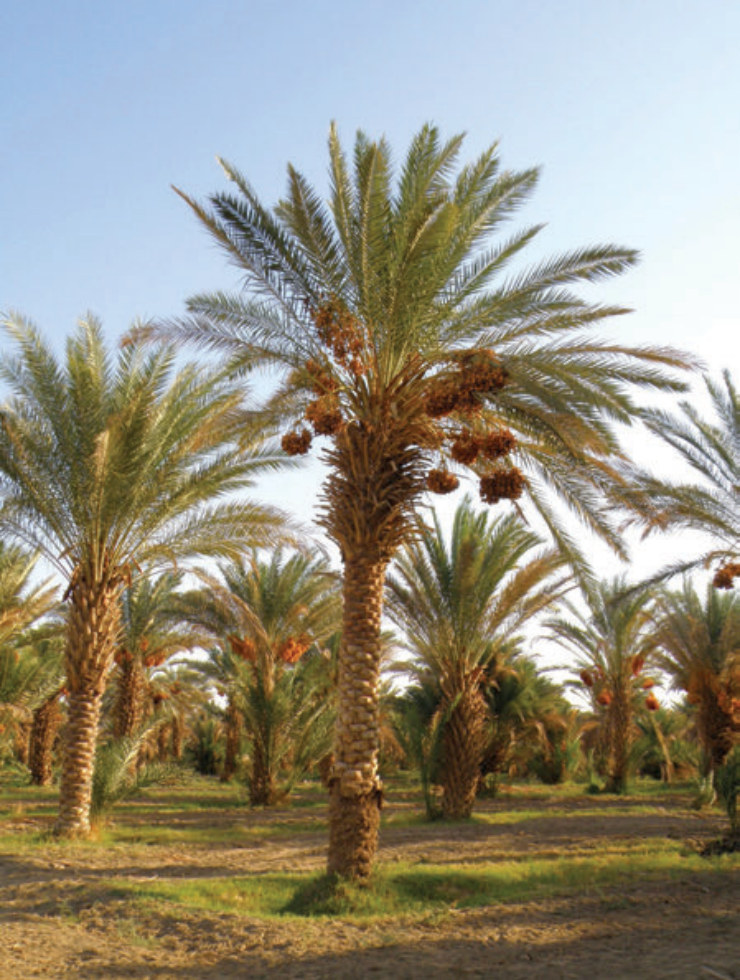
Plant name
Palm
Latin name
Pheonix dactylifera L
Common names
Palm trees, date palms
foreign names
Eng.ate palm, Fr.attier
The group
Palm trees
Habitat and Geographic Distribution
The plant is believed to have originated in the arid belt stretching from Morocco to Pakistan, and it is also believed to have been cultivated in Iraq since ancient times and in Egypt since the Common Era.
Botanical description
The stem is unbranched, upright, and covered with the bases of deciduous leaves.
The leaves are 20.
The tree is dioecious, with a general rhizome, deeply segmented, and its main leaf is bluish-green, oblong, and succulent.
The inflorescence is a raceme with long, zigzagging branches.
The stem is thick, semi-cylindrical, and linear.
The flowers are unisexual, inset.
The male flowers have six segments in two whorls; the outer segment is tertiary-toothed and cup-like, while the inner segment is free.
The male flowers have six stamens, and the anthers are semi-inset.
The female flowers have a spathe similar to that of the male flowers, while the female flowers consist of three free carpels, of which only one matures.
The fruit is a single-seeded berry (a date or drupe), inset, ovoid to elliptical.
The seed has a long cleft, and the endosperm is composed of very tough cellulose fibers. Flowering from April to May
Used part
fruits
chemical components
Dates contain 70% sugars (glucose, fructose, sucrose), acids, fats, proteins, vitamins (A, B1, B2, C), and minerals, including iron, phosphorus, potassium, boron, sulfur, manganese, copper, calcium, and magnesium.
Ripe dates contain phenolic compounds.
Chemical analysis of the ethanolic extract of dates showed that it contains the following components: maltose (a polysaccharide), catechin, myristine, quercetin, and vaconides, beta-sitosterol, d-galacturonic acid, and chlorogenic acid.
Dates contain beta-carotene.
Nutritional and medicinal uses: Dates are considered an ideal food for humans because they contain essential nutrients, particularly proteins and sugars, which are vital for building the body and providing it with necessary energy.
One kilogram provides three thousand calories, equivalent to the daily energy expenditure of a moderately active man.
Those fasting are usually advised to break their fast with dates because the sugars are quickly absorbed, compensating the body for the drop in blood sugar levels during fasting.
Dates also possess numerous health benefits, including antiparasitic properties.
Dates possess anticancer, anti-lipid, and antiviral properties, and they protect the liver, kidneys, and stomach.
Dates cleanse and invigorate the liver, act as a diuretic, and cleanse the kidneys (due to sugars and vitamin B2).
The phosphorus in dates enhances mental activity and neutralizes blood acidity, which can cause kidney and gallstones, gout, hemorrhoids, and high blood pressure.
The vitamin A in dates helps maintain eye moisture and luster, strengthens the optic nerves, and aids in children's growth and weight gain.
Dates also contribute to...
Dates stimulate the thyroid gland, strengthen the nerves, soften blood vessels, moisturize the intestines, and protect them from inflammation.
Dates calm the nerves, treat nervous anxiety, and increase sexual potency.
They contain anti-cancer compounds (phosphorus and arginine, etc.).
The cellulose fiber in dates acts as a natural laxative, preventing constipation and hemorrhoids.
Dates contain oxytocin, a hormone that stimulates uterine contractions, thus aiding in childbirth.
Additionally, they prevent bleeding during and after childbirth. It lowers blood pressure in pregnant women.
Properties and medical uses
Palm information is provided for educational purposes only and does not represent a prescription or a substitute for consulting a doctor.
Side effects and precautions
Allergic reactions or drug interactions may occur; self-use should be avoided by pregnant and breastfeeding women, children, and patients with chronic diseases.
the environment
The plant is widely grown in hot, dry, sunny areas where water is available near the surface of the earth, yet it is drought-resistant.
Agriculture and productivity
The method of propagation by offshoots, which form around the base of the trunk, is the most common method of propagating palm trees vegetatively on a commercial scale.
Recently, it has become possible to propagate them commercially by tissue, by budding, and by using flower parts.
Palm trees also respond to seed propagation.
The offshoots are planted directly in the field, whether it is an orchard or on the perimeter of fields and the sides of agricultural roads, after they have been separated from the mother tree.
They can be planted in all seasons of the year except winter, at a distance of 7-8 meters between the tree and the other, in holes 40-50 cm deep so that the root does not rot, and in a slightly inclined position against the direction of the wind.
The top of the offshoot is tied with mats or hemp to protect it from the heat of the sun and the cold until its new leaves grow.
A tree that is 15 years old or older, and in its full productive stage, can yield approximately 50 kg of fruit per year.
Asparagus officinalis L., Asparagus altilis (L.) Asch., Asparagus altilis subsp.
oxycarpus (Steven) K.Richt., Asparagus altilis subsp.
polyphyllus (Steven ex Ledeb.) K.Richt., Asparagus caspius Schult.
& Schult., Asparagus caspius Hohen., Asparagus collinus Schur, Asparagus esculentus Salisb. (Hyacinthaceae) Asparagaceae
History and Heritage
The name means boat and rumba.
The poison is attributed to tropis, meaning beautiful and wonderful, and kalos, from the Greek, where Calotropis is a genus name meaning high.
Procera refers to the coronary lobes.
As for the species name, the plant was used medicinally, as it was mentioned in ancient Egyptian medicine in the Erythraean Papyrus, in a prescription related to vascular diseases.
The Arabs knew it in ancient times, and Al-Asma'i mentioned it (the fruit has a skin which, when split open, reveals something like cotton, similar to the mucus of the camel).
Abu Hanifa al-Dinawari described it in his book on plants (as a large tree with a sweet gum, broad leaves, and a sugar that comes out of its flower, called "sweet of the truffle," which has a bitter taste).
The tree is mentioned in ancient Arabic medical tradition, where it was used as a laxative, ulcer remedy, vermifuge, and urinary tract stimulant.
The leaves, when heated, were applied to the abdomen to treat stomach aches.
The flowers were considered a tonic, and the ash was used as an expectorant and appetite stimulant.
It was also used to treat asthma.
The tree was known in ancient India to the point of being revered.
The Indians incorporated it into their medical prescriptions, using the sap of the root to treat certain skin diseases and the flowers to improve digestion and stimulate appetite.
The parts used are the plant's sap, the root sap, and the milky sap. Its Latin name is Pheonix dactylifera L.
Medical note
This information is for educational purposes only and does not constitute medical advice.
Poisonous or potent plants should only be used under the supervision of a qualified physician or pharmacist.
Related images
