Moringa | A medicinal plant in the Akhdar encyclopedia
The seeds possess antibacterial properties due to their mustard oil content. Moringa extract is important in protecting the liver from carcinogens and healing liver disorders. Experiments on rabbits have shown that moringa fruit reduces cholesterol, phospholipid, and triglyceride levels in the bloo…
Plant name
Moringa
Latin name
Moringa oleifera Lam
Common names
Moringa, horseradish tree, drumstick tree, shua, ben tree
foreign names
Eng. Ben nut tree, Fr. Moringa
The group
Myrtaceae
Habitat and Geographic Distribution
It is believed to be native to the Himalayas and the Arabian Peninsula. It is cultivated in many tropical and subtropical countries.
Botanical description
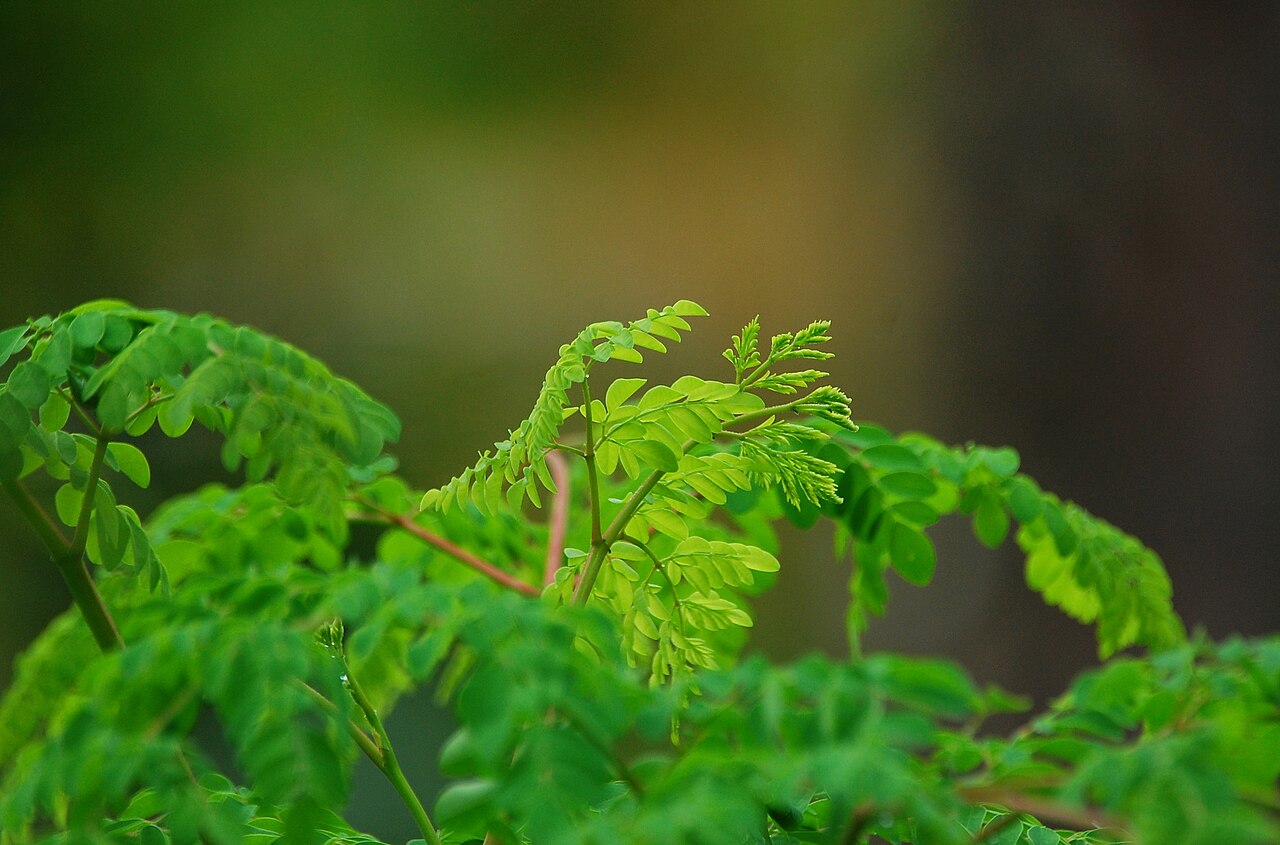
Tree: huge, its bark is resinous, its young branches are downy.
The leaves are alternate, deciduous, trifoliate compound (cm).
The main axis is 15 cm long (including the long leaf stalks, which can reach up to 11 cm in length).
The secondary axis (3 of the secondary axes, which are 11 cm long) is slender, hairy, and bears 9 leaflets, which in turn bear 2 cm in length.
The leaflet is 30 cm long.
The inflorescence is 0.5-1.8 cm long.
The flowers are white, about 1.3-2.1 cm wide, and their peduncle is 2.5 cm long.
They have a honey scent.
The calyx tube is hairy, its lobes are unequal, petal-like, compound, linear to uterine, 1 cm long, backward-curved, about 1.5 cm long, bearing yellow tendrils in the center, complete, with a dull apex.
The petals are white, the anterior ones are erect, the others backward-curved, spoon-shaped, bearing prominent tendrils, 1 cm long, about 1.5 cm wide, and about 1.5 cm long.
Their filaments The male reproductive organ is 0.5 cm long and hairy on the underside.
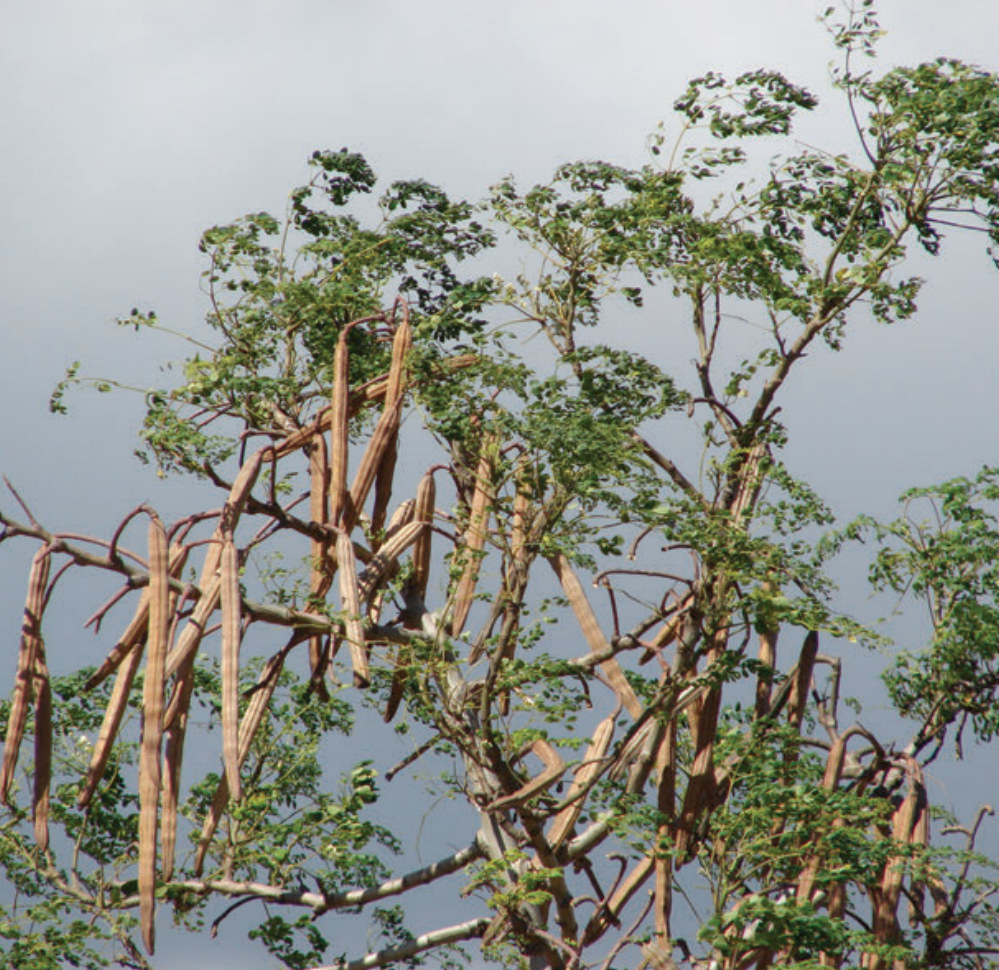
The ovary is oblong and vascular; the fruit is a pod, drooping and bearing a centimeter.
The seeds are embedded in a 40 cm long indentation: within the cyme, triangular, lanceolate, dark, and generally spherical. Flowering occurs from January to April.
Used part
The fruits, seeds (the plant has a taste similar to that of hot horseradish), roots, and leaves
chemical components
The seeds contain: (in seeds from which the fatty material has been removed) and include, among other compounds, 9% benzylglucosinolate (glucosinolate), phenolic carboxylic acid, myrisinase (which produces benzyl isothiocyanate via myrisinase enzyme), 3-12% palmitic acid, 60-70% palmitic acid, 50% oleic acid (the main component of which is fatty oil), etc., behenic acid, in addition to 3-12% behenic acid, stearic acid, in addition to the minerals iron, calcium, and selenium, B, A, and C.
The leaves contain a large amount of vitamins and also contain high concentrations of essential amino acids for humans.
Properties and medical uses
The seeds possess antibacterial properties due to their mustard oil content.
Moringa extract is important in protecting the liver from carcinogens and healing liver disorders.
Experiments on rabbits have shown the effect of moringa fruit in lowering cholesterol, phospholipid, and triglyceride levels in the blood.
Lipid levels were also reduced in the liver, heart, and aorta, and an increase in cholesterol excretion via feces was observed.
The root extract of *Callisia dulcis* is used to treat gastrointestinal disorders, epilepsy, paralysis, heart rhythm disorders, high blood pressure, fever, and colds.
Externally, it is used to treat gingivitis, abscesses, boils, rheumatism, and snakebites.
The seed extract reduces the negative effects of chronic inflammation by inhibiting a series of inflammatory factors.
Isochersteine has antioxidant activity and exhibits an inhibitory effect on free radicals (ROS) by increasing antioxidant enzymes such as SOD dismutase, glutathione peroxidase (GPx), and catase. It also has immune-boosting benefits.
Side effects and precautions
Large doses of the roots cause nausea, tinnitus, and vomiting. Do not use during pregnancy.
Other uses
Moringa leaves are an excellent nutritional supplement, rich in minerals and vitamins.
The following are the estimated values (in grams) of dried leaves compared to other foods: Moringa Dried Leaves (100 g) / Other Foods: Vitamin A (18 mg / 1.8 g): Carrots; Vitamin C (15 mg / 30 mg): Oranges; Calcium (2000 mg / 120 mg): Milk; Iron (28.2 mg / 1.14 mg): Spinach; Potassium (1320 mg / 88 mg): Bananas; Protein (27.9 g / 3.1 g): Yogurt.
The unripe pods, called "drumsticks," are among the most valuable parts of the tree.
They are eaten in India and prepared similarly to green beans, with a mild flavor reminiscent of asparagus.
Moringa oil, extracted from the seeds, is a valuable oil, similar to olive oil.
It can be used in cooking, either fresh or cooked (as it spoils or becomes rancid very slowly), and in industry (paints and lubricants), or in the preparation of some cosmetics and perfumes.
It is also suitable for use as lighting oil in oil lamps, providing a clear, almost smokeless light.
It is also resistant to bacteria.
The seeds constitute 99% of the oil.
Ground moringa seeds can be used to filter polluted water, effectively removing uranium (UTN 100 >).
This is a first-class fermenting agent that can be used to treat river water containing suspended solids and reducing turbidity.
The residue from oil extraction can be used as a substitute for the seed powder.
the environment
o 40 - mm of rainfall annually.
The suitable temperature range is 250.
A drought-tolerant plant that grows in areas with an average of m, prefers neutral, slightly acidic loamy soils: well-drained, and it tolerates o m, tolerates high temperatures up to clay soils, but it does not tolerate waterlogging.
Agriculture and productivity
It is propagated by seeds, which are soaked one day before planting, watered after planting, and germinate within 15 days.
It can also be propagated by cuttings.
Cuttings 45 cm long and 10 mm in diameter are taken and planted in a 3:1 sand-soil mixture.
A 3-year-old tree produces 300-400 pods per year, and large trees can produce up to 1000 pods per year. Eucalyptus camaldulensis Dehn
History and Heritage
The name Moringa, the genus name of the plant, originates from the state of Albar in western India.
The word "moringa" means "oil," and the species name "moringa" means "dreamer." The name derives from the plant's characteristic properties, as oil is extracted from its seeds.
The plant is used as both food and medicine.
Al-Antaki says of it, "All parts of the plant prevent tumors and catarrh, improve perspiration, strengthen the body, and heal wounds." Ibn Sina says, "When mixed with vinegar and water, it opens blockages in the intestines." Al-Muzaffar says, "The best part is the fragrant caper seed, which removes warts from the face and is beneficial for hard tumors when used in an ointment.
It also removes hardness from the liver and spleen when its seeds are drunk with red vinegar." The parts used are the fruits and seeds (the plant has a taste similar to that of hot radish), roots, and leaves.
Medical note
This information is for educational purposes only and does not constitute medical advice.
Poisonous or potent plants should only be used under the supervision of a qualified physician or pharmacist.
Related images