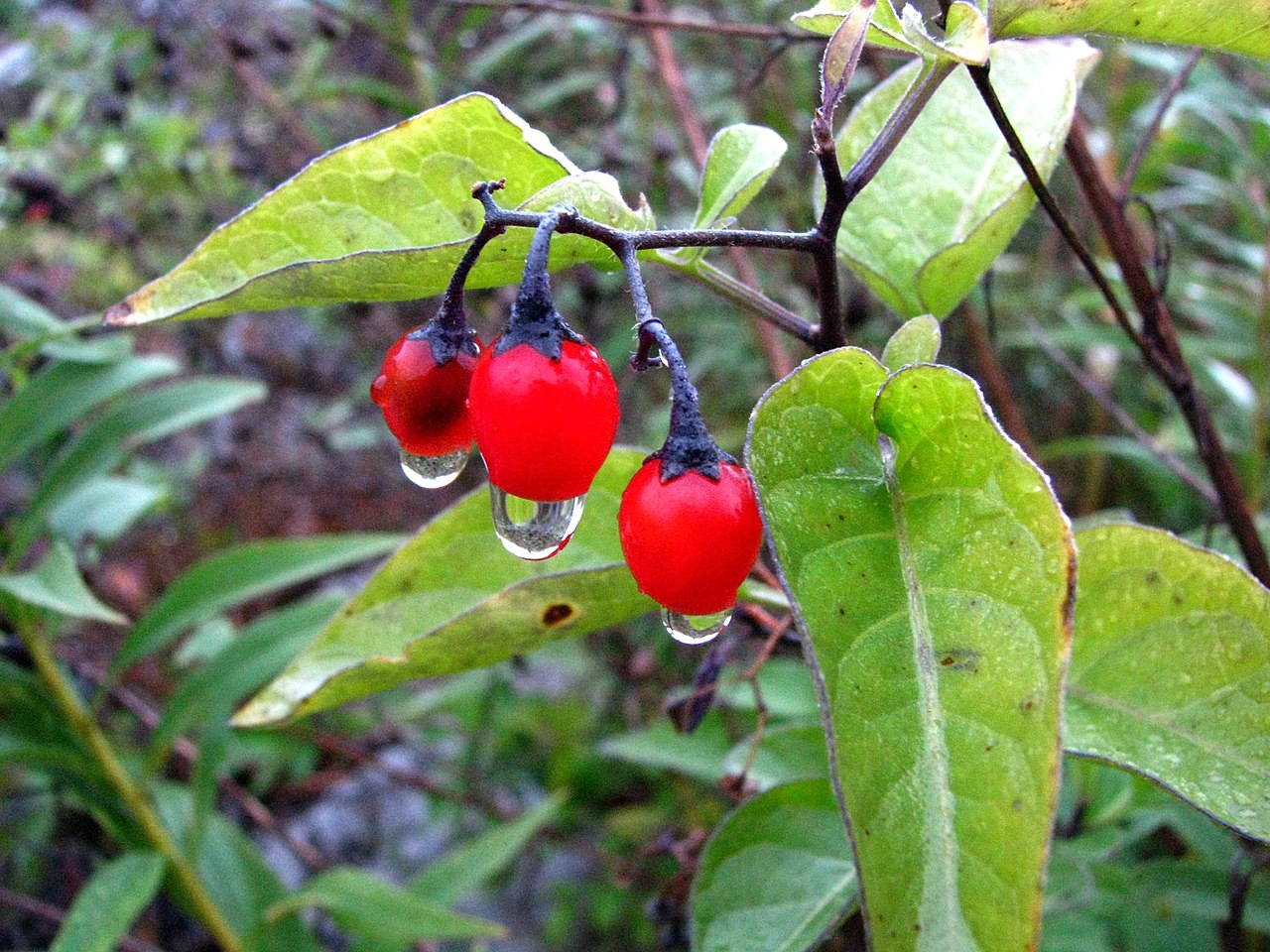
The Maghd | A medicinal plant in the Akhdar encyclopedia
Alkylsteroidal glycosides possess phagocytic properties. The compound solasodine has local anesthetic, cortisone-like, and cardiac tonic properties. It is currently used to treat eczema, warts, abscesses, and acne. It is also used for its purifying, immune-stimulating, antibacterial, and antiviral…
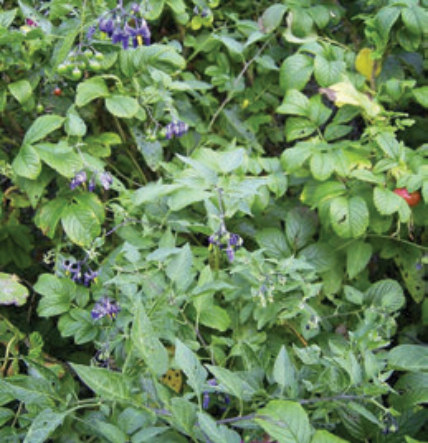
Plant name
The maqd
Latin name
Solanum dulcamara L
Common names
The black eggplant
foreign names
Eng. Bittersweet nightshade, Fr. Morelle grimpante, ouce-amere
The group
eggplant
Habitat and Geographic Distribution
It is believed to have originated in Eurasia, North Africa, and the temperate regions between Europe and Asia, from where its cultivation spread to Europe and North America.
The species is found on every continent, including the Arabian Gulf countries, Iraq, and the Levant.
Botanical description
The stem is almost hairless or downy, with a base approximately 100 cm long.
It is a woody shrub with herbaceous and often drooping branches.
The leaves are ovate to sepal, entire, and lanceolate.
The inflorescence is a cyme with a long stalk.
The flowers are hermaphroditic with articulated stalks.
The calyx has five fused sepals with triangular, broad lobes.
The corolla has five petals.
The male flowers are purple, longer than the calyx, and violet.
The stamens are supra-petaled with short filaments, and the anthers are longer than the filaments.
The ovary is bicarpal and superior.
The fruit is a berry, ovate or spherical, approximately 1 mm in diameter.
It resembles black gooseberry (Solanum nigrum) in its composition, properties, and uses. It flowers in summer.
Used part
The market and the papers
chemical components
The plant contains steroid alkaloid glycosides.
The amount of alkaloids varies depending on the plant part and variety.
It is highest in unripe fruits (0.4-0.07%) and leaves during flowering.
These alkaloids include alpha- and beta-solamarine, tomatididenol derivatives, soladulicidin derivatives, solamargine, solasonene, and solasodin derivatives.
The total alkaloid content in the fruits decreases as they ripen.
The stems and flowers contain steroidal saponins (responsible for the drug's bitter taste).
The seeds contain a group of rutin alkaloids. The drug also contains carotenoids, particularly in the fruits.
Properties and medical uses
Alkylsteroidal glycosides possess phagocytic properties.
The compound solasodine has local anesthetic, cortisone-like, and cardiac tonic properties.
It is currently used to treat eczema, warts, abscesses, and acne.
It is also used for its purifying, immune-boosting, antibacterial, and antiviral properties.
A decoction of the leaves is traditionally used as a poultice to treat nosebleeds, rheumatism, viral skin infections, psoriasis, bruises, and hemorrhoids.
It is beneficial for skin itching and boils, and it acts as a diuretic.
Precautions: All parts of the plant are toxic to humans, livestock, and rabbits.
Poisoning, especially fatal poisoning, occurs when animals consume large quantities of the plant.
Symptoms include cerebral disturbances accompanied by a dry throat, skin irritation and redness, increased sweating, and gastritis and enteritis.
Consumption can cause neurological disorders, tremors, instability, abdominal pain and diarrhea, excessive salivation, rapid heartbeat, low blood pressure, and kidney failure. It should not be used during pregnancy or lactation.
Side effects and precautions
All parts of the plant are poisonous to humans, livestock, and rabbits.
Poisoning, especially fatal poisoning, occurs when animals ingest large quantities.
Symptoms include cerebral disturbances accompanied by dry throat, skin irritation and redness, increased sweating, and gastroenteritis.
Ingestion can cause neurological disorders, tremors, impaired coordination, abdominal pain, diarrhea, excessive salivation, tachycardia, hypotension, and kidney failure. It should not be used during pregnancy or lactation.
the environment
The plant *Al-Maghd* grows in cultivated areas, along roadsides, around houses, in gardens, on embankments, and on the banks of streams.
It thrives in fertile, sandy clay soils with high moisture content and rich nitrogen fertilizer, spreading as a harmful weed and competing with crops and vegetables.
It also spreads in elevated, flat areas and in damp, shady places, and often grows on the edges of lakes, marshes, and forests.
This plant thrives in light silty soils and is also suitable for calcareous soils.
It tolerates acidity (pH 4.8-7.9).
Alkalinity and salinity reduce the green matter content and active ingredient content.
Agriculture and productivity
It is propagated by seeds in beds or rows in spring.
It can also be propagated by root and stem cuttings.
It can be successfully cultivated in various climatic environments.
Vegetative growth is abundant at an average temperature of 15-25°C and atmospheric humidity of 65-80%.
Increasing the photoperiod leads to abundant vegetative and fruit growth and an increased content of the active ingredient.
The plant is propagated by transplanting.
The seeds are sown in the nursery in late autumn, with a planting depth not exceeding 2.5 cm.
The seedlings are transplanted to their permanent location in early spring, when they have 3-4 leaves.
They are planted in rows spaced 75 x 60 cm apart and watered immediately.
The plant requires moderate irrigation and responds well to fertilization.
The stems and leaves are harvested before flowering by cutting them at soil surface level.
The process is then repeated after two months, or only the large leaves can be harvested every 15-25 days.
The cut parts are dried naturally or artificially.
One hectare yields 1.5-2 tons of leaves and 2.5-4 tons of dried stems and branches. Styrax officinalis L., Styrax cotinifolia Salisb., Styrax officinarum Crantz
History and Heritage
The scientific name of the genus is derived from the Greek word solanus, meaning "east wind," and it has been used medicinally since ancient times as a sedative and tranquilizer.
The plant has been used medicinally since the time of the Greeks to treat rheumatism and skin diseases.
The plant has a sweet taste at first, which soon becomes bitter, hence the name of the species Dulcamara, where Dulcis means "sweet" and Amarus means "bitter" (also the French name).
This species has been used in herbal medicine since ancient times (in the sixteenth century), but it was only recently known in the Arab world with the interest of pharmaceutical companies in extracting its alkaloids and using it as a plant source of compounds used in the manufacture of sex hormones.
Medical note
This information is for educational purposes only and does not constitute medical advice.
Poisonous or potent plants should only be used under the supervision of a qualified physician or pharmacist.
Related images