Myrrh | A medicinal plant in the Akhdar encyclopedia
The three components of myrrh contribute to its therapeutic properties. The volatile oil and resins possess antiseptic properties effective against many types of bacteria, fungi, and viruses. Liquid preparations are used as a diluted tincture or gargle for inflammation of the oral tissues, gums, an…
Plant name
The bitter
Latin name
Commiphora myrrha (NEES) ENGL
Common names
Myrrh, bitterness, Abyssinian lock
foreign names
Eng. Myrrh, Fr. Myrrhe, Myrrh Gum
The group
Incense
Habitat and Geographic Distribution
It is widespread in the southern Arabian Peninsula and tropical eastern Africa, from the coasts of Somalia, Djibouti, Eritrea, Ethiopia, Sudan, and Kenya.
Botanical description
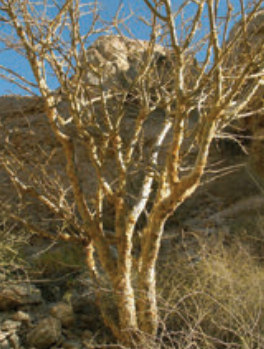
The bark peels off on 2.5-4 cm thick, shrubby or woody, thorny, deciduous branches, forming silvery to white or gray plates.
A thick, yellowish-white sap is harvested from the bark of the branches when they are wounded; this sap turns into spherical masses upon contact with air.
The leaflets are translucent, reddish-brown in color.
The leaves are alternate, sessile, compound, with the terminal leaflet being the largest, entire or toothed.
The leaflets are ovate, entire, and 3 mm long.
The lateral leaves are small (3 cm wide).
The flowers are gathered in shriveled inflorescences containing one or two flowers.
The flowers are pedunculated (3 mm long).
The petals are white to dull brown or purple, 2.5-5 mm long.
The calyx is 3 cm long (3 cm wide).
Long and 4 (stamens 8 mm).
Male 4 - fruit is drupe-like, compressed, ovoid to elliptical, blunt to acute, thick, smooth. Flowering from March to June
Used part
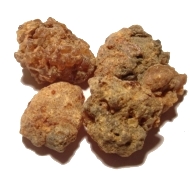
Myrrh (gum).
A resinous substance resembling frankincense or mastic beads, secreted by the stems of the plant after they are cut.
It has a thick consistency, a light reddish-brown color, a distinctive aromatic scent, and a pungent, bitter taste.
Good quality myrrh gum is collected directly from the tree trunk after it solidifies, while poor quality gum tends towards a dark brown color due to age, or appears to contain sand, resulting from being collected after it has run off onto the sandy ground beneath the tree.
chemical components
Myrrh consists of a homogeneous mixture of resin, gum, and volatile oil.
Alpha-amyrin, alpha-amyrenone: 40% resin; alpha-copaene, b-eudesmol, d-elemene: mainly composed of sesquiterpene compounds; 10% volatile oil; curzenenone, furanoeudesma, curzeren: the most important furosesquiterpenes; furanosesquiterpenes; methyl-glucurono-galactans: the most important 30-60% mucilage; and halogenated compounds.
Properties and medical uses
The three components of myrrh contribute to its therapeutic properties.
The volatile oil and resins possess antiseptic properties effective against many types of bacteria, fungi, and viruses.
Liquid preparations, such as a diluted tincture or gargle, are used to treat inflammation of the oral tissues, gums, and mucous membranes of the pharynx and bronchi.
Myrrh tincture is also used to treat athlete's foot (fungal growth between the toes).
Myrrh possesses analgesic, astringent, and antiseptic properties, and is effective in treating even infected wounds.
This is attributed to its volatile oil, which is rich in mono- and sesquiterpene compounds.
In folk medicine, myrrh is used as an appetite stimulant, digestive aid (stimulating the flow of digestive juices), and carminative.
It is beneficial in cases of enteritis.
Furthermore, taking myrrh gum capsules is helpful in cases of chronic respiratory tract infections accompanied by copious amounts of thick, white mucus, as myrrh gum is an expectorant and dissolves mucus or phlegm.
Myrrh is used topically in the form of powder, tincture, or gargle solution for its astringent and antiseptic properties in treating acne, skin inflammations, boils, ulcers, anal fissures, hemorrhoids, gingivitis, rheumatic pains, and sprains.
It is also beneficial in treating schistosomiasis, diabetes (the aqueous resin solution has a direct stimulating effect on insulin), and flatulence.
pharmaceutical forms
Myrrh is commercially available either in its natural form or as an essential oil, capsules, dry powder, or tincture.
Side effects and precautions
Myrrh should be used with caution and under medical supervision, and its use should be limited due to the potential for colon problems.
Myrrh gum should not be used during pregnancy, as it is a uterine contraction and may cause miscarriage.
Furthermore, it is not recommended to consume myrrh gum for more than two weeks, as it may negatively affect the kidneys.
Other uses
Myrrh gum is used in the composition of many perfumes.
the environment
At 1300 m, the plant spreads on basalt rock slopes in warm regions with altitudes ranging from 300 mm above sea level, and is sensitive to frost.
It does not like excessive humidity, as heavy winter rains can lead to rot and death of the trees.
Agriculture and productivity
It propagates by seed or division.
Branches root readily.
It does not develop a main taproot, but rather a network of small roots, so it can be successfully grown in containers.
Other names for this plant include: Opuntia ficus-indica (L.) Mill., Cactus ficus-indica L., Cactus opuntia L., Opuntia ficus-barbarica A.
Berge, Opuntia arcei Cárdena, Opuntia chinensis (Roxb. K. Koch), Opuntia incarnadilla Griffiths, and Opuntia vulgaris Mill.
History and Heritage
"Meaning gum or resin, kommi" from the Greek where Commiphora is the genus name (commiphora or balsam, and the first 2009) "means dreamer, mentioned by Nahal phoros" and "balsam," and some indicate that the poison is an Arabicized word, as mentioned by Al-Shihabi from Arabic: "murr." The describer of the species extracts a resin from the plant known for thousands of years and used to treat sore throats and gums, in addition to its role as a natural body perfume.
The Greek physician BC described it as a balm for ulcers.
The pharaohs used it in mummification, Hippocrates 377, and women burned it in Egypt to ward off house pests.
It has been known since ancient times in the Asiatic region for its benefits and uses in treating wounds and other ailments, and it has held a commercial position for more than a thousand years.
Myrrh has been used in China, called "Moyao," since BC, especially for healing wounds.
600: Part Myrrh (9 gum).
A resinous substance resembling frankincense or mastic gum, secreted by the stems of the plant after they are scratched or wounded.
It has a thick consistency, a reddish-brown color, a distinctive aromatic scent, and a pungent, bitter taste.
The best quality myrrh is collected directly from the tree trunk after it solidifies, while the inferior type is dark brown due to age or appears sandy after being collected after it has run off into the sandy ground beneath the tree.
Latin name: Commiphora myrrha (NEES) ENGL.
Balsamodendrum myrrha Nees (basionym), C. molmol (Engl.) Engl. C. myrrha var.molmol Engl
Medical note
This information is for educational purposes only and does not constitute medical advice.
Poisonous or potent plants should only be used under the supervision of a qualified physician or pharmacist.
Related images