Common almond | Medicinal plant in the Akhdar encyclopedia
The pectins and organic acids found in the fruit pulp have diuretic and laxative properties. Rosehip fruits, rich in vitamins, are used as an additional source of vitamin C. A decoction of the fruit is traditionally used for its diuretic properties, and in treating kidney and urinary tract stones,…
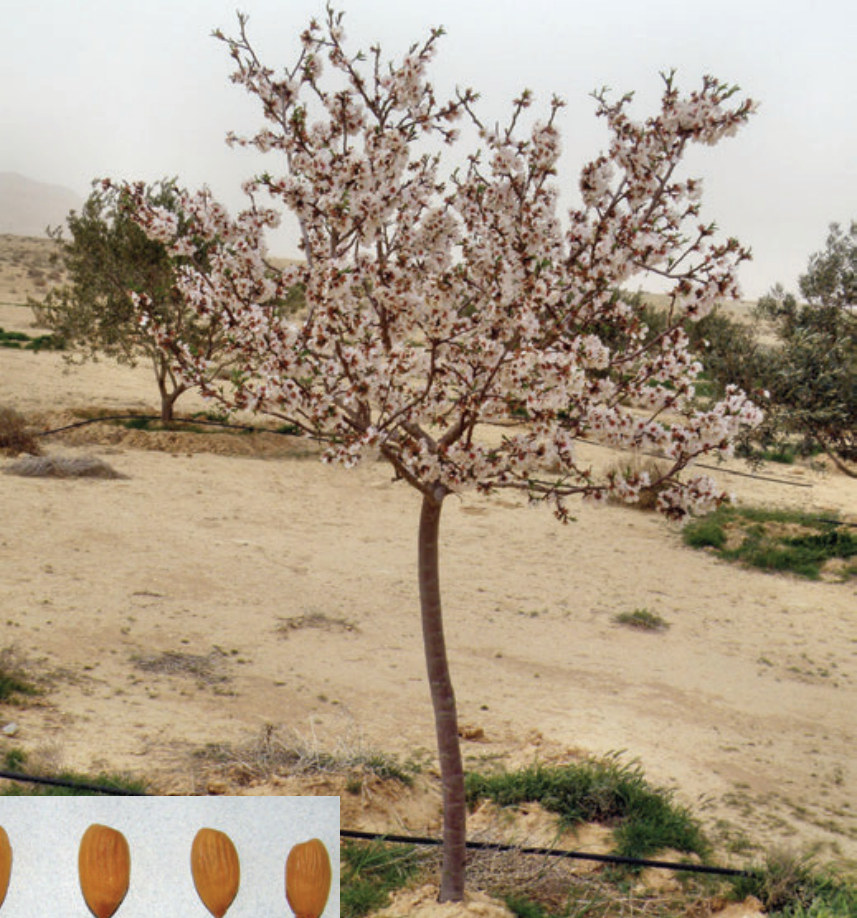
Plant name
common almonds
Latin name
Prunus dulcis (Mill.) D.A.Webb
Common names
common almonds
foreign names
Eng. Almond, Fr. Amandier
The group
Pink
Habitat and Geographic Distribution
The Mediterranean region, west of the Irano-Turanian zone, is the homeland of the Rasha almond, which grows wild in the Zagros Mountains, Kurdistan, the Syrian Dalkh mountains, and the Rasha mountain range of Lebanon.
The Arabian almond, on the other hand, grows in the Arab Rasha region, where it naturally occurs in the Zagros Mountains and Mount Sinjar, extending to the Arabian Gulf and the Gulf of Aden, and in the Syrian Desert in the Wadi al-Luwayza near Palmyra.
Botanical description
M, branches are not thorny.
8 - Tree (rarely shrub), cm tall, blade 2.5 cm, spadix length 2 - 0.5 x 8 - leaves - oblong to uterine, gradually tapering at the base, toothed margin 1.5 - glandular, glabrous.
Flowers usually appear before leaves.
Calyx cm, tube bell-shaped, slightly constricted near the aperture, opposite several scales, semi-rounded, covered with woolly hairs, lobes ovate-oblong, rounded at the apex, - margin white and hairy, length equal to the tube length.
Petals cm, white or pink, 2 - bearing erect veins, semi-rounded, often notched at the apex, short-chained.
The fruit is a drupe, 3-2 x 4-2 cm in size, compact, green-ovoid, grayish-hairy, with a leathery middle layer that splits open upon ripening.
The inner layer (kernel) is very hard, yellowish, and irregularly pitted, brownish-red in shape.
The seeds are flat and mustard-colored.
Flowering occurs from February to March.
The species includes several varieties, some with sweet seeds and others with bitter ones.
Examples include: Prunus dulcis var.
amara (C.) Buchheim, Prunus dulcis var.
fragilis Buchheim, and Prunus dulcis var.
spontanea (Korsh.) Buchheim.
Other species of the genus found in the Mediterranean region include P. orientalis and Prunus arabica (Arabian almond).
Used part
Flaxseed oil is obtained from the pressing of the seeds.
Constitutional linseed oil is obtained by cold pressing the ripe fruit.
It is bright yellow to brownish or ochre in color, clear in appearance, and has a characteristic odor.
It has low viscosity and quickly solidifies if left as a thin film (dry oil).
It is sparingly soluble in ethanol but miscible with sulfur, chloroform, and benzene. Latin name: Linum usitatissimum L.
chemical components
24% linoleic acid) composed of unsaturated fatty acids (30-45% linoleic acid).
Its seeds contain: fatty oil, 40% saturated fatty acids (ALA) (alpha-linolenic acid) of the weight of linseed oil components, alpha-linolenic acid).
Unsaponifiable stigmasterine (cholestyramine, stigmasterine, linusitamarine, phenylpropane derivatives of which 25% are lignans.
The seeds also contain mucilage and lignans.
It has a calming effect on the respiratory system.
The roots contain chlorogenic acid and cyanogenic glycosides. The leaves and stems contain flavonoids.
Properties and medical uses
The pectins and organic acids found in the pulp of the fruit have diuretic and laxative properties.
The fruits of the rosehip, rich in vitamins, are used as an additional source of vitamin C.
A decoction of the fruits is used traditionally for its diuretic properties, and in the treatment of kidney and urinary tract stones, vitamin C deficiency, influenza, to regulate stomach acidity, anemia, and scurvy.
The leaves are used for their astringent properties (tannins), and in the treatment of diarrhea, wounds, and burns.
It is used to treat symptoms of osteoporosis, rheumatism, and colds.
It possesses antibacterial, anticancer, antidiabetic, and anti-obesity properties.
Preparations made from the leaves have the following effects: It is a powerful free radical scavenger due to the presence of antioxidant compounds in addition to vitamin C.
It also possesses anti-inflammatory activity, reducing pro-inflammatory cytokines and chemokines, inhibiting pro-inflammatory enzymes, including COX-1/25-LOX, decreasing C-reactive protein levels, reducing chemotaxis, and inhibiting pro-inflammatory metalloprotease.
pharmaceutical forms
Flaxseed, Barlean Vita - Flax: Powder, soft gelatin capsules, oil.
The plant is available in various forms.
Barlean, Flax Oil: Side effects, interactions, and precautions.
Symptoms of overdose include shortness of breath, rapid breathing, weakness, and poor muscle coordination that can progress to paralysis and seizures.
It should not be given in cases of intestinal obstruction or severe constipation, acute gastrointestinal inflammation, or prostate cancer.
Flax should not be used with laxatives.
It should also be avoided during pregnancy or in labor, as it may harm the fetus or cause miscarriage.
Immature flax seeds should not be consumed. When using flax, drink plenty of fluids to reduce intestinal gas.
Side effects and precautions
The toxicity of bitter almond seeds is due to their content of a bitter glycoside (amygdalin).
Common almonds grow in agricultural lands and their borders, as well as in rocky areas near agricultural lands.
Oriental almonds, on the other hand, are considered a more environmentally resilient mountain variety, found in the lower, cool, and moderately cold semi-humid bioclimatic zone.
They exhibit high tolerance to cold and drought.
Almonds thrive in various soil types.
Arabian almonds are even more resilient and are among the most drought- and continental-tolerant almond varieties.
Other uses
Almonds are included in the dietary habits of many countries.
The essential oil, containing benzaldehyde, is used as a fragrance in many cosmetic preparations.
the environment
Common almonds grow in agricultural lands and their borders, as well as in rocky areas near cultivated fields.
The Rashki almond, on the other hand, is a highly resilient mountain variety, found in the lower, cool, semi-humid bioclimatic zone and exhibiting a high tolerance to aridity and drought.
Almonds are found in various species and orders.
The Arabian almond is the most resilient and is among the most drought- and continental-tolerant almond varieties.
Agriculture and productivity
The plant is propagated by hardened cuttings taken from branches older than one year, as well as by suckers, and rarely by seed.
Cuttings 20-25 cm long are taken and planted in holes measuring 40x40x40 cm.
Before planting, 2-3 kg of organic fertilizer is placed in the hole, and the plant is watered as needed.
Maintenance continues after planting in the permanent location, including irrigation, fertilization, weeding, and pruning.
Other species include: Coffea arabica L., Coffea arabica var.
typica Cramer, Coffea bourbonica Pharm.
ex Wehmer, Coffea corymbulosa Bertol, Coffea laurifolia Salisb., Coffea moka Heynh, Coffea sundana Miq., and Coffea vulgaris Moench.
Almonds can be propagated from seeds, and the resulting seedlings can then be grafted.
There are also several experiments in vegetative propagation of almonds, particularly the Arabian almond variety, using cuttings and layering.
History and Heritage
The name linon, the genus name for flax, comes from the Greek word for flax, *Usitatissimum*, which is the poisonous compound found in these plants.
Flax has been known for over five thousand years, including to the ancient Egyptians and Indians.
They cultivated it for its fibers and used its seeds medicinally.
The ancient Greeks also recognized the medicinal properties of flax seeds; Hippocrates recommended them for treating inflammations of the mucous membranes.
In the 18th century, Charlemagne in France issued laws mandating the consumption of flax seeds to maintain the health of his subjects.
Mahatma Gandhi famously said, "Wherever flax seeds become a common food among the people, health is better."
Medical note
This information is for educational purposes only and does not constitute medical advice.
Poisonous or potent plants should only be used under the supervision of a qualified physician or pharmacist.
Related images


