Syrian Flame | Medicinal Plant in the Akhdar Encyclopedia
Research indicates that the compound acetoside possesses antioxidant, antitumor, antiseptic, and anti-suppurating properties. It also suggests that the compound samioside has antibacterial properties, and that the compound naringenin possesses anti-ulcer and anti-malarial properties. The flowers of…
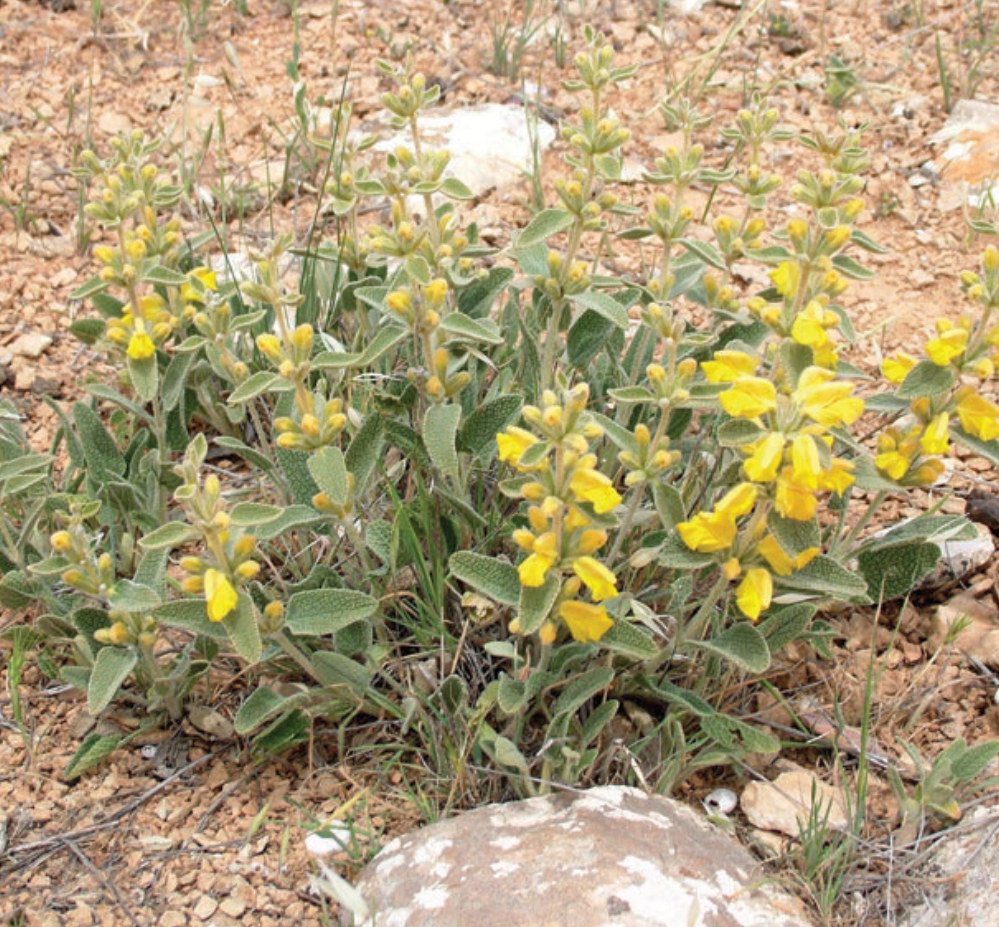
Plant name
Syrian flames
Latin name
Phlomis syriaca Boiss
Common names
The Syrian flame, the flame of Niswell
foreign names
Eng. Lampwick, Fr. Phlomis
The group
oral
Habitat and Geographic Distribution
Turin and Rashki Mediterranean (Amanus Mountains - Iran, Syria and Lebanon)
Botanical description
The leaves are yellowish, covered with stubby, downy hairs, and stubby hairs, later becoming almost a small shrub, bare in length.
The stems are erect, slender, simple or pyramidal-branched at the top.
The leaves are petiolate, undivided, and somewhat cratered, measuring 10-2.5 x 4-1.5 cm and thick.
The stem is oblong to uterine, with a truncated base.
The flowering leaves are the same length as, or longer than, the corymbs.
The flowers are gathered in few, widely spaced corymbs, each containing 6 mm.
The calyx is 6 mm long, and the flowers are sessile or semi-sessile.
The bracts are few in number, reddish-brown in shape, narrower than the calyx, 6-mm long, tubular, bearing prominent ribs, with ovoid, acute teeth, often ending in 15-15 sepals, 5-15 cm long, the lower teeth slightly longer than the upper ones, yellow, twice the length of the upper ones.
The corolla is the calyx, the tube is embedded in the calyx, the upper lip is narrower than the lower lip, forming a semicircle, covered with pubescence above.
The male is biparous, with filaments containing appendages.
The female is bicarpel-divided, bisectoral, divided by a false septum into four segments, each containing one ovule.
The fruit is an ovoid to trifoliate acinus, smooth or nearly smooth. Flowering occurs from May to June.
Used part
Pneumatic parts. Latin name: Phlomis syriaca Boiss. P. nissolii L. var. leptorrhacos Boiss
chemical components
The aerobic parts contain several flavonoid glycosides, including acetoside, lamiide, naringenin, samioside, and luteolin.
The most important compounds are iridoids, phenylethanoid glycosides, and volatile oils.
Twenty-one iridoids and 53 phenylethanoid glycosides and simple phenolic glycosides have been identified, including two tetraglycosides, physocalycoside, and lunarifolioside.
The plant contains quinic acid, monomeric phenylpropanoids, neolignans, lignans, luteolin, chrysoeriol glycosides, flavonoids (including shikimic acid), naringenin, methoxyflavonols, kaempferol, quercetin glycosides, megastigmane glycoside, mono- and di-triterpenoids (including terpenoids), octenol triglycoside, and acetophenone glycosides.
Properties and medical uses
Research indicates that the compound acetoside possesses antioxidant, antitumor, antiseptic, and anti-suppurating properties.
It also indicates that the compound samioside possesses antibacterial properties, and that the compound naringenin possesses anti-ulcer and anti-malarial properties.
The flowers of the Syrian flame are included in the composition of some herbal blends sold by herbalists in Syrian markets as a natural tea.
Side effects and precautions
Allergic reactions or drug interactions may occur; self-use should be avoided by pregnant and breastfeeding women, children, and patients with chronic diseases.
the environment
M, it also grows in semi-arid regions on sunny, stony plateaus and mountain slopes, and even at high altitudes it grows in fields and pastures.
Agriculture and productivity
It propagates by seeds and division.
The plant is generally not cultivated. Prunella vulgaris L. Prunella vulgaris subsp. parviflora Ehrh
History and Heritage
The scientific name for the genus Phlox comes from the Greek word for flame or torch, indicating that the leaves were once used as wicks for firewood. The species name also points to its distribution in Syria (Syriaca).
Medical note
This information is for educational purposes only and does not constitute medical advice.
Poisonous or potent plants should only be used under the supervision of a qualified physician or pharmacist.
Related images

