Frankincense | A medicinal plant in the Akhdar encyclopedia
Boswellic acid is highly effective in treating asthma, rheumatism, and arthritis, as well as in lowering blood lipid levels and reducing the risk of certain types of blood cancer such as leukemia. It has also been shown to be a pain reliever, to strengthen the body's immune system, to enhance liver…
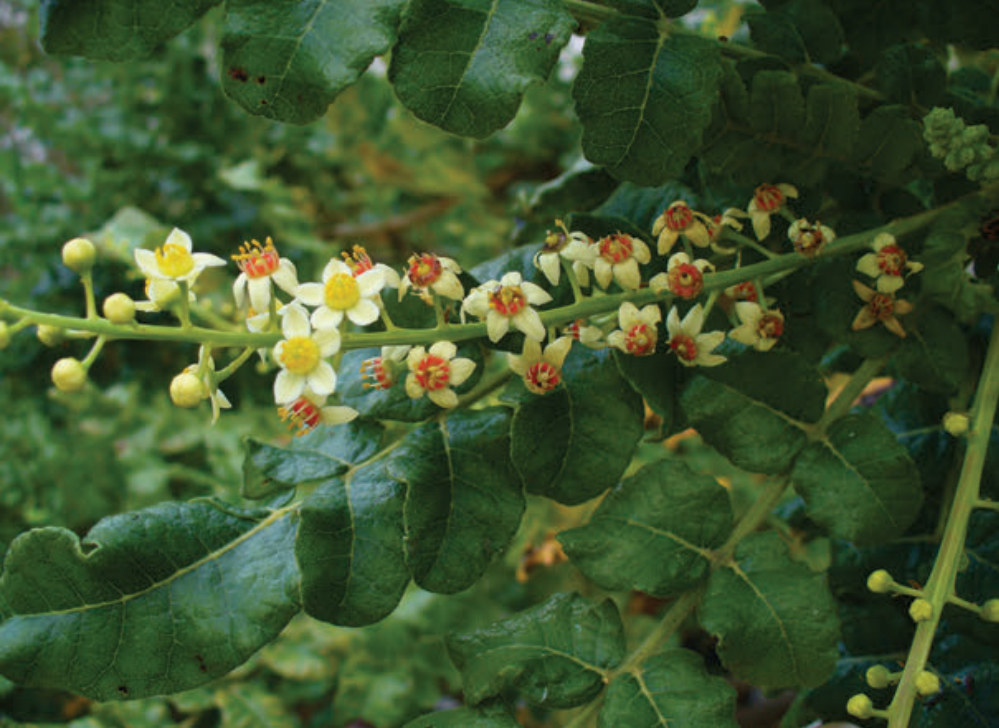
Plant name
Frankincense
Latin name
Boswellia sacra Flueck
Common names
Frankincense, olibanum, castor oil, rolling
foreign names
Eng.Oliban, Olibanum, Fr. Incense Tree
The group
Incense
Habitat and Geographic Distribution
Southern Arabian Peninsula (particularly Yemen and the Sultanate of Oman), and along the northeastern coast of Somalia and the Indian subcontinent
Botanical description
M, 8 - A small, deciduous tree, with one or more trunks, and densely hairy branches.
In trees growing singly on steep slopes, the trunk base develops into a cushion-like shape, adhering to the rocks and providing some stability.
The bark is brown and papery, easily chipped.
The leaves are pinnately compound, alternate, and clustered at the ends of pairs.
The leaflets are alternate, oblong, and cristae (40 mm long).
The flowers are small, yellowish-white, and 20 mm long.
The corolla has two teeth and is about 5 cm long.
The calyx consists of 10 stamens, which are clustered in racemes in the leaf axils.
The ovary is surrounded by a papillary disc.
The male part has 4 petals, 5 segments long, comprising 5 angular or wing-like segments, and opens to 5 cm.
The fruit is an obovate capsule, approximately 1 cm long, containing one seed each. Flowering occurs from September to November.
Used part
Frankincense, a resinous gum secreted from the bark of the frankincense tree after it is cut, has a distinctive aroma and a bitter taste.
Frankincense is classified according to color, purity, harvest time, and the location where the frankincense tree grows.
The further the tree is from the rainfall zone, the better its production in terms of both quantity and quality.
Frankincense that is white with a bluish tinge and free of impurities is considered the finest and most expensive.
The quality decreases as the frankincense turns reddish or is mixed with other impurities.
chemical components
Frankincense consists of a homogeneous mixture of resin, gum, and volatile oil.
The water-soluble resins (the resin is a milky liquid before it hardens upon contact with air) comprise 60%.
It possesses antimicrobial properties.
The gum contains boswellic acid (25%), volatile oil (their main components being 10-15%), sabinene, limonene, alpha-pinene (50%), mono- and polypeptide compounds, and others.
It also contains a high percentage of gum.
Frankincense is characterized by its high volatile oil content, reaching up to [a certain percentage]. It is also characterized by the absence of incensole.
Properties and medical uses
Boswellic acid is highly effective in treating asthma, rheumatism, arthritis, and in lowering blood lipid levels and reducing some types of blood cancer such as leukemia.
It has also been shown to be a pain reliever, to strengthen the body's immune system, to enhance liver activity, and a useful anti-inflammatory in treating coughs, bronchitis, and sinusitis.
It is also used in treating ulcerative colitis, eye inflammation, and gum inflammation.
The essential oil possesses antiseptic properties for the respiratory system and is used topically for the treatment of rheumatism, joint pain, and external wounds.
It is also a carminative and diuretic.
Frankincense is used traditionally as an expectorant, to relieve abdominal and chest pain, and to treat eye inflammation.
It is also used as an antidote and aids in fracture healing in the form of plasters and poultices.
Frankincense is considered a promising candidate for the treatment of neurodegenerative diseases, including Alzheimer's, and frankincense extract has a therapeutic effect on diabetes.
Of type 2 (T2D), a small to moderate dose of frankincense extract may be beneficial in enhancing the adaptive immune response in mild to moderate COVID-19 infections.
The promising effects of frankincense extract and boswellic acid B are attributed to their antioxidant, anti-inflammatory, immunomodulatory, cardiotonic, antiplatelet, antibacterial, antifungal, and antiviral activity.
Side effects and precautions
Topical application of frankincense can cause skin irritation.
Other uses
It is used in religious occasions as a fragrant incense.
The essential oils extracted from frankincense are used in the manufacture of perfumes and creams for facial and dry skin care.
Precautions: Topical application of frankincense can cause skin irritation.
Note: Frankincense may be adulterated with pine resin or gum arabic.
Adulteration can be easily detected, as gum arabic does not burn, pine resin smokes, and frankincense is flammable.
the environment
The frankincense tree grows singly in valleys, crevices, watercourses, and on the slopes of highlands and plateaus, and on low slopes in arid regions.
It rarely grows in high-altitude areas with high humidity.
The tree's root system forms a cushion-like structure at the base of the trunk, allowing it to adhere to rocks and providing greater stability.
The tree tolerates the harshest environmental conditions on rocky slopes and at altitudes of up to [missing information - likely a specific altitude].
Agriculture and productivity
It is propagated by seed.
It has been observed that the germination rate of seeds taken from trees that have been severely wounded to produce frankincense is lower than that taken from trees that have not been wounded at all.
However, the easiest method of propagation is by hardened cuttings, which root easily if suitable conditions are provided.
The tree begins to produce frankincense at the age of 8 to 10 years.
Frankincense is obtained by making a vertical cut in the trunk, about 10 cm wide, with a sharp instrument.
Harvesting may take 3-4 months.
The tree's growth, the quantity of frankincense produced, and its quality vary depending on the growing conditions.
Frankincense trees found in the narrow valleys of arid regions beyond the seasonal rainfall zone in the Dhofar region of Oman are known to produce the finest quality frankincense.
Commiphora myrrha (NEES) ENGL.
Balsamodendrum myrrha Nees (basionym), C. molmol (Engl.) Engl. C. myrrha var.molmol Engl., Balsamea myrrha Baill
History and Heritage
The scientific name of the genus Boswellia is derived from the name of John Boswell, and the species name sacra is from the Latin crum cra, meaning "pure" or "holy".
It is called the sacred tree because of its religious uses.
It is mentioned in the Bible, and it is believed that the name "frankincense" is derived from "milk" (the sap of the tree), sometimes called "bitter gum." It is a type of tree resin, similar to frankincense, which is chewed and sometimes used as incense due to its pleasant aroma.
Frankincense has been known since pre-Christian times.
In ancient times, the Arabian Peninsula was the sole source of frankincense, and ancient civilizations relied on its trade.
The ancient civilizations of Yemen and the Nabataeans believed that the center of the frankincense trade was the "lost" city of Iram of the Pillars in the southern Arabian Peninsula.
The frankincense trade was linked to the Incense Route, a trade route connecting India with the Arabian Peninsula and Egypt.
Ancient records concerning its collection and trade are shrouded in legend, and its use was associated with many religious rituals and medicines among various peoples, such as the ancient Egyptians.
Greek and Roman physicians used frankincense to treat a wide range of ailments.
Frankincense was used to treat various diseases, and its price in the markets of the Roman Empire was sometimes equal to that of gold.
Therapeutic methods based on frankincense were mentioned in Syriac medical texts, in medical texts used by Muslim physicians in the Middle Ages, and in Indian and Chinese medical manuscripts.
Some mistakenly refer to frankincense as "male" and "female," which are scientifically incorrect because the flowers of the frankincense tree bear both male and female reproductive organs (hermaphroditism).
The part used is the resin, which is...
Frankincense is a resinous gum secreted by the bark of the frankincense tree after it is cut.
It has a distinctive odor and a bitter taste.
Frankincense is classified according to color, purity, harvest time, and the location where the frankincense tree grows.
The further the tree is from the rainfall area, the better its production in terms of both quantity and quality.
Frankincense that is white with a bluish tinge and free of impurities is considered the finest and most expensive type.
The quality decreases as the frankincense turns reddish or is mixed with other impurities.
note
Frankincense may be adulterated with pine resin or gum arabic.
The adulteration is easily detectable, as gum arabic does not burn, pine resin smokes, and frankincense ignites.
Medical note
This information is for educational purposes only and does not constitute medical advice.
Poisonous or potent plants should only be used under the supervision of a qualified physician or pharmacist.
Related images


