Coriander | A medicinal plant in the Akhdar encyclopedia
Coriander is used as an antibacterial, anti-inflammatory, anticancer, and anti-inflammatory agent, as well as for neuroprotective purposes, anxiety relief, and to alleviate migraines, lower blood lipids, reduce blood sugar, and lower blood pressure. Coriander seeds are a well-known spice that stimu…
Plant name
coriander
Latin name
Coriandrum sativum L
Common names
Coriander, Chinese parsley, coriander, coriander, coriander
foreign names
Eng. Coriander, Fr. Cultivated coriander
The group
celery
Habitat and Geographic Distribution
Geographically, it originated in the Eastern Mediterranean and Western Iran, and from there its cultivation spread to most temperate and semi-tropical regions of the ancient world.
Botanical description
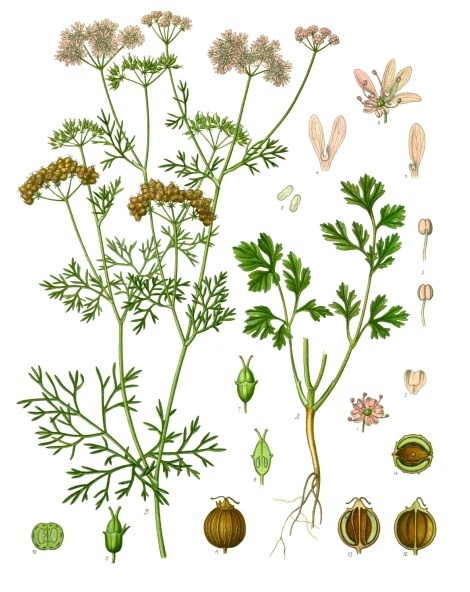
The stem is erect, slender, and 50 cm long.
It is a perennial herb, about a hamza in length, branching dichotomously from the base.
The leaves are glossy and have three types: the basal leaves are long-petioled, appearing withered, undivided or trilobed; the lower stem leaves are deeply divided more than once into pedicels, toothed margins; the upper leaves are flat, ovate, and deeply divided more than once into thread-like lobes.
The flowers are small, white, and gathered in compound umbels composed of rays.
The bracts are single or absent.
The simple umbel is 5 mm reddish.
The calyx is linear with three rays.
The bracts are blunt, slightly reduced to small teeth.
The petals are perfectly equal in size.
The fruit consists of two segments.
Two spherical fruits appear on the surface of the fruit, 1.5-5 mm in diameter.
Primary ribs are flat and slightly irregular, while secondary ribs are thin, straight, and more prominent.
The fruit only becomes flat when the flowers have dried, from March to June.
Native habitat and geographical distribution: Taurine, from where it spread to the Mediterranean and western Iran, and its cultivation has reached most temperate and subtropical regions of the Old World.
Used part
The dried, ripe fruit; the essential oil extracted from the fruit.
chemical components
Geraniol (70%) (coriandrol = linalool).
Its main components: Linalool (0.4-1.4%).
The fruits contain 21% volatile oil and fixed oils: limonene, camphor, borneol, petroselinic acid, linolenic acid, oleic acid (its main components), scopoletine, umbelliferone (the most important of which is umbelliferone), hydroxycoumarins, hydroxycoumarin compounds, and flavonoids, including kaempferol, quercetin, and their glycosides.
Properties and medical uses
Coriander is used as an antibacterial, anti-inflammatory, anticancer, anti-convulsant, neuroprotective, anxiety-relieving, analgesic, migraine relief, cholesterol reduction, blood sugar reduction, and blood pressure reduction.
Coriander seeds are a well-known spice that stimulates appetite and aids digestion.
They are also antioxidants due to the presence of numerous flavonoids.
Coriander seed oil exhibits antimicrobial activity against gram-positive and gram-negative bacteria, some yeasts, dermatophytes, and filamentous fungi.
The volatile oil stimulates the secretion of digestive juices, expels gas, and relieves colic and spasms.
Studies have demonstrated the benefits of coriander seeds for diabetics, as they stimulate the pancreas to secrete insulin.
Coriander is included in dietary regimens due to the lipid-lowering and cholesterol-lowering effect of its fixed oil.
Its oil is used as a fragrance in some pharmaceutical preparations.
The ground seeds are used traditionally to freshen breath, especially after eating garlic, and are also used for indigestion, coughs, fever, and bladder infections.
Coriander oil is used topically to treat nosebleeds and, when applied topically, to treat hemorrhoids and rheumatism.
pharmaceutical forms
Ground is used
Side effects and precautions
Allergic reactions or drug interactions may occur; self-use should be avoided by pregnant and breastfeeding women, children, and patients with chronic diseases.
the environment
The plant tolerates drought and high temperatures, although its vegetative and fruit production is higher in temperate and subtropical regions compared to hot or cold regions.
It grows in well-drained and aerated loamy or heavy soils, and also thrives in fertile black soils. However, it does not tolerate high levels of soil alkalinity or acidity.
Agriculture and productivity
The plant is sown in autumn as a winter crop in warm regions, and in spring as a summer crop in cold regions.
It is propagated by new seeds that are no more than one year old, sown in rows or in holes within raised beds.
3-4 seeds are placed in each hole, and one hectare requires 15-25 kg of fruit.
The seeds begin to germinate at a temperature of 6-8°C, and the germination stage under these conditions takes 2-52 days.
The seedlings can tolerate temperatures as low as -7°C.
Thinning is necessary when the seedlings reach 6-8 cm, leaving two seedlings per hole.
(Cuminum cyminum L., Cuminum aegyptiacum Mérat ex DC., Cuminum sativum J.Sm., Cuminum odorum Salisb.)
History and Heritage
The Arabic name "Kuzbara" comes from the Greek word "Koris," while the scientific name "Coriander" refers to the genus Coriandrum, derived from the Greek word "Koris," meaning "satisfum." The plant has a fresh aroma.
The fruit has been used for over two thousand years, with mentions dating back to the Ebers civilization.
The species is also mentioned in the Ebers Papyrus of ancient Egypt, as well as in references to the Hanging Gardens of Babylon and in ancient Indian texts written in Sanskrit.
It was also known to the Greeks, Romans, and Chinese.
The part used is the dried, ripe fruit, and the essential oil extracted from it. The Latin name is Coriandrum sativum L.
Medical note
This information is for educational purposes only and does not constitute medical advice.
Poisonous or potent plants should only be used under the supervision of a qualified physician or pharmacist.
Related images