Common flax | A medicinal plant in the Akhdar encyclopedia
Flaxseed oil possesses anti-inflammatory, anti-tumor, cardioprotective, bowel regulator, cytokinase inhibitor, lipid-lowering, antibacterial, and anti-carcinogenic properties, in addition to being rich in Omega-3 fatty acids. It is used internally for constipation and topically for inflammation…
Plant name
Common flax
Latin name
Linum usitatissimum L
Common names
Common flax
foreign names
Eng.Flax, Fr. Lin
The group
Linen
Habitat and Geographic Distribution
The Mediterranean and fertile crescent is now cultivated worldwide for its fiber, seeds, and oil.
Botanical description
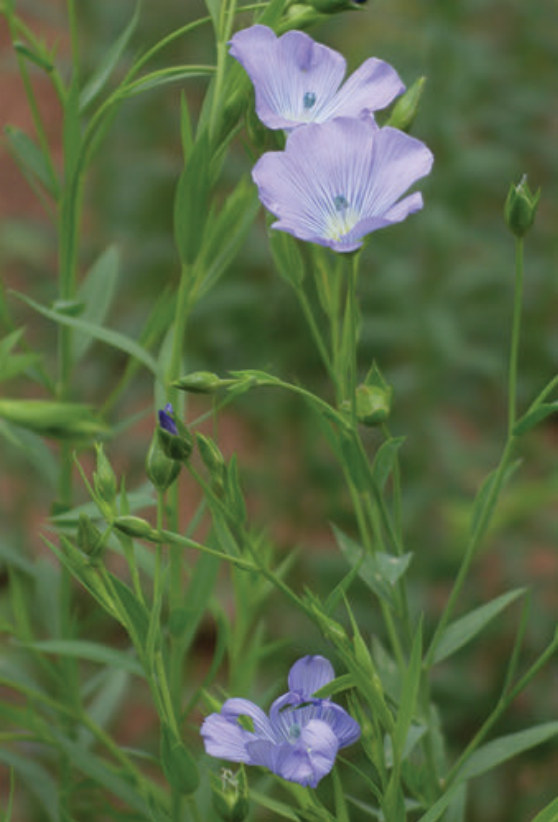
An annual or sometimes perennial herb with an erect, slender stem reaching about one meter in height.
The leaves are simple, sessile, uterine, sometimes narrow and linear, glabrous, 4 cm - entire margin, trilobed, mm long.
The flowers are hermaphroditic, radial, and striated: symmetrical, clustered in cymose inflorescences, axillary or sepal, mm long.
The calyx is terminal, petal-shaped, sky blue, and perennial.
The corolla opens only in the sun and falls off easily.
The male flowers are stamens with broad filament bases, alternating with stromals.
The ovary is five-lobed, containing two ovules: within each lobe, at least five free.
The fruit is a capsule, spherical, 6 mm in diameter, light brown, containing approximately one seed pod.
The seeds are reddish-brown, ovoid or 6 mm long, oblong, flattened, mm long.
One end is 1.5–0.75 mm long and rounded, the other pointed and hooked.
The upper surface of the seed has fine, irregular perforations.
The seed coat is easily detached and covers a thin layer of endosperm and a straight embryo, both of which are salivary.
Soaking the seeds in water causes the formation of a salivary coating. The cotyledons are large, flat, and oil-rich.
Used part
Flax seeds, flaxseed oil produced from pressing
chemical components
24% linoleic acid) composed of unsaturated fatty acids (30-45% linoleic acid).
Its seeds contain: fatty oil, 40% saturated fatty acids (ALA) (alpha-linolenic acid) of the weight of linseed oil components, alpha-linolenic acid).
Unsaponifiable stigmasterine (cholestyramine, stigmasterine, linusitamarine, phenylpropane derivatives of which 25% are lignans.
The seeds also contain mucilage and lignans.
It has a calming effect on the respiratory system.
The roots contain chlorogenic acid and cyanogenic glycosides. The leaves and stems contain flavonoids.
Properties and medical uses
Flaxseed oil possesses anti-inflammatory, anti-tumor, cardioprotective, bowel regulator, cytokinase inhibitor, lipid-lowering, antibacterial, and anti-carcinogenic properties, in addition to being rich in omega-3 fatty acids.
It is used internally for constipation and topically for skin inflammations.
Diluted flaxseed oil is used for irritable bowel syndrome, intestinal inflammation, and hemorrhoids.
It is also used topically for burns, anal inflammation, and chronic prostatitis.
A decoction of the seeds is used traditionally as a laxative and treatment for constipation, to lower blood sugar, and to treat spasms and inflammation of the colon.
A paste made from the ground seeds is used as a poultice to treat respiratory problems and skin inflammations.
A decoction of the seeds is used traditionally to treat bladder infections, whooping cough, and spasms of the digestive system.
Other uses include cooking oil, soap for grease, and it is an ingredient in varnishes and oil paints, as well as in papermaking.
It is also used as an excipient in dermatological pharmaceutical preparations.
Pharmaceutical forms: The plant is available as a powder, soft gelatin capsules, and oil.
It is sold under names such as Flaxseed, Barlean's Flax Oil, and Barlean's Vita-Flax.
Side effects, interactions, and precautions: Symptoms of overdose include shortness of breath, rapid breathing, weakness, and poor muscle coordination that may progress to paralysis and seizures.
It should not be given in cases of intestinal obstruction or severe constipation, acute inflammation of the digestive tract, or prostate cancer.
Flaxseed should not be used with laxatives.
It should also be avoided by pregnant or breastfeeding women, as it may harm the fetus or cause miscarriage.
Immature flaxseeds should not be consumed.
When using flaxseed, it is advisable to drink plenty of fluids to reduce intestinal gas.
pharmaceutical forms
Flaxseed, Barlean Vita - Flax: Powder, soft gelatin capsules, oil.
The plant is available in various forms.
Barlean, Flax Oil: Side effects, interactions, and precautions.
Symptoms of overdose include shortness of breath, rapid breathing, weakness, and poor muscle coordination that can progress to paralysis and seizures.
It should not be given in cases of intestinal obstruction or severe constipation, acute gastrointestinal inflammation, or prostate cancer.
Flax should not be used with laxatives.
It should also be avoided during pregnancy or in labor, as it may harm the fetus or cause miscarriage.
Immature flax seeds should not be consumed. When using flax, drink plenty of fluids to reduce intestinal gas.
Side effects and precautions
Symptoms of overdose include shortness of breath, rapid breathing, weakness, and poor muscle coordination that can progress to paralysis and seizures.
It should not be given in cases of intestinal obstruction or severe constipation, acute gastrointestinal infections, or prostate cancer.
Flaxseed should not be used with laxatives.
It should also be avoided by pregnant or breastfeeding women, as it may harm the fetus or cause miscarriage.
Immature flaxseeds should not be consumed. When using flaxseed, drink plenty of fluids to reduce intestinal gas.
the environment
Flax is a long-day plant.
Seeds begin to germinate, and seedlings can sprout at temperatures as low as 5°C.
It can tolerate temperatures as low as 4°C, while temperatures as high as 18°C, which is suitable for its growth, lead to increased branching, faster flowering, and increased seed production, although fiber quality deteriorates in these conditions.
Flax requires moisture in all stages except during the ripening stage.
It thrives in well-drained, medium-sized soils such as loamy or clayey soils.
Light soils are unsuitable for its cultivation, especially in areas with low rainfall or irrigation water. The appropriate pH is 6.5.
Agriculture and productivity
Flax is propagated by seed.
It is sown in the autumn in temperate regions and in the spring in colder regions.
The soil is prepared for planting by deep autumn plowing and several shallow tillages, followed by the addition of fertilizers.
Flax is a relatively undemanding crop in terms of nutrients, and mineral fertilization is not recommended if the soil is fertile.
The basic post-planting care operations are hoeing, weed and disease control, pest control, and irrigation when needed.
One hectare yields 600-700 kg of seeds under normal conditions. (Lawsonia inermis L., Lawsonia alba Lam., Lawsonia spinosa L.)
History and Heritage
The scientific name of the genus is derived from the Greek word linon, which is the Latin name for these plants.
The species name, usitatissimum, means "familiar" or "common." Flax has been known for over five thousand years.
The ancient Egyptians and Indians cultivated it for its fibers and used its seeds medicinally.
The ancient Greeks also recognized the medicinal properties of its seeds, and Hippocrates recommended them for treating inflammations of the mucous membranes.
In the eighteenth century, Charlemagne in France issued laws mandating the consumption of the seeds to maintain the health of his subjects.
Mahatma Gandhi said, "Wherever flaxseed becomes a common food among the people, there is health." The best part.
The part used is flaxseed, the oil produced by pressing the seeds.
Constitutional flaxseed oil is obtained by cold-pressing ripe fruit.
It is light yellow to brown or green in color, clear in appearance, and has a characteristic odor.
It has low viscosity, solidifies quickly, and is poorly soluble in ethanol, but miscible with ether, chloroform, and benzene.
Medical note
This information is for educational purposes only and does not constitute medical advice.
Poisonous or potent plants should only be used under the supervision of a qualified physician or pharmacist.
Related images


