Yarrow | A medicinal plant in the Akhdar encyclopedia
Studies have demonstrated the properties of the essential oil in inhibiting the growth of certain types of fungi and bacteria, particularly Gram-positive bacteria. The alcoholic extract of the plant has also shown properties in reducing blood clotting, thus contributing to the prevention of blood c…
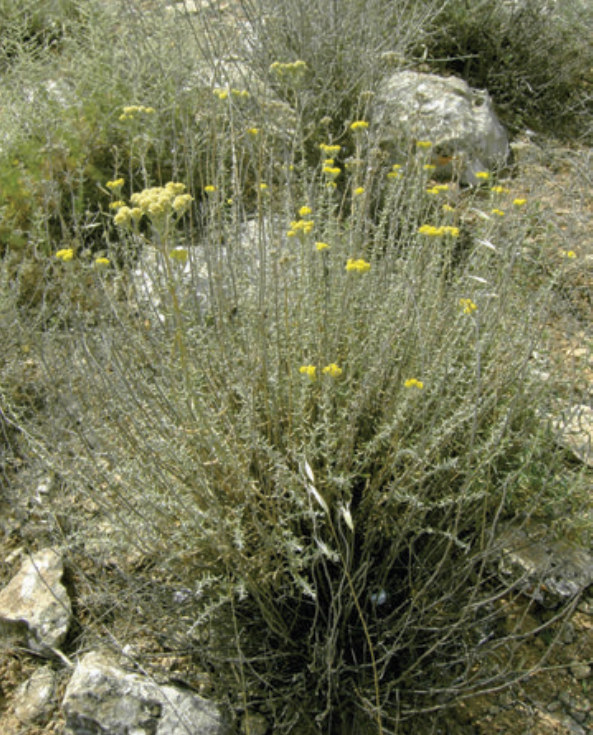
Plant name
sickle cell yarrow
Latin name
Achillea falcata L.
Common names
Sickle cell wormwood, wormwood
foreign names
Eng. Milfoil, Fr. Achilles sickle
The group
Star
Habitat and Geographic Distribution
Western Irani – Turani
Botanical description
A small, highly branched shrub, reaching a height of 1 cm.
The stem is erect and simple, covered with 50 layered hairs, becoming almost bare laterally.
The leaves are narrow, linear, and slightly tapered at the tips, covered with grayish woolly hairs, short and often arching, deeply divided into very small segments, some overlapping each other in a dense, sprawling pattern.
Each segment is further divided into three rounded, toothed lobes.
The ovoid heads are gathered in compound comb-like inflorescences.
The head bears tubular and radial flowers.
The peduncles are long, approximately twice the length of the head, nearly spherical, and 4 times the length of the head.
The bracts are covered with grayish, layered woolly hairs.
The receptacle bears bracts.
The ligules are female, few in number, yellow, tridentate, and one-third to one-half the length of the bract.
They are arranged in a single row in the head.
The central flowers are tubular, hermaphroditic, and five-toothed.
The fruit is a compressed acinus: narrow at the base, broad and truncated at the apex, and lacking a seed coat. Flowering occurs from April to September.
Used part
Aerial parts.
Latin name: Achillea falcata L., incl. var. breviradiata Boiss. A. sulphurea Boiss., A. damascena DC
chemical components
(Allergenic compounds).
Achillifoline and achillin: Sestoterpene ketones.
Quercone etine, pectolinarigenine: Valprosides, the most important of which are coumarin compounds, and a small amount of tannins.
The volatile oil varies in composition depending on its source.
In oil of Lebanese origin, the most important compounds are: terpinen-4-ol, 1,8-cineole 4%, fragranol 17%, artemisia ketone 5%, and grandisol 21%.
In oil of Jordanian origin, the most important compounds are: camphor 17%, 1,8-cineole 4%, p-cymene 11%, beta-thujone 10%, and terpinen-4-ol 5%.
Properties and medical uses
Studies have demonstrated the properties of the essential oil in inhibiting the growth of certain types of fungi and bacteria, particularly Gram-positive bacteria.
The alcoholic extract of the plant has also shown its ability to reduce blood clotting, thus contributing to the prevention of blood clots in the arteries and veins.
The plant, with its essential oil and sesquiterpene lectins, possesses anti-inflammatory, antispasmodic, digestive, and bile-stimulating properties, as well as acting as a liver detoxifier.
A decoction of the aerial parts is a natural source of antioxidants beneficial in preventing many diseases linked to blood lipid levels.
This decoction is traditionally used as a digestive aid and to treat gastritis.
The leaves and flowers are used to prepare a tincture or ointment applied topically to treat wounds, stop external bleeding (hemorrhoids), and alleviate rheumatic pains.
Side effects and precautions
Allergic reactions or drug interactions may occur; self-use should be avoided by pregnant and breastfeeding women, children, and patients with chronic diseases.
the environment
It spreads in dry deserts on petrified vertebral columns.
Agriculture and productivity
The plant can be propagated by seeds or by dividing vegetative and root growth, but seed propagation is more economical. Storage is not recommended.
History and Heritage
It is Achilles, the brother of the name, which is an Arabicized form of the Greek word for the legendary Greek hero Achilles, the hero of Homer's Iliad.
It is said that Achilles used plants of this genus to heal his enemy after slashing him with a sword.
Soldiers also used it, as did Chiron in 1184 BC.
The story mentions that the sage Arrasar (1184-1194 BC, during the Trojan War) gave this plant to his young disciples, who later used it during the Trojan War, to stop bleeding during the war. The name of the species is *falcata*.
Medical note
This information is for educational purposes only and does not constitute medical advice.
Poisonous or potent plants should only be used under the supervision of a qualified physician or pharmacist.
Related images
