Aromatic yarrow | Medicinal plant in the Akhdar Encyclopedia
The essential oil of the flowering tops possesses antibacterial properties, particularly against Gram-negative bacteria such as Escherichia coli and Candida albicans, and it also stimulates bile secretion. Research indicates the effectiveness of the plant's aqueous extract in inhibiting the growth…
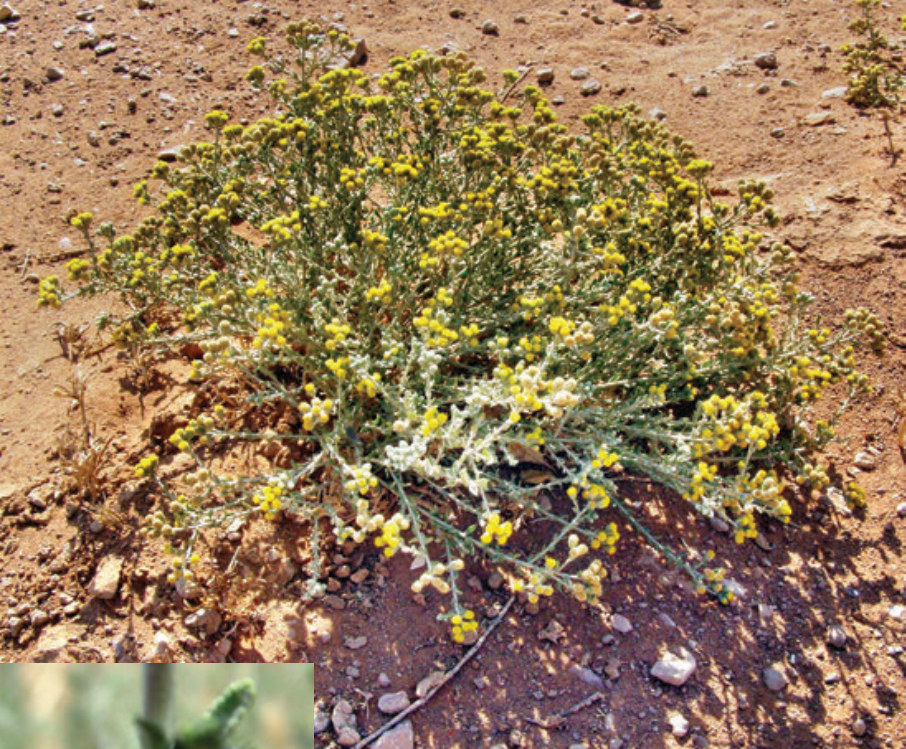
Plant name
aromatic yarrow
Latin name
Achillea fragrantissima (Forssk.) Sch
Common names
Fragrant yarrow, wild yarrow
foreign names
Eng. Lavender cotton, Fr. Santoline
The group
Star
Habitat and Geographic Distribution
Western Irani-Turanian, and Eastern Arab desert
Botanical description
100 cm - A small, fragrant, woody-base shrub with white stems.
Numerous, slender, rigid branches terminate in clusters of small, woolly heads, which are gathered into a racemose inflorescence.
The leaves are simple, small, oblong or ovate, undivided, somewhat thick, toothed, grayish-downy, becoming almost glabrous later.
The flower heads are disc-shaped, gathered into an ovoid, grayish-downy, grayish-closed racemose inflorescence.
The bracts are compound and oblong.
The perianthic florets are small and yellow, the central ones are tubular.
The fruit is an acinus, lacking spores. It is about 1/October long. Flowering begins in March.
Used part
flowering plant
chemical components
Its main components: The aerial parts contain volatile oil.
33% santolina alcohol, artemisia alcohol, terpinen-4-ol, 57% p-cymene, paracymene, thujone, p-phloroglucin, resorcin: the most important tannins.
3% flavonoids: cirsilol, swertisine, vicenine, myristic acid, palmitic acid, palmitic acid, lauric acid, various fatty acids, the most important of which is lauric acid, bitter substances, and many other minor compounds. The roots contain some of the aforementioned flavonoid compounds.
Properties and medical uses
The volatile oil of the flowering tops has antibacterial properties, particularly against Gram-negative Echerichia coli and Candida albicans fungi, and it also stimulates bile secretion.
Research indicates the effectiveness of the aqueous extract of the plant in inhibiting the growth of cancerous malignant cells (anti-tumor), and has demonstrated its properties in treating diabetes.
Yarrow is popularly used as a hot digestive beverage beneficial for treating gastrointestinal disorders and malabsorption (celiac disease), headaches resulting from digestive disturbances, some types of nervous headaches (nerve-calming), expelling worms, treating dysentery and chronic diarrhea, tonsillitis, and neuralgia (tinnitus).
A decoction of its aerial parts or its essential oil is used topically to treat neuritis, scalp diseases (alopecia), and to treat weak hair follicles through massage, opening and strengthening hair follicles.
It is also used to alleviate rheumatic pain, chronic arthritis, and gout, to stop bleeding, and to treat wounds, skin allergies, hemorrhoids, vernal conjunctivitis, and eye infections.
Yarrow is used in herbal baths to soothe nerves and give the body a pleasant aroma.
Phenols have anti-allergic, anti-inflammatory, anticancer, and antibacterial properties.
Its ethanolic extract is effective in wound healing.
Essential oils obtained from yarrow have shown, along with their nanoemulsions, to be effective against the mold mite Tyrophagus putrescentiae.
Suitable nanoemulsions containing these oils can be developed to eliminate this mite.
The phytochemicals present in the plant are beneficial in neurodegenerative diseases where neuroinflammation is part of the pathophysiology.
Precautions: Do not take yarrow before meals as it can upset the stomach.
Also, the herb is an emmenagogue (menstrual flow stimulant), so pregnant women should avoid using it.
Side effects and precautions
Allergic reactions or drug interactions may occur; self-use should be avoided by pregnant and breastfeeding women, children, and patients with chronic diseases.
the environment
It is widespread in the deserts of arid regions, the edges of small valleys and watercourses, preferring sandy, non-saline lands.
Agriculture and productivity
Similar to what was mentioned in the previous type. Achillea millefolium L
History and Heritage
The genus name is mentioned in the previous section, while the species name, *fragrantissima*, is Latin and means "fragrant." This genus has long been used in folk medicine to stop bleeding and treat wounds.
It was known in ancient times in the Far East, where it is mentioned on Confucius's tomb.
In India, it was used alongside rosemary in steam inhalation to treat fever. In Scotland, it is used to make an ointment for treating wounds.
Medical note
This information is for educational purposes only and does not constitute medical advice.
Poisonous or potent plants should only be used under the supervision of a qualified physician or pharmacist.
Related images


