Holy yarrow | A medicinal plant in the Akhdar encyclopedia
The essential oil possesses antibacterial properties against both Gram-positive and Gram-negative bacteria. Research in mice has demonstrated the anti-inflammatory activity of the essential oil, and the plant's antioxidant content has shown its ability to stimulate pancreatic function and lower blo…
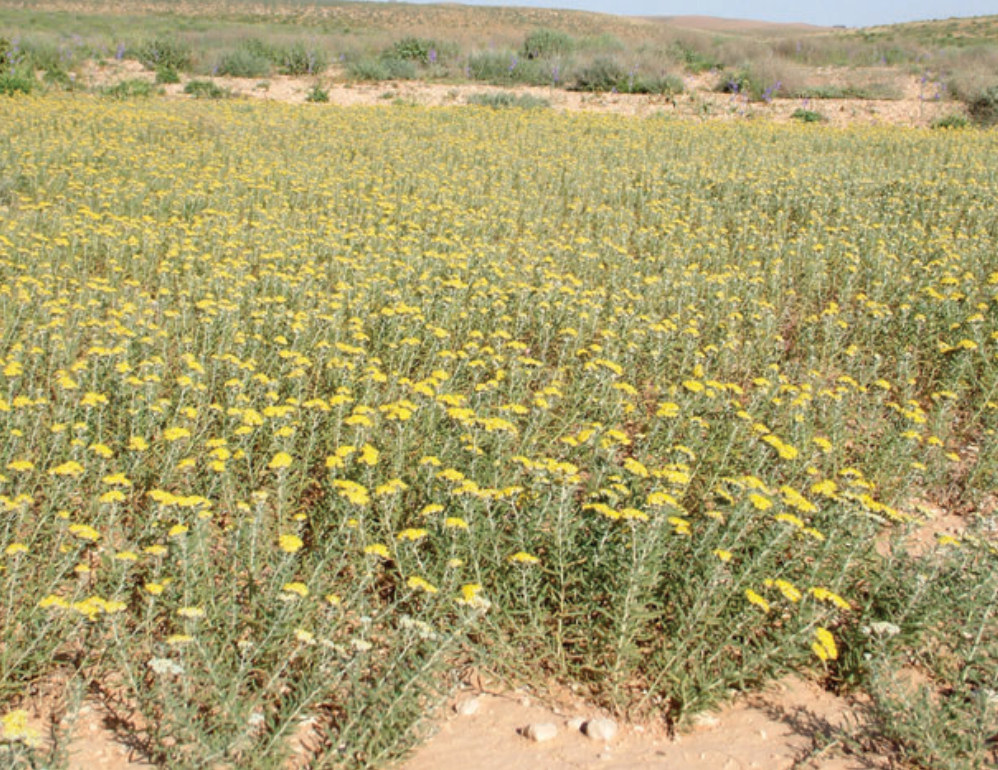
Plant name
Holy Qaysumah
Latin name
Achillea santolina L
Common names
The sacred wormwood, the two sacred perfumes
foreign names
Eng. Santoline-leaved sneezewort,Fr. Achillée santoline
The group
Star
Habitat and Geographic Distribution
Iranian-Turanian, and it is widespread in Syria, Lebanon, Palestine and Iraq
Botanical description
30 cm, covered with a perennial herb, its height covered with grayish-wool hairs.
The stems are erect to ascending, simple or branched, leafy, and the cymes are in the upper section below the flower heads.
The leaves are narrow, linear, green, deeply divided into very small segments arranged transversely: slender but not tightly packed (loose).
The lobes are rounded, each segment divided along a toothed, spiny margin.
The flower heads contain tubular and ligule flowers, clustered in semi-spherical to spherical clusters, with layered, woolly hairs.
The flowers are at the stem end in compound inflorescences.
The ligule bracts are yellow, trilobed, wider than they are long, and narrower than the bracts.
The fruit is a tightly compressed acinus: narrow at the base, broad, and truncated at the apex. It lacks pubescence. Flowering occurs from March to April.
Used part
The part used varies depending on the type and preparation; a reliable or competent reference should be consulted before use.
chemical components
The aerial parts contain a volatile oil whose main components are: terpineol, fragranyl acetate, fragranol, cineole, camphor, transcarveol, santolin, santolinol, valphenates, and crystalline compounds.
Properties and medical uses
The essential oil possesses antibacterial properties against both Gram-positive and Gram-negative bacteria.
Studies in mice have demonstrated the anti-inflammatory activity of the essential oil, and the plant's antioxidant content has shown its ability to stimulate pancreatic function and lower blood sugar levels.
A decoction of the plant is traditionally used as a general tonic, stimulant, expectorant, digestive aid, carminative, and vermifuge.
Side effects and precautions
Allergic reactions or drug interactions may occur; self-use should be avoided by pregnant and breastfeeding women, children, and patients with chronic diseases.
the environment
It spreads in dry areas and on petrified vertebrate orders.
Agriculture and productivity
The plant is propagated by seeds or by dividing the vegetative and root growth, but seed propagation is more economical.
Artemisia absinthium, Absinthium officinale Brot., Absinthium vulgare Lam., Artemisia pendula Salisb
History and Heritage
The genus name was mentioned previously, while the species name santolina is from Latin and means "sacred".
Medical note
This information is for educational purposes only and does not constitute medical advice.
Poisonous or potent plants should only be used under the supervision of a qualified physician or pharmacist.
Related images


