Centaury | A medicinal plant in the Akhdar encyclopedia
An important medicinal plant in many countries (Morocco and Algeria). It is used in traditional medicine to treat various ailments, including inflammation, thrombosis, pneumonia, and as a blood purifier and hypotensive. It is also used to treat other conditions such as diabetes, fever, rhinitis, st…
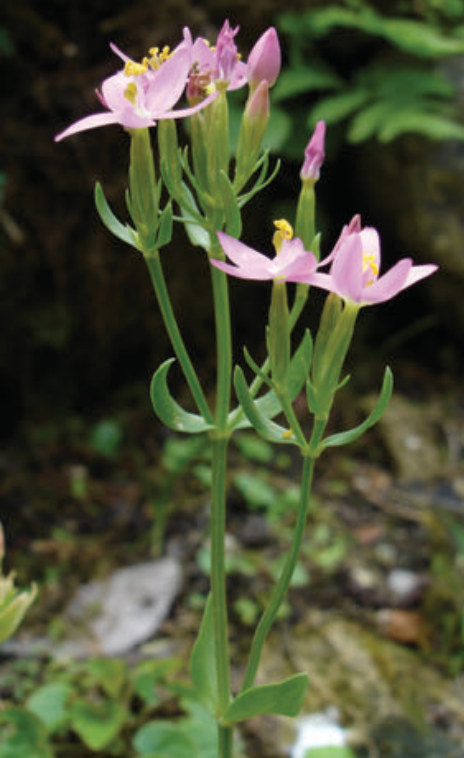
Plant name
Centaury
Latin name
Centaurium erythraea Rafn
Common names
Centaury, Little Centaury, Snake's Gall, Snake's Hog
foreign names
Eng. Centaury, Fr. Petite centaurée
The group
Gentian
Habitat and Geographic Distribution
Mediterranean, Iranian-Turanian
Botanical description
An annual or biennial herb (sometimes perennial), 1 cm tall.
The stems are erect, four-lobed, terminating in a comb-like inflorescence composed of clusters of dichotomous, closely packed, sessile inflorescences.
The leaves are simple, opposite, pedunculated, entire, auricular, ellipsoidal, rounded to subacute, with basal leaves emerging above the soil surface in rosettes, and stoichioids widely spaced.
The flowers are five-lobed, 1 mm long, approximately 7 - short pedicel.
The calyx is to the length of the corolla tube.
The corolla is funnel-shaped, pink, 2 mm long, with a bicornuate tube that becomes membranous after flowering.
The stamens are located on the upper part of the corolla tube, and the anthers are prominent and spirally twisted after opening.
The ovary is superior and twofold.
The carpels are thread-like and perennial. The stigmas are present. Flowering occurs from May to August.
Used part
The herbaceous plant (the aerial part of the plant).
Latin name: Centaurium erythraea Rafn, C. umbellatum Gilib., C. minus Moench, Erythraea centaurium Borkh
chemical components
Swertiamarin, swerosides, include: serosides, secoiridides, gentiopikrin, gentianine, gentianine alkaloids (such as gentianine), bellidifoline (such as bellidifoline), and xanthones (xanthones).
Properties and medical uses
An important medicinal plant in many countries (Morocco and Algeria), it is used in traditional medicine to treat various ailments.
It is used as an anti-inflammatory, anticoagulant, and for pneumonia, as a blood purifier, and to lower blood pressure.
It is also used to treat other conditions such as diabetes, fever, rhinitis, stomach ailments, urinary tract infections, indigestion, loss of appetite, hemorrhoids, and as a diuretic.
It is also used for various cardiovascular disorders, including hypertension.
The plant is used to increase saliva and digestive secretions, reduce fever, and treat indigestion and digestive disorders.
It is also used as a tonic and to treat kidney stones.
A decoction of the plant is applied topically to treat wounds.
The essential oils and extracts of the plant have demonstrated numerous biological properties, including antibacterial, antioxidant, antifungal, anti-leishmanic, anticancer, antidiabetic, anti-inflammatory, insecticidal, diuretic, digestive-protective, hepatoprotective, skin-protective, neuroprotective, and growth-inhibiting properties.
Larvae.
Plant extracts stimulate endothelial-dependent vasodilation and inhibit angiotensin II-induced fibroblast proliferation, which may explain the antihypertensive effects.
The plant is recommended for treating gastrointestinal disorders and reducing hypercholesterolemia.
It has the ability to inhibit acetylcholinesterase (AChE) and 3-hydroxy-3-methylglutaryl coenzyme A (HMGR). It reduces the free radical 2,2-diphenyl-1-picrylhydrazyl (DPPH).
Side effects and precautions
The plant should be avoided by those with stomach or intestinal ulcers, and its prolonged use should also be avoided.
Other uses
It is used in the formulation of cosmetic skin tightening products, and in hair coloring and dyeing.
the environment
The plant grows wild along roadsides, waterways, and neglected areas, on hard, stony soils. It tolerates alkaline soils and prefers shady locations.
Agriculture and productivity
Centaury plants are propagated by seeds, which are sown in early spring.
In warmer regions, they can be sown in autumn, as the plant flowers early.
Pelargonium odoratissimum (L.) L'Hér., Cortusina odoratissima (L.) Eckl. & Zeyh., Geraniospermum odoratissimum (L.) Kuntze, Geranium odoratissimum L
History and Heritage
It was mentioned by Ibn al-Baytar, al-Nattaki, Ibn Sina, and al-Ghassani.
Ibn Sina said, “Centaurea is called in Arabic ‘Lufa al-Saghir’ (small cornflower).
Centaurea is a plant praised since ancient times by ancient physicians to this day.
It is the herb of a thousand medicines, and it is the herb of fever.
It is also beneficial for the stomach, as it eliminates bloating and expels intestinal worms.”
Medical note
This information is for educational purposes only and does not constitute medical advice.
Poisonous or potent plants should only be used under the supervision of a qualified physician or pharmacist.
Related images


