Saltwort | A medicinal plant in the Akhdar encyclopedia
The plant is popularly used to treat diabetes (possibly due to its chromium content), and it also possesses carminative and antacid properties. In traditional Algerian medicine, it is used to treat thyroid disorders. The aqueous extract of the leaves of the plant has beneficial effects in lowering…
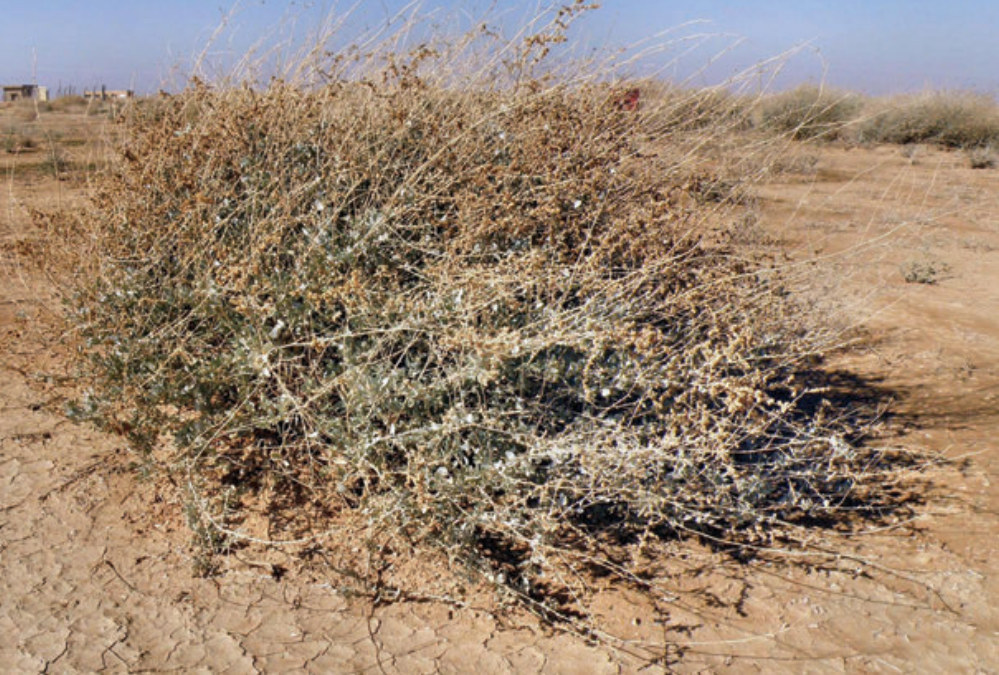
Plant name
salt harvesting
Latin name
Atriplex halimus L
Common names
Saltwort, saltbush, saltbush. time
foreign names
Eng. Saltwortal, Fr. Arroche mari
The group
The rooster's comb (Amaranthaceae, formerly Chenopodiaceae)
Habitat and Geographic Distribution
Arabic.
It grows naturally in the Mediterranean basin, the Mediterranean and Saharan regions of Central Africa, and the Atlantic part of Europe.
It is widespread in the Levant, the Arabian Peninsula, Kuwait, Cyprus, Libya, Tunisia, Morocco, Mauritania, Cyprus, and South Africa.
Botanical description
The stem is covered with vesicular hairs.
The stem is erect, highly branched, woody, cylindrical or angular, 1-2 lobes, 1 mm long, alternate (8 sub-opposite at the base), ovate to ovate, 40-4×60-10 mm, whitish.
The leaves are simple, petiolate, whitish, rhomboid to triangular, pedicel or sagittal, entire, wavy, or toothed margin, silvery, with prominent veins; the upper leaves are narrow and uterine.
The flowers are unisexual, clustered in dense, membranous inflorescences at the apex.
The terminal spikes bear leaves.
The male flowers are inconspicuous, their number is small.
The female flowers are at the base of the inflorescence and are sparse, but possess two leathery bracts called "spigots." The fruit is a sac-like apricot, its fruiting sac being free and membranous.
The flower stalk is rounded or nearly rounded, or 5 mm in diameter.
The lobes are 5-reninous, with a short pedicel base, complete or toothed edges, a smooth or reticulated surface, and a length and width of about 5 mm.
They are columnar, lenticular, dark brown, and rounded.
The lobes are free-spining.
The flowers bloom from April to October.
It grows naturally in western Asia and is widespread in northeastern Africa.
A.
hortense is one of its species, including *A. hortense*, and is also found in Europe.
Used part
plant
chemical components
The plant contains many nutrients (proteins, vitamins, and minerals, most importantly chromium). The plant does not contain any toxic compounds. A-C
Properties and medical uses
The plant is popularly used to treat diabetes (possibly due to its chromium content), and it also possesses carminative and antacid properties.
In traditional Algerian medicine, it is used to treat thyroid disorders.
The aqueous extract of the leaves of the plant has beneficial effects in lowering high blood sugar levels. It may be a good candidate for anticancer properties.
Side effects and precautions
It should not be consumed by children, breastfeeding women, or patients with kidney or liver disease.
Other uses
The tender shoots and leaves are used raw in salads due to their salty flavor, or cooked like spinach leaves, retaining their distinctive salty taste when simmered gently.
The seeds can be roasted, mixed with honey, and used in some soups or blended with grains to make bread.
A red dye, similar to henna, is extracted from the plant's leaves and used to dye hands and feet. The plant's ash is used as an alkali in soap making.
the environment
Although it grows well in non-saline environments, it lives in the Halophyte, a group of arid, salt-tolerant plants.
It is suitable for areas with gradually increasing winter temperatures, ranging from cold to warm, and tolerates low temperatures in well-drained sandy and loamy soils.
It can grow in loamy soils.
It is found in open, sunny, and unshaded areas on saline sandy plateaus.
It resists wind and shifting sands and is used to stabilize shifting sands.
It is an important shrub that can be used in land reclamation and rehabilitation programs for arid and semi-arid saline lands. The leaves retain their salty taste even when grown in slightly saline soils.
Agriculture and productivity
This plant is easy to germinate and propagates by seed.
It is best to remove the fruit coverings or soak them in water for 36 hours. It will then germinate.
History and Heritage
The Arabs have long recognized the pastoral value of saltbush and considered it the best grazing land for camels, goats, and sheep.
However, increased drought reduces its palatability for sheep due to its high salt and oxalate content.
Ibn al-Baytar mentioned that its seeds are beneficial for treating jaundice and tumors.
Medical note
This information is for educational purposes only and does not constitute medical advice.
Poisonous or potent plants should only be used under the supervision of a qualified physician or pharmacist.
Related images


