Small squill | Medicinal plant in the Akhdar Encyclopedia
The alkaloid vincamine has blood pressure-lowering properties, negatively affects cardiac chronometry, is an antispasmodic, hypoglycemic, sympathomimetic, and counteracts the effects of sympathomimetic drugs. It is used to treat circulatory disorders…
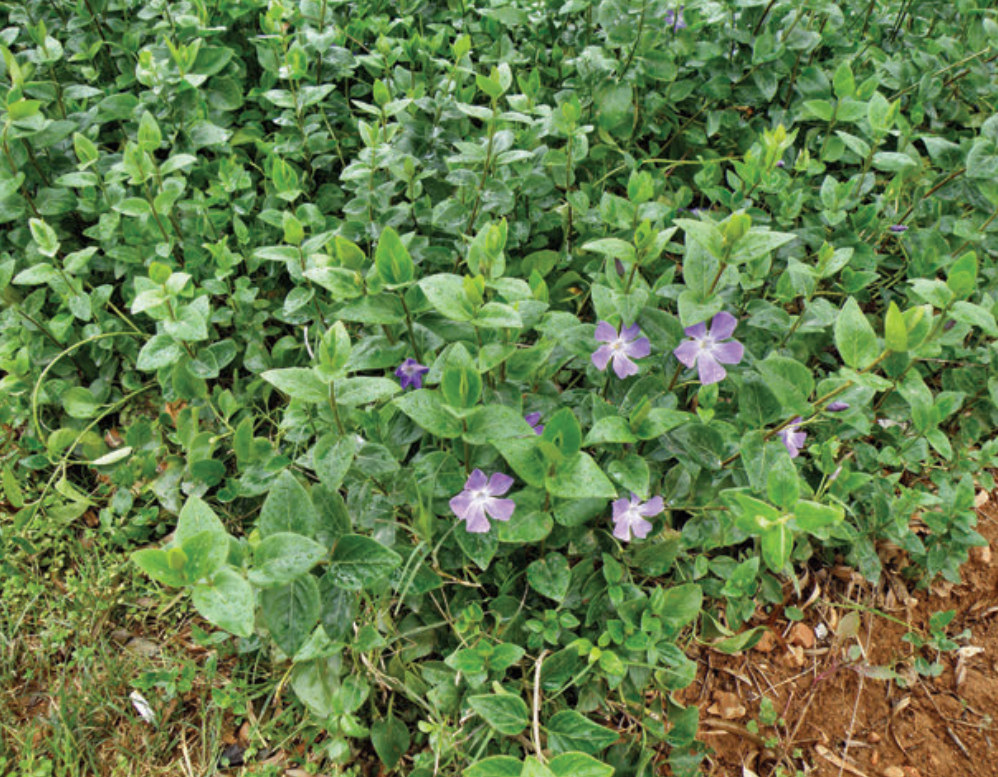
Plant name
small rods
Latin name
Vinca minor L
Common names
The small rod, the small vine
foreign names
Eng. Lesser periwinkle, Fr. Petite Pervenche
The group
The Apocrypha
Habitat and Geographic Distribution
Wild species of this genus are found in various regions of the Mediterranean basin and Central Europe, and are cultivated in many countries such as the United States, Russia, Germany, Switzerland, and France.
Botanical description
The milk thistle, a perennial herb, grows to a height of [insert height here] and spreads in colonies.
It secretes a colorless sap.
The leaves are simple, glossy, opposite, short-stemmed, entire, oblong, ovate, or ellipsoidal, pedicel-based, and fringed, measuring [insert dimensions here] cm.
The flowers are solitary, axillary, 0.5-2.5 x 4.5 cm, and five-lobed.
The calyx is [insert length here] mm long, with five lobes, pointed.
The flowers are small, blue, funnel-shaped, and the tube is cylindrical.
The corolla is lilac, with a five-lobed aperture.
The lobes are flat, obovate, and lobed, with a pointed apex.
The stamens are located slightly below and in the middle of the tube.
The female reproductive organs are dioecious, 2.5-3 cm obliquely arranged, overlapping on the left, with a diameter of [insert diameter here].
The fruit is a follicle and erect. The seeds are numerous and barren. Flowering occurs in spring and summer.
Used part
Dried leaves, tender flowering plant. Latin name: Vinca minor L.
chemical components
Apovincamine (vincine), the most important component of which is vincamine (0.15-1.4%), is an indole alkaloid. It contains flavonoids.
Properties and medical uses
The alkaloid vincamine has blood pressure-lowering properties and also negatively affects cardiac chronometry.
It is an antispasmodic, hypoglycemic, sympathomimetic, and antagonistic to the action of sympathomimetic drugs.
It is used to treat circulatory disorders (especially cerebral circulatory problems), memory loss, hypertension, cystitis, and gastroenteritis.
Externally, it is used to treat nosebleeds, sore throats, eczema, and abscesses.
And bleeding.
Fenbastine alkaloid, a chemotherapy drug usually derived from vincamine alkaloid, is used with other drugs to treat many types of cancer, including Hodgkin lymphoma, non-small cell lung cancer, bladder cancer, brain cancer, skin cancer, and breast cancer.
It is administered intravenously.
All plant extracts had a better inhibitory effect against S.
aureus compared to Escherichia coli.
E.
coli was inhibited by all extracts in a dose-dependent manner. Precautions: Ingestion of excessive doses of the plant causes poisoning.
Side effects and precautions
Allergic reactions or drug interactions may occur; self-use should be avoided by pregnant and breastfeeding women, children, and patients with chronic diseases.
the environment
The plant is widespread in areas of the Mediterranean basin, Latin America and North America.
The United States of America is the leading producer of periwinkle, followed by Germany, Russia, France and Switzerland.
Some of its varieties are also found in Syria in the Jabal al-Arab and Hauran regions and the western countryside of Damascus, and are grown for ornamental purposes in homes and public gardens.
The plant tolerates both high and low temperatures, but prefers a temperate climate that allows for high levels of vegetative growth and active ingredient production.
Longer and more intense photoperiods increase vegetative growth and the amount of active ingredient in the plant.
The plant thrives in most agricultural soils, but light, well-drained, and aerated soils are best.
Calcium in the soil enhances vegetative growth and increases the amount of active ingredient.
Agriculture and productivity
It is propagated by seeds, stem cuttings, or root cuttings.
Seeds are sown in early spring and transplanted to the permanent field after two months.
Planting is done in rows with a spacing of 80 cm between rows and 70 cm between seedlings or cuttings within the same row.
It is irrigated immediately after planting.
Planting can also be done in basins or beds.
Plant care consists of moderate irrigation during the growing season, nitrogen and phosphate fertilization in particular, and control of the numerous fungi and viruses that affect it.
The vegetative parts are cut before flowering in two stages: the first in summer and the second in autumn, and dried in the shade or in dryers with a temperature not exceeding 45°C.
Yields per hectare reach 2.5-3 tons of dried grass and 1.5-2 tons of dried roots.
(Hedera helix L., Hedera poetica Salisb., Hedera helix var.
arborescens Lodd.) ex Loudon., Hedera helix f.
poetarum (Nicotra).
McAll.
& A.Rutherf., Hedera communis Grey., Hedera helix var. vulgaris DC., Hedera helix f. helix
History and Heritage
It means minor, and the descriptive toxin for the species V. herbacea is the scientific toxin of the genus as stated in the species.
Medical note
This information is for educational purposes only and does not constitute medical advice.
Poisonous or potent plants should only be used under the supervision of a qualified physician or pharmacist.
Related images


