Yellow safflower | A medicinal plant in the Akhdar encyclopedia
The Persian safflower (C. persicus) is similar in its uses to cultivated safflower or false saffron (C. tinctoria). Safflower seed oil is used to prevent arteriosclerosis, lower blood pressure, improve blood circulation, and reduce the formation of blood clots. The plant is also used traditionally…
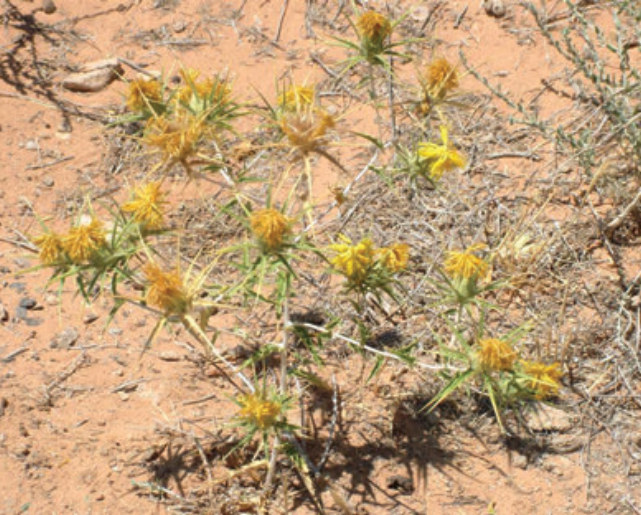
Plant name
yellow safflower
Latin name
Carthamus persicus Willd.
Common names
Yellow safflower, amber
foreign names
Eng. Wild safflower, Fr. Carthame de Perse
The group
Star
Habitat and Geographic Distribution
Western Irano-Turanian region, it grows wild in Iran, Syria, Palestine, Lebanon, northern Iraq, and Turkey.
Other species include: Carthamus lanatus (also known as Carthamus tinctorius L.), a medicinal plant native to the western Mediterranean; Carthamus caeruleus (also known as Carthamus tinctorius L.), a Mediterranean-widespread plant; Carthamus flavescens (also known as Carthamus tinctorius L.), a yellow-flowered plant found in the Levant; and Carthamus persicus (also known as Carthamus tinctorius L.), found in Syria, Iraq, Turkey, and Iran.
Safflower is also cultivated in the United States and Europe for its flowers, used to color food, and its seeds, which yield an edible oil.
Botanical description
50 cm - A perennial herb, almost hairless in length.
The stem is white, rigid, and branched in a raceme-like pattern.
The leaves are simple, alternate, and uterine, possessing some small, yellow spines along the margin.
The basal leaves emerge in a rosette, are petiolate, and wither at flowering.
The stem leaves are thin and almost attached to the stem.
The flower heads are uniformly flowered, racemally branched, and surrounded by a double bract.
The outer bract is approximately the length of the flowers; its bracts are uterine, toothed, and spiny, resembling the stem leaves in shape.
The inner bract is broadly ovate, 1 cm in diameter; its bracts are uterine, complete, and 2.5 cm long, ending in a spine: weak, shorter than the outer ones, straw-like, and almost slender at the base.
The receptacle is semi-mimetic and covered with hair-like scales.
The flowers are all tubular, uniform, and yellow.
The fruit is an acinus, smooth, four-sided, umbel-shaped, with an inverted apex and a toothed ring.
The stump is lateral, and the marginal fruits are hairless.
The hairs of the Acinus dalkhus are perennial, with purplish-red, pinnate hairs.
They grow in more than one row and are about one and a half times longer than the acinus itself. Flowering occurs from April to May.
Used part
The seeds and the oil extracted from them, the flower buds (collected in the morning and dried in the shade, because sunlight breaks down the pigment they contain).
chemical components
The seeds of both species contain a fatty oil rich in fatty acids such as oleic acid, linoleic acid (55-88%), and linolenic acid.
The flower fragments contain flavonoid compounds such as carthamidin (tetrahydroxyflavonone), carotenoids, glycosides, the red pigment carthamin, and the flavonoid carthamunone (orange-red).
The flower fragments also contain protein, crude fiber, and ash.
It also contains alkaloids, lignanoids, organic acids, polyacetylenes, riboflavin, steroids, and quinochalcone C-glycosides.
Other quinochalcone components isolated from aqueous extracts of the flower petals include cartormin, safflomin B, safflomin C, isosafflomin C, precarthamine, safflor yellow A and B, tinctormin, and flavonoids (azaleatin, saffloroside, and cinaroside).
The aqueous extract of the flowers also contains isocartormin.
Isocartormin, a semiquinone chalcone C-glycoside, is an isomer of cartormin.
There is a relationship between the content of active ingredients and the intensity of flower color.
The most colorful flowers (bright red, light yellow, or bright orange) were characterized by higher content of anhydrosafflor B, kaempferol, quercetin, and safflomin C compared to less colorful flowers.
Studies have shown the presence of 20 to 92 compounds in safflower essential oil.
Hydrodistillation of safflower petals yields a pale yellow oil (0.175% v/w).
Twenty compounds, representing 99.81% of the oil, were identified, the most important being undecanoic acid, octane, heptacosane, nonanoic acid, tetradecanoic acid, and tetrahydro-1-naphtol.
Properties and medical uses
Safflower (C.
persicus) is similar in its uses to cultivated safflower or false saffron (C.
tinctoria).
Safflower seed oil is used to prevent arteriosclerosis, to lower blood pressure, to improve blood circulation, and to reduce the formation of blood clots.
The plant is traditionally used to treat high cholesterol (LDL), and a decoction of the seeds is used for its laxative properties to treat constipation, as well as wounds, vitiligo, melasma, and itching.
Safflower flowers are used as an emmenagogue, abortifacient, expectorant, and anti-inflammatory for lung infections.
They are also used to treat internal and external wounds.
Consuming safflower oil aids in weight loss, maintaining and regenerating muscle mass, and has an antioxidant effect.
pharmaceutical forms
Safflower is available in tea, infusions, preserves, and liquids, sold under names such as Safflower oil and Saffron.
Pharmacological Interactions and Precautions: Safflower should not be taken with medications that may affect the immune system, such as Prograf and Imuram.
The flowers, oil, and seeds should not be used by pregnant or breastfeeding women.
It should be used with caution in cases of burns, blood infections, organ transplants, or any other condition that suppresses the immune system. No vaccinations should be received while taking safflower.
Side effects and precautions
Safflower should not be taken with medications that may affect the immune system, such as Prograf and Imuram. It should not be used
Other uses
Two dyes are extracted from safflower flowers: one red (carthamon), which is soluble in bases, and the other yellow (carthamin), which is soluble in water.
The red dye is used to make lipstick and blush, and safflower dye is also used to dye cotton and silk fabrics.
A fatty oil suitable for food use is extracted from the seeds.
Safflower flowers are known for their many culinary uses (flavoring and coloring).
The colors of crushed safflower fragments are similar to those of saffron stigmas, making them easy to adulterate due to the significant price difference between the two.
the environment
Safflower is a plant of sunny, hot, and dry regions, characterized by its high resistance to drought and hot weather.
Its seedlings tolerate temperatures as low as 6°C, and its moisture requirements are very low.
However, seeds may rot in the inflorescence, and fertilization is impaired in conditions of high humidity.
It thrives in various soil types except for waterlogged soils.
It tolerates poor soils and salinity but produces high yields in permeable, fertile, or fertilized soils.
Agriculture and productivity
The plant is propagated by seeds.
Organic and mineral fertilizers are added to the soil, which is then prepared by digging to a depth of 30 cm, leveling, and smoothing it.
The seeds are sown by broadcasting behind the plow or in furrows with a spacing of 50-60 cm between the furrows and 20-25 cm between the furrows.
Alternatively, the method of sowing can be followed by planting in square furrows at a distance of 45 cm, placing several seeds in each furrow.
Sowing takes place in winter.
Thinning and replanting operations are carried out two weeks after germination, especially in irrigated agriculture.
Maintenance practices such as fertilization, irrigation, and weeding continue.
The petals are collected in the morning and spread out in the shade to dry.
The plants are uprooted and the seeds collected in late summer.
One hectare yields 30-70 kg of squills and 750-1500 kg of seeds. Centaurea cyanus L., Centaurea segetalis Salisb., Cyanus segetum Hill
History and Heritage
The year 2009 is the year of the discovery of the plant.
The scientific name for the genus, Karthum or Karthom, is believed to be of Aramaic origin.
It was adopted when one of its species was introduced to Europe in the 6th century and cultivated to extract a red dye used for coloring silk and making blush.
The name refers to its original habitat in Iran. Persicus means "dyer," and the species name is Tinctorius.
Medical note
This information is for educational purposes only and does not constitute medical advice.
Poisonous or potent plants should only be used under the supervision of a qualified physician or pharmacist.