Fashagh | A medicinal plant in the Akhdar encyclopedia
Steroidal saponins are responsible for the mild skin irritant and the diuretic and diaphoretic effects at high doses, in addition to its general emulsifying and foam-stabilizing effect. Preparations of the roots are used traditionally as a diuretic, diaphoretic, and for treating kidney ailments, as…
Plant name
The falshagh
Latin name
Smilax aspera L
Common names
Fashagh, gooseberry, Sabreen, wolfberry, Amsh Q, Bator, Qambatour
foreign names
Eng. Rough bindweed, Fr. Salsapareille
The group
Solanaceae (nightshade family)
Habitat and Geographic Distribution
Mediterranean.
It is found in the countries of the Mediterranean basin and the Anatolian plateau, extending to China, Pakistan, India, Sri Lanka, Nepal, Myanmar, and southern equatorial Africa.
Botanical description
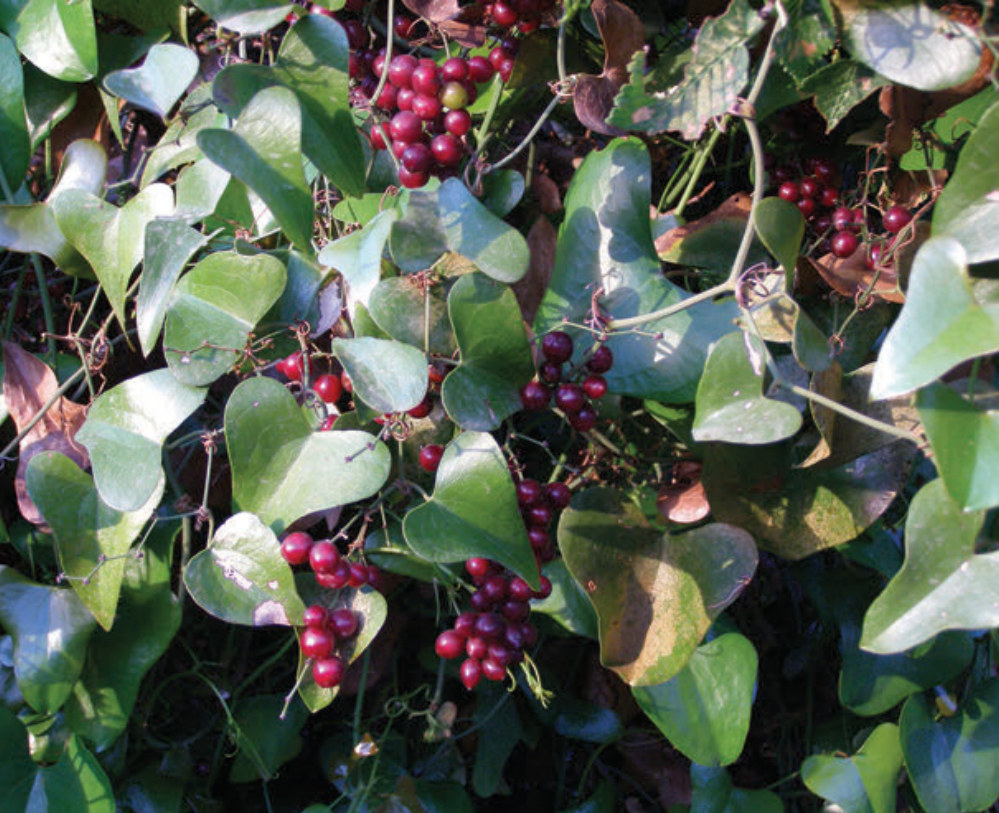
M, barren, with a thick rhizome.
The stem is perennial, slender, zigzagging, angular, climbing.
15 - A climbing shrub, reaching length on trees and shrubs or twining against walls, bearing hooked thorns and rarely lacking thorns.
The leaves are triangular, pointed at the apex, bearing no thorns at all or bearing a few scattered thorns on the - permanent, leathery, lanceolate or heart-shaped margins and sometimes along the midrib on the underside.
The flowers are unisexual, the spathe is simple, cream-colored, mm, red.
10 - mm.
The fruit is a berry 3.5 mm long. The length of the female flowers is 5 mm. Flowering is from October to January.
Used part
rhizomes
chemical components
Desglucoparillin, as a freed parillin product with sarsaparilloside: the main components are 0.5-3% steroidal saponins. (sarsapogenin, desglucoparillin)
Properties and medical uses
The steroidal saponins are responsible for the mild skin irritant and the diuretic and diaphoretic effects at high doses, in addition to its general emulsifying and foam-stabilizing effect.
Preparations of the roots are used traditionally as a diuretic, diaphoretic, and for treating kidney ailments, as well as for antiseptic, stimulant, and general body cleanser.
A decoction of the roots is used topically to treat rheumatic diseases and some skin conditions such as psoriasis.
It also has antioxidant activity.
A red dye can be obtained from the mature tendrils.
The juice of the mature fruits is applied to the skin to treat scabies.
Precautions for use: No adverse health events have been reported with proper dosage administration.
In rare cases, gastrointestinal complaints and nausea may occur, and kidney irritation may develop.
Side effects and precautions
No adverse health effects have been reported with proper dosage administration.
In rare cases, gastrointestinal complaints and nausea may occur, and kidney irritation may develop.
the environment
The plant grows in forests and scrubland, on riverbanks, borders, and hedgerows in semi-arid, semi-humid, and humid bioclimatic zones with fresh, temperate, and warm waters.
It tolerates frost but is sensitive to sunlight.
It thrives in various soil types with temperatures up to 40°C, high in the sun, and high summer temperatures exceeding certain acidity levels.
It prefers light (sandy), medium, and humid soil types and is sensitive to salinity.
Agriculture and productivity
The plant is propagated by rhizome division, semi-woody cuttings, and rarely by seeds, which require special care and are very slow to germinate.
Rhizomes or cuttings are rooted in special containers or pots with light shade, then transplanted to their permanent location after rooting.
If the plant is grown for seed production, care must be taken to plant separate male and female plants, as it is dioecious.
It is best to plant the plant in a dense, difficult-to-penetrate hedge.
Atropa bella-donna L.
Atropa lethalis Salisb., Boberella belladonna (L.) E.H.L.
Krause., Atropa caucasica Kreyer., Atropa acuminata Royle ex Lind., Atropa borealis Kreyer ex Pascher., At ropa mediterranea Kreyer ex Pascher
History and Heritage
The scientific name of the genus Smilax is derived from Greek mythology, where it was given to a young girl who died of love for her young lover Crocus and was transformed into this plant.
The species adjective aspera means "crude," referring to the appearance of the stem.
Medical note
This information is for educational purposes only and does not constitute medical advice.
Poisonous or potent plants should only be used under the supervision of a qualified physician or pharmacist.
Related images


