Pistacia legasis | Medicinal plant in the Akhdar Encyclopedia
Mastic has been used in traditional medicine since ancient times. In the Levant, it was chewed to freshen breath, treat indigestion and intestinal spasms, address liver ailments, strengthen gums, maintain white teeth, stop bleeding, and alleviate rheumatic pains, gout, and neuralgia. Mastic prepara…
Plant name
The Legacy Bats
Latin name
Pistacia lentiscus L
Common names
Pistacia legasis, Pistacia alba, Pistacia lentiscus, Mastic, Roman mastic: Radhu, Pistacia
foreign names
Eng. lentisk, Fr. pistachio tree lentisk
The group
heart
Habitat and Geographic Distribution
Countries around the Mediterranean: The Mediterranean Sea, from the Canary Islands and Portugal to the Middle East and reaching as far west as the Mediterranean, in the forests of the temperate coastal regions of Syria, Cyprus, Greece, and China. It is found at altitudes not exceeding [amount missing].
Botanical description
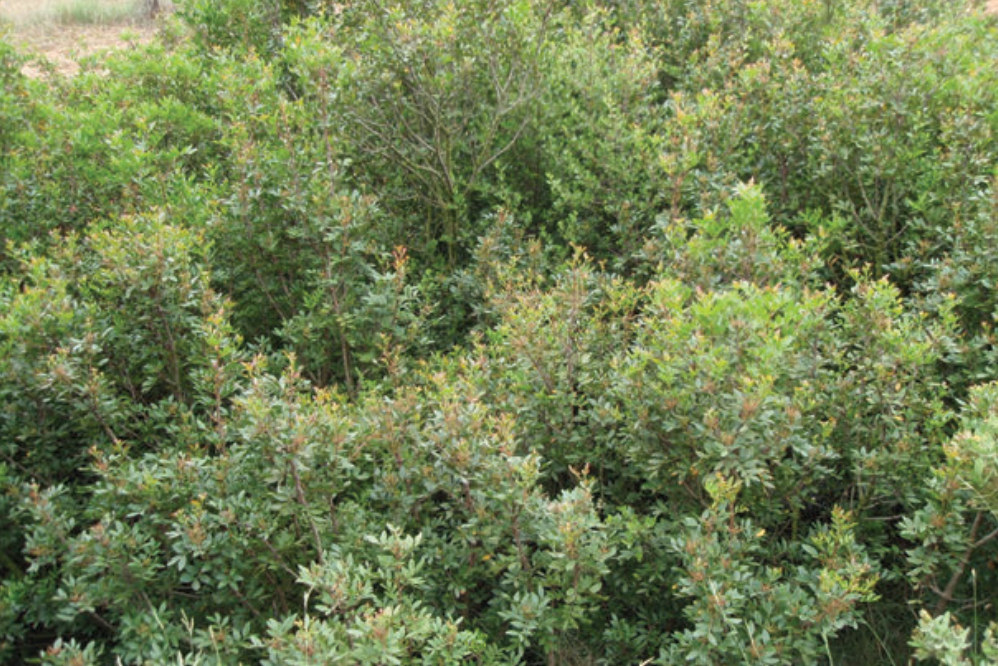
Evergreen shrubs (rarely trees), 10-10 m tall, perennial, compound pinnate.
Leaves: 3 pairs of leaflets, 4 pairs, comprising 0.5-1.5 × 3-1.5 cm.
The compound leaf is pinnate.
Leaflet: 1 cm, leathery, ovate to oblong or ellipsoid, rounded apex, lanceolate, glabrous.
Flowers: unisexual.
Male inflorescences: subspis and compact.
Female inflorescences: axillary, clustered in bundles of subspis inflorescences.
Male flowers: 4 - stamens and pistil 5 - spur containing 1 mm, style spur.
1.5 - vestigial.
Female flowers: slender, spadix length about.
Stigmas: 3 mm, reddish-black when mature, reticulated surface. Above: 4 - Fruit: drupe, nearly spherical, diameter. Flowering: March to April
Used part
The resin gum, or mastic, is found in the leaves and fruits of the tree.
Mastic is a resinous exudate that can be produced spontaneously or artificially by removing strips of bark or by making long incisions in the trunk and large branches.
A yellow, liquid resinous sap flows from these incisions, some of which remains attached to the tree as fragile, oval or elongated teardrop-shaped drops, while the rest falls to the ground.
Mastic is harvested three times a year.
The first harvest is whitish and considered the finest quality. The second harvest is bright yellow, and the final harvest is grayish.
chemical components
Mastic consists of a mixture of resin, volatile oil, and bitter substances.
The resin includes tirucallol, oleanolic acid, isomastic acid, and triterpenes.
Its most important components are: alpha-, beta-, caryophyllene, myrcene, and alpha-, beta-, and beta-pinene.
Its most important components are: alpha-, linalool, cardinene, cardinene, terpinene, and beta-caryophyllene.
The leaves contain flavonoid compounds, tannins, and volatile oil. The fruits contain fatty oil.
Properties and medical uses
Mastic has been used in traditional medicine since ancient times.
In the Levant, it was chewed to freshen breath, treat indigestion and intestinal spasms, address liver ailments, strengthen gums, maintain teeth whiteness, stop bleeding, and treat rheumatic pains, gout, and neuralgia.
Mastic extracts are used internally to treat sinusitis, bronchitis, and urinary tract infections.
Mastic, containing bitter substances and volatile oil, possesses digestive properties, protects against stomach and intestinal ulcers caused by Helicobacter pylori, and acts as an astringent, helping to reduce diarrhea and vaginal discharge.
Mastic extracts are used topically as chewing gum to clean and freshen the mouth, treat gingivitis, wounds, hemorrhoids, blood congestion and stasis, varicose veins, and alleviate rheumatic and joint pain.
A decoction of the leaves is traditionally used to treat stomach ulcers, and the oil of the fruit is used to treat digestive disorders and constipation.
Side effects and precautions
Allergic reactions or drug interactions may occur; self-use should be avoided by pregnant and breastfeeding women, children, and patients with chronic diseases.
Other uses
Mastic is considered one of the finest and most expensive resins.
It is currently used to flavor many types of sweets and syrups, and is also used in the manufacture of incense, perfumes, cosmetics, and dental adhesives.
A fatty oil is extracted from the fruit and used in the production of high-quality soaps and some cosmetic preparations.
the environment
The terebinth tree thrives in semi-arid, semi-humid, and humid hot and temperate bioclimatic zones, and is somewhat arid.
In the Mediterranean climate zone, it does not tolerate frost.
It grows on various soil types (clay, marl, sandy, calcareous), preferring clay soils, and it is resistant to salty sea winds and sea spray.
Agriculture and productivity
The plant is propagated by seeds and cuttings.
Cuttings are produced in a nursery and then transplanted to their permanent location, planted in holes approximately 35 cm deep and 2 m apart.
The cuttings are irrigated during the summer months of the first year.
(Pistacia vera L., Pistacia nigricans Crantz., Pistacia variifolia Salisb., Pistacia macrophylla Pers., Len tiscus vera L. (Kuntze
History and Heritage
The word "terebinth" originates from the Akkadian language, dating back to the second millennium BC.
The Babylonians used it to name these trees.
The descriptive name for the species, *lentiscus*, is the ancient Greek name for this type.
*Pistacia lentiscus* is a representative of a very ancient flora, with roots extending back to the Tertiary period.
In the past, a resinous substance called mastic was extracted from it to make a gum known as "shio gum." The ancient Egyptians used it to whiten teeth.
Ibn Sina mentioned it as "al-dharw," a fragrant substance used in women's perfumes in Aleppo.
Its concentrated watery properties were used to increase saliva production and to treat oral ulcers.
Ibn al-Baytar described it, saying that the toothpicks made from *al-dharw* are fragrant, and its gum is useful in perfumery.
The oil from its seeds is an expectorant for phlegm.
The parts used are the resinous gum (mastic), leaves, and fruit.
Mastic is a resinous secretion that can be produced spontaneously or artificially by removing strips of bark or by making long incisions in the tree trunk and large branches.
A yellow, liquid resinous sap flows from these incisions, some of which remains attached to the tree as fragile, oval or elongated teardrops, while the rest falls to the ground.
Mastic is harvested three times a year.
The first harvest is whitish and is considered the finest quality mastic. The second harvest is bright yellow, and the final harvest is grayish.
Medical note
This information is for educational purposes only and does not constitute medical advice.
Poisonous or potent plants should only be used under the supervision of a qualified physician or pharmacist.
Related images


