Pistachio | A medicinal plant in the Akhdar encyclopedia
Pistachios help lower LDL (bad) cholesterol levels in the blood and protect against cardiovascular disease, as well as significantly reducing inflammation. Fresh or roasted pistachio kernels have been used as food for a long time. Various parts of the pistachio tree have been used in traditional me…
Plant name
pistachios
Latin name
Pistacia vera L
Common names
pistachios
foreign names
Eng. Aleppo pistachio, Fr. Aleppo pistachio
The group
heart
Habitat and Geographic Distribution
The pistachio originated in Central Asia, and its distribution extends from the Mediterranean basin to Central Asia.
It grows wild in Iran, Afghanistan, Uzbekistan, and Iraq.
Commercial varieties have been cultivated in many parts of Southern Europe, the Levant, and the Caspian region.
It is now also grown in California and some Mediterranean countries, such as Greece and Italy.
The most important pistachio-producing countries are Iran, the United States, and Turkey.
Botanical description
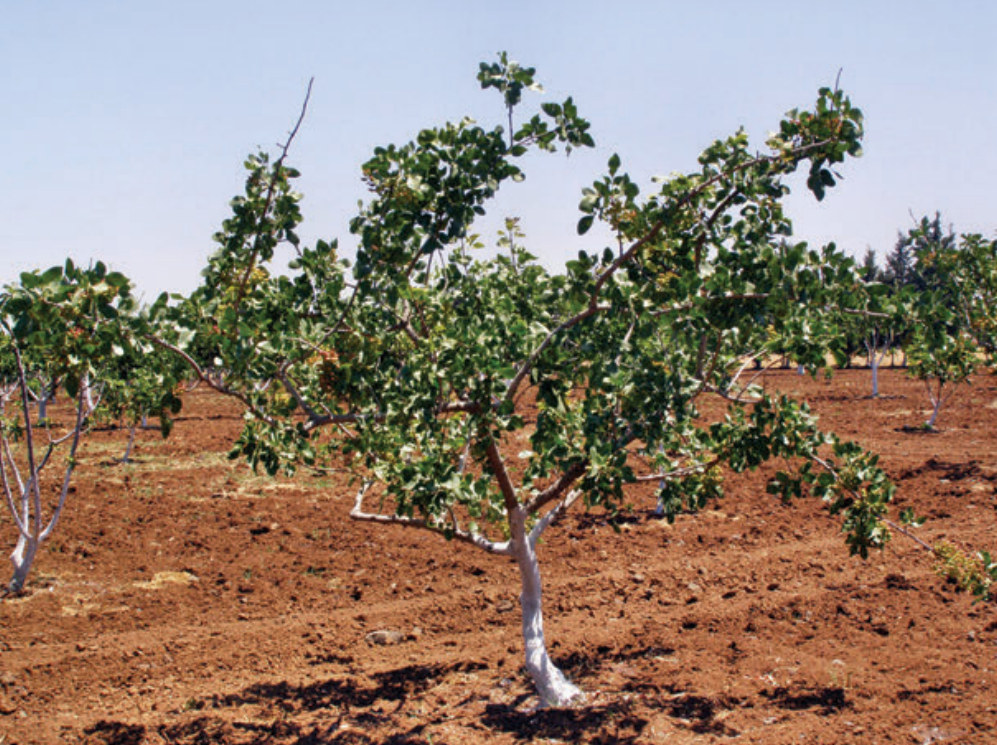
A small, deciduous, dioecious tree, usually with a gray, lenticular stem.
The stem is 6 cm long and stiff.
The leaves are pinnately compound, consisting of one or two pairs of leaflets in female trees.
The leaflet is ovate, rounded at the apex, initially hairy, then becoming glabrous and leathery.
The leaves of male trees are smaller and have fewer leaflets.
The flowers are unisexual, with the male flowers often appearing about a week before the female and clustered in inflorescences.
The calyx has stamens with sepals.
The corolla is absent.
The male flowers are basal, free at the top, and fused at their bases with sepals.
The style is basal.
The female flowers are clustered in racemes and are smaller than the male flowers.
The calyx consists of a stamen.
The male flowers are oblong, ending in a third stigma, and the ovary is inferior.
The fruit is a drupe, approximately [length missing in original text].
This includes a group of agricultural varieties that differ from each other primarily in fruit characteristics (size, cracking, color, winter chilling requirements, and accumulated heat necessary for fruit ripening). Flowering occurs in March.
Used part
The part used varies depending on the type and preparation; a reliable or competent reference should be consulted before use.
chemical components
Pistachios contain antioxidant compounds, proteins, starch, oils, cellulose fibers, and minerals such as phosphorus, potassium, and sodium.
They are also rich in vitamins A and B.
The leaves and fruits contain monoterpene hydrocarbon compounds, alpha-pinene, limonene, alpha-terpinolene, and osmin.
The oil resin contains monoterpene compounds with antibacterial properties, the most important of which are camphene, limonene, and carvacrol.
It also contains diterpene compounds such as abietadiene and abietatriene.
The seeds (the edible part) contain phenolic compounds.
The most important components are gallic acid, catechin, epicatechin, gallic acid methyl ester, and phenolic lipids, the most important of which are cardanol compounds and flavonoid compounds (quercetin and rutinoside).
It should be noted that the flavonoid content decreases during fruit ripening.
The seeds contain a fixed oil at a rate of 50-60% of their dry weight, characterized by its richness in unsaturated fatty acids (73%) (the most important of which are oleic acid and linoleic acid), as well as other fatty acids, the most important of which is linolenic acid.
Palmitic, palmitolic, myristic, eicosanic, behenic, lignoseric, arachidonic, and margaric acids.
The most abundant sterols in the fruit are beta-sitosterol, cafestol, avenacerol, stigmasterol, prasecasterol, and cholesterol.
Monoterpenes, diterpenes, and triterpenes found in the resin are the most abundant essential oil from various parts, and these compounds are associated with anti-inflammatory and antimicrobial effects.
From the fruit, [the following is extracted/contain...
The compounds naringenin, eriodyctyol, daizein, genistein, quercetin, kaempferol, apigenin, and luteolin were isolated.
The fruits also contain the anthocyanin pigments cyanidin-3-O-glucoside, cyanidin-3-galactoside, and quercetin-3-O-rutinoside, the most important of which are...
Properties and medical uses
Pistachios help lower LDL (bad) cholesterol levels in the blood and protect against cardiovascular disease, as well as significantly reducing inflammation.
Fresh or roasted pistachio kernels have been used as food for a long time.
Various parts of the pistachio tree have been used in traditional medicine to lower blood pressure and to treat digestive, liver, urinary tract, and respiratory disorders.
Scientific results have also revealed its effectiveness as an antioxidant, antimicrobial, antiviral, cholinesterase, anti-inflammatory, antidiabetic, anti-tumor, anti-hyperlipid, anti-atherosclerotic, and anti-liver activity agent, as well as its beneficial effects on digestive system disorders.
The essential oil and gum extracted from pistachios showed antibacterial activity against various types of Gram-positive and Gram-negative bacteria.
Alpha-pinene, verbenone, terpineol, linalool, carvacrol, and favone were observed to be the main antibacterial compounds, especially against Helicobacter pylori.
The seeds also showed beneficial effects on HDL and LDL levels, which are affected by atherosclerosis.
Pistachios can be considered a functional food, as they have been shown to contain various valuable phytochemicals with biological activities, most notably anthocyanins, flavonoids, and phenolic acids.
Their fresh or roasted kernels have been used as food and in the food industry for a long time, in addition to being a delicious nut.
Side effects and precautions
Allergic reactions or drug interactions may occur; self-use should be avoided by pregnant and breastfeeding women, children, and patients with chronic diseases.
the environment
The pistachio is a light-loving species, preferring regions with cold winters and long, hot, dry summers.
Pistachio trees tolerate frost during the winter and spring.
They grow in various soil types and thrive in slightly saline, highly fertile, porous, and well-drained soils.
They produce approximately 400 mm annually on hills and plateaus with rocky and calcareous soils.
They are also successful in areas with rainfall of 400 mm (pH 7.7-8.5). Pistachios tolerate high levels of alkalinity.
Agriculture and productivity
Pistachios are propagated by seeds in order to obtain rootstocks for grafting or for planting, while they are propagated vegetatively by grafting for fruit production, and they can also be propagated by layering.
Good seeds are taken from the new crop and laid out if their coverings have not cracked for a short period.
As for those whose coverings are cracked, it is sufficient to soak them in water for two days before planting.
The seeds are sown in the nursery in rows 120 cm wide and at intervals of 20 cm within the row.
The seedlings are transferred to the permanent ground after one or two years, and grafting is done before or after the transfer, by means of grafting with a scion.
It is also possible to graft the diaspora with a ring bud or shield bud.
The planting method in permanent fields depends on the variety, soil fertility, and the purpose of cultivation.
Planting distances are shorter if the goal is to obtain resinous oil than if the goal is to obtain fruit, or both fruit and oil.
These distances also vary depending on the variety and soil fertility.
Pistachios only require irrigation in the first few years, when they are watered once a month until the third year.
Pistachios respond well to moderate fertilization with essential elements, especially nitrogen.
Production begins 8 years after planting and gradually increases until the tree is 25 years old.
It is generally an alternate-bearing species.
A single tree yields 15-30 kg of fruit annually, and one ton of leaves and stems produces 15-18 kg of crude resinous oil.
(Rhus coriaria L., Rhus heterophylla C.C.Gmel., Rhus sumac O.Targ.Tozz., Rhus variifolia DC., Toxicodendron coriaria (L.) Kuntze., Rhus amoena Salisb)
History and Heritage
The scientific name of the genus (previously mentioned) is derived from the Greek word pistake, likely a corruption of the Persian word "pistachio" (pistachio).
The species name vera means "true" or "real." P.
vera is the only species cultivated commercially; other species are mostly derived from its rootstock.
Medical note
This information is for educational purposes only and does not constitute medical advice.
Poisonous or potent plants should only be used under the supervision of a qualified physician or pharmacist.
Related images


