Farsh | A medicinal plant in the Akhdar encyclopedia
The drug (Cucumberpetas) has laxative and purgative properties and is used in cases of chronic constipation. It also possesses antiviral, anti-inflammatory, and antihypertensive properties. It is traditionally used to treat diabetes and internal inflammations such as duodenal ulcers, bronchitis, as…
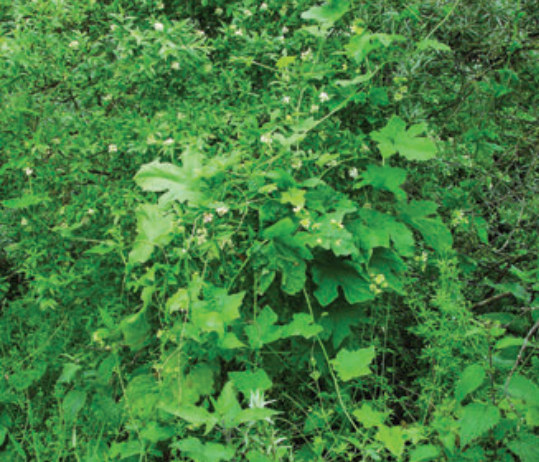
Plant name
The mattress
Latin name
Bryonia cretica L. subsp. dioica (Jacq.) Tutin
Common names
Farsh, a game once, snake grapes, the Ardisha
foreign names
Eng. Red bryony, Fr. Bryone dioïque
The group
The lottery
Habitat and Geographic Distribution
Eastern Mediterranean countries, Southern Europe and North Africa
Botanical description
A dioecious perennial herb.
The root is a tubular, vascular tissue that stores nutrients.
The stem is slender, glabrous, smooth, and climbing; the tendrils are long and unbranched.
The leaves are glabrous, ovate to sub-round in general shape, heart-lobed at the base, palmately to uterinely lobed; the petioles are glabrous or bear ovate, white tubercles in a dispersed manner.
The male flowers are borne in racemes, 15 cm long, with long, thread-like pedicels, 30 cm long, squamous, triangular inflorescences.
The corolla is pubescent and fine.
The sepals are yellow with green veins, variegated, with five free stamens, and filaments with lobes.
The male flowers are densely hairy.
The female inflorescences are loose or dense, sometimes branching from the base, and bear a flower; the ovary is spherical and smooth, with a style that is almost prominent.
9 - The fruit is a berry, red, spherical, with semi-compressed, oval, smooth seeds. Flowering occurs from March to May.
Used part
The roots are harvested during summer and early autumn, and the young shoots are harvested in spring and early summer.
The plant, particularly the roots, contains the chemical constituent cucurbitacin (a toxic compound that irritates the skin and mucous membranes), which is found in the young roots as glycones and glycosides.
It also contains small amounts of bryoamarid, bryoside, and bryodioside A and C, as well as triterpenic acids, including bryonolic acid and alpha-hydroxy-bryocoumaric acid.
Additionally, it contains ribosome inhibitory proteins, such as bryodine-L and bryodine-R, fatty acids, starch, resin, and alkaloids.
Properties and medical uses
The drug (Cucorbetacine) has laxative and purgative properties and is used in cases of chronic constipation.
It also possesses antiviral, anti-inflammatory, and antihypertensive properties.
It is popularly used to treat diabetes and internal inflammations such as duodenal ulcers, bronchitis, asthma, whooping cough, and edema.
It is also used to treat joint inflammation, especially gout.
In vitro, Rubiodine exhibits cytotoxic properties.
Pharmaceutical preparations: It is available as tinctures, decoctions, and powders.
pharmaceutical forms
It is available in the form of tinctures, decoctions, and powders.
(Precautions for use: The drug is highly toxic when used in high doses, and the plant should only be used under medical supervision.
Its use is not recommended for children, pregnant women, or breastfeeding mothers.
The drug is a skin irritant and can cause irritation, blistering, reddening, and itching on the affected areas. It can also cause convulsions, hypothermia, and coma.)
Side effects and precautions
The drug is highly toxic at high doses; the plant should only be used under medical supervision.
Its use is not recommended for children, pregnant women, or nursing mothers.
The drug is a skin spray and can cause irritation, blistering, reddening, and itching on the affected areas. Latin name: Bryonia cretica L. subsp. dioica (Jacq.) Tutin Bryonia dioica Jacq
the environment
A fast-growing, deeply rooted climbing plant that spreads in shady areas of meadows and forests, or along stream banks. It grows in most types of soil, provided it is well-drained and non-acidic.
Agriculture and productivity
It reproduces by mature seeds scattered in rows, or sown in greenhouses in special containers, and transplanted to permanent soil after a year, noting that the plant is dioecious when cultivated to obtain [a specific yield/type of plant].
History and Heritage
The name "Menu" comes from the Greek word "bryein," meaning "green branches," and "Menu root," meaning "dual" or "dual," from the Greek word "dioica," meaning "sedative." The plant was used medicinally in Europe, and it was mentioned in the English Constitution of Medicine in 1653.
It was also mentioned by Ibn al-Baytar, al-Antaki, and Ibn Sina, who said: "The rhizome of the plant, when combined with fenugreek and caraway, cleanses and purifies the skin, removing freckles and dark marks left after ulcers." The parts used are the roots (harvested during the summer and early autumn) and the tender shoots (harvested in the spring and early summer).
Chemical constituents: The plant, especially the roots, contains cucurbitacin (a toxic compound that irritates the skin and mucous membranes).
In tender roots, it is found in the form of glycones and glycosides, including small amounts of bryoamirids, bryodiosides A and C, and bryodiosides.
It also contains triterpenic acids, including bryocoumaric acid A, bryocoumaric acid A, ahpla-hydroxymultiflora, and bryodine-L.
Additionally, it contains ribosome inhibitor proteins, including bryodine, fatty acids, starch, resin, and alkaloids.
Medical note
This information is for educational purposes only and does not constitute medical advice.
Poisonous or potent plants should only be used under the supervision of a qualified physician or pharmacist.
Related images


