Gharqad | A medicinal plant in the Akhdar encyclopedia
The plant, with its phenolic compounds and flavonoids, possesses antioxidant (free radical) and anti-proliferative properties, as well as anticancer properties. The alcoholic extract of the plant has shown a hypotensive effect. The leaves are used in folk medicine to treat flatulence and wounds.
Plant name
The Gharqad
Latin name
Nitraria retusa (Forssk.) Aschens
Common names
The Gharqad
foreign names
Eng. Salt tree, Fr. Nitraire with retuse leaves
The group
Gharqadiya
Habitat and Geographic Distribution
Arabic, and widespread in Palestine, Sinai, Egypt, Iraq, Kuwait, Saudi Arabia, and Yemen, extending to the Saharan region of neighboring Sudan.
Botanical description
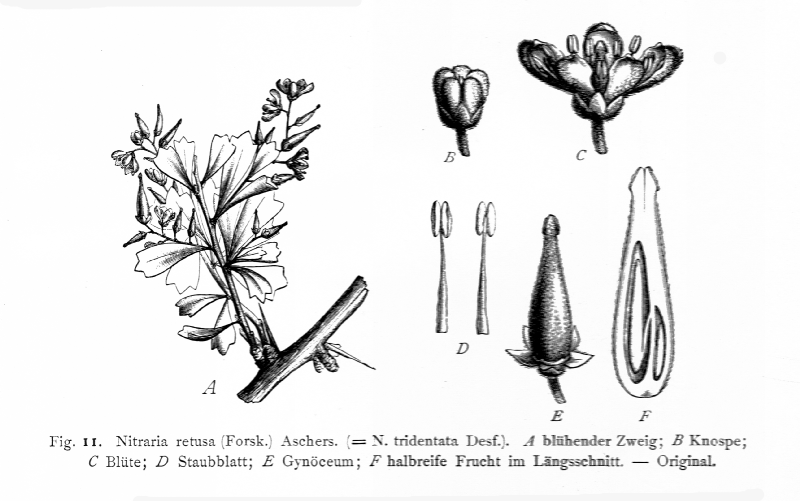
The branches are covered with 2 - a highly branched shrub, its young shoots covered with grayish down, their tips forming thorns.
The stem is numerous, erect, and highly branched.
The leaves are 2 - simple, 2 - arranged in bundles or alternate, entire margins, obovate with inverted teeth.
5 - pedicel, with a notched or lobed apex covered with overlapping hairs or nearly glabrous.
The stipules are fine, membranous, and nematocysts.
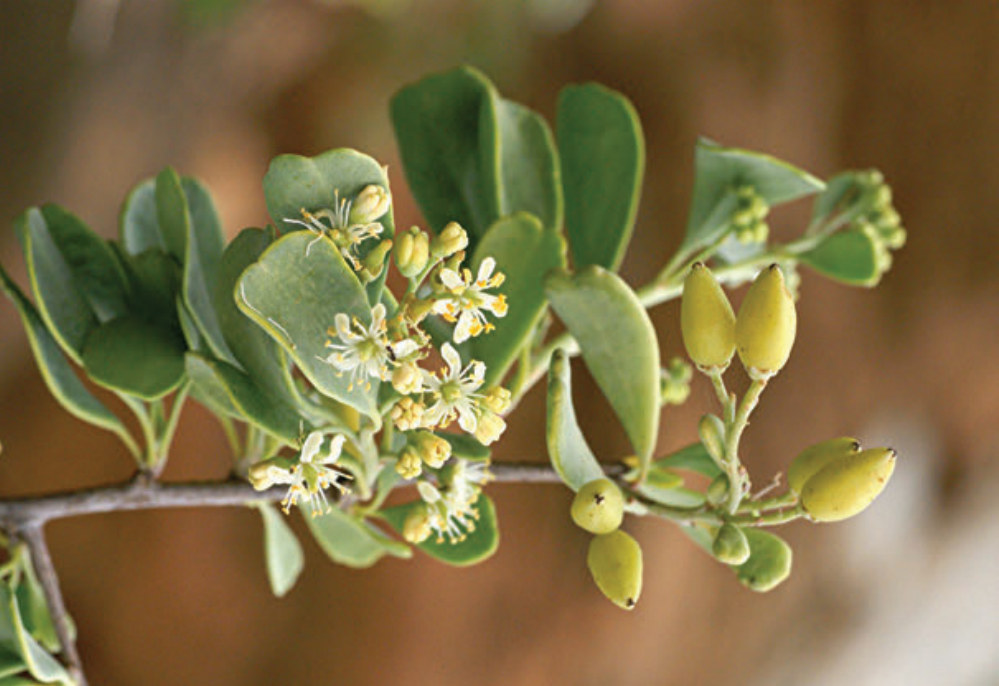
The flowers are hermaphroditic, 8 mm long, gathered in cymose inflorescences.
The petals are 8 - glabrous or partially fused to their bases, ovate, 5 - dichotomously branched at the ends of young branches.
The calyx is white, - free petals, twice the length of the calyx or more, 5 - stubby, nearly glabrous, nematocysts with the fruit.
The corolla has stamens arranged in three whorls, of equal length, and are hairy.
The male is pyramidal, tapering gradually to a style.
The female is tricarpal; the ovary is superior, tricarpal, oblong-triangular, acuminate, purplish-red, ovate-pastor.
The fruit is a drupe, monocarpal and monoseed, reddish in color, longitudinally furrowed. The seeds are ovoid. Flowering occurs from April to May.
Used part
Papers and the fresh market
chemical components
Vasicinone, and alkaloids including: Vasicinone polyphenols.
The leaves and tender stems contain phenolic compounds, isorhamnetin 3-rutinoside, isorhamnetin 3-glucoside, and its derivatives: isorhamnetin, quercetin, and valphenoids.
Properties and medical uses
The plant, with its phenolic compounds and flavonoids, possesses antioxidant (free radical) and anti-proliferative properties, as well as anticancer properties.
The alcoholic extract of the plant has shown a hypotensive effect. The leaves are used in folk medicine to treat flatulence and wounds.
Side effects and precautions
Allergic reactions or drug interactions may occur; self-use should be avoided by pregnant and breastfeeding women, children, and patients with chronic diseases.
Other uses
The local population uses the boxthorn tree in soap making, and its fruit is used to extract a dye for fabrics.
The fruit is eaten fresh or cooked due to its pleasantly salty flavor, and it is also used to curdle milk. Its wood is used as fuel because of its quick ignition.
the environment
This plant thrives in very dry, hot, and temperate bioclimatic zones, particularly in wadis, valleys, and near water sources.
It adapts to gypsum, clay, or relatively saline sandy soils.
The species indicates the presence of a shallow water table.
It resists burial by sand and tolerates sea winds and spray. The plant plays a vital role in stabilizing sand dunes rich in marine salts.
Agriculture and productivity
The plant is propagated by seeds, and can also be propagated by cuttings.
History and Heritage
It is called al-Faraj in the Maghreb, and in Algeria it is called Ghardaq.
It was mentioned by Ibn al-Baytar and al-Antaki, but Ibn Sina did not mention it.
It was mentioned in the authentic hadith on the authority of the Prophet, may God bless him and grant him peace, that he said: “The Hour will not come until the Muslims fight the Jews, and the Muslims will kill them until the Jews hide behind the rock and the tree, and the rock or the tree will say: O Muslim, O servant of God, there is a Jew behind me, so come and kill him, except for the Ghardaq, for it is one of the trees of the Jews.”
Medical note
This information is for educational purposes only and does not constitute medical advice.
Poisonous or potent plants should only be used under the supervision of a qualified physician or pharmacist.
Related images