Noble bay | Medicinal plant in the Akhdar Encyclopedia
A medicinal and aromatic plant widely cultivated in many parts of the world. The plant is important in the food and pharmaceutical industries. Its commercial value is derived from its essential oil, which has applications in various industries. The leaf oil is used topically in the form of balms or…
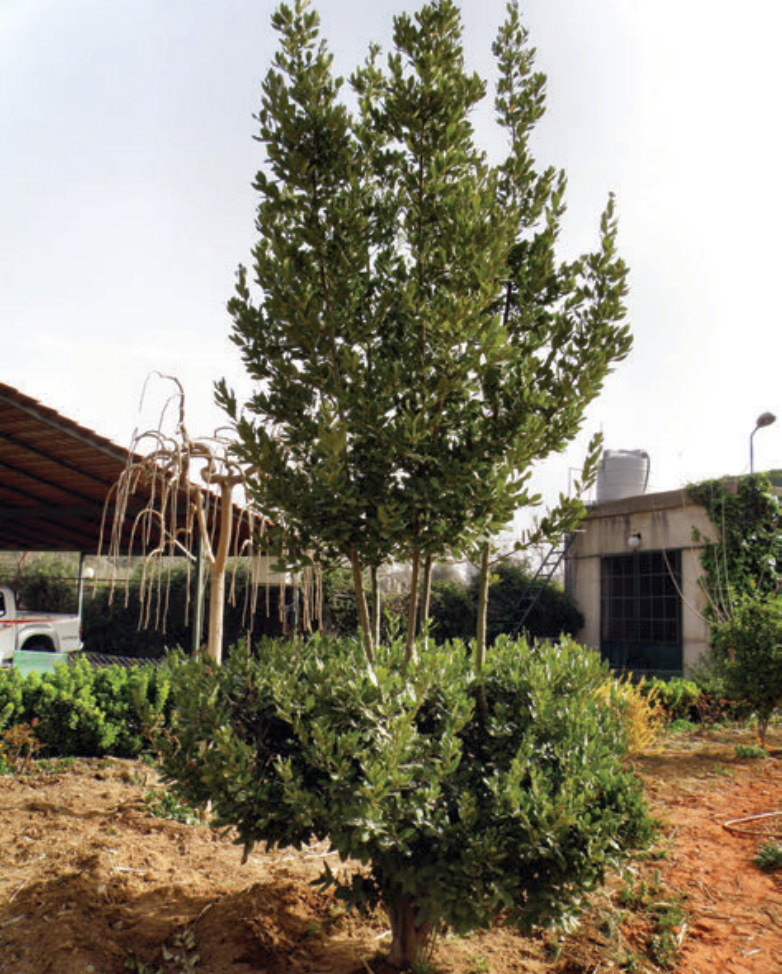
Plant name
noble laurel
Latin name
Laurus nobilis L
Common names
Noble laurel, myrtle
foreign names
Eng. Laurel, Fr. Laurier-sauce
The group
Al-Ghariya
Habitat and Geographic Distribution
Mediterranean countries
Botanical description
M, all its parts are barren except for the flower spikes, which are slightly downy.
10 - An evergreen tree, the trunk is straight, grayish at the base, and reddish at the top.
The leaves are simple, alternate, entire, and short.
12 - The pedicels are leathery, oblong to uterine, wavy at the margin, pointed at the apex, and taproot-like at the base.
The flowers are unisexual, and the plant is dioecious.
The flowers are gathered in umbel-like inflorescences composed of several small umbels.
The flowers are surrounded before opening by several bracts that quickly fall off.
The spikes of the umbels and the 5 - each of which contains short, downy flowers.
The calyx is simple, pale yellow, composed of four barren segments, and does not last long.
The stamens in the male flowers are numerous and arranged in more than one spiral, with short filaments.
Their anthers open via two stamens that rise in an arc after ripening.
The female flowers are few in number, with four stamens and four sepals, and each sepal contains a single ovary and a single ovule.
The fruit is a black berry, borne on a permanent flower stalk, resembling a small olive in shape and size.
Flowering occurs from March to April, and the fruit ripens when it turns black in late summer and early autumn.
Used part
The fruits, leaves, and essential oil extracted from the leaves
chemical components
3- The leaves contain: volatile oil, geraniol, eugenol, laurenbiol, eremanthin, costunolide, dehydrocostuslactone (sescoterpene lactones), laurenbiol, eremanthin, and tannins, including reticulin (alkaloid of the isoquinoline class), and 1,8-cineol (its percentage varies depending on the harvesting and storage method).
4- The fruits contain: volatile oil, methylcinnamate, citral, α-β-pinene, laurenbiol, eremanthin, costunolide, dehydrocostuslactone (sescoterpene lactones).
The fatty oil is extracted from the fruit.
Steam it until it softens, then cold-press it, and a green oily substance (linoleic acid, lauric acid, palmitic acid, oleic acid) flows out.
Its main components are acids (25-55%). (Laurel paste) is the color, and it is called laurel butter.
Properties and medical uses
A medicinal and aromatic plant widely cultivated in many parts of the world.
The plant is important in the food and pharmaceutical industries.
Its commercial value is derived from its essential oil, which has applications in various industries.
The oil from the leaves is used topically in the form of balms or ointments to treat rheumatic and joint diseases and to relieve neuralgia.
Its reddening and antimicrobial properties (against bacteria, fungi, and viruses) make it effective in treating gingivitis, ear infections, wounds, bruises, and various skin diseases and inflammations (oily skin, psoriasis, acne).
A mixture of the fatty and volatile oils is used to treat boils and pustules. The essential oil has also been shown to have anticancer properties.
Side effects and precautions
The use of this essential oil is not recommended for pregnant women, due to the potential for allergic reactions caused by the mono- and semi-terpene lactones it contains.
Other uses
Aromatic bay leaves are classified among the spices that stimulate digestion and are used to enhance the flavor of meat and fish.
Bay butter is used in veterinary medicine to repel insects and treat parasites that infect animal skin.
Bay butter is also an ingredient in bay soap, a product for which some Syrian cities are famous and which has gained international renown for its ability to maintain skin softness and health.
The plant resists diseases and insects and protects surrounding plants from disease.
Precautions for use: The use of volatile oil is not recommended for pregnant women, due to the potential for allergic reactions caused by the mono- and hemi-terpene lactones contained in the leaves.
the environment
The bay tree is widespread in forested environments and is considered an environmentally resilient species.
It tolerates low temperatures but is affected by frost, which causes significant damage to the foliage. It thrives in fertile, moist, well-drained soils that receive ample sunlight.
Agriculture and productivity
Bay laurel is propagated by seeds or dried or fresh fruits with the pulp intact, treated with cold stratification, noting that bay seeds lose their viability quickly.
It responds well to vegetative propagation by layering and by hardened cuttings treated with a hormone.
Seedlings are planted at 2-3 years of age and require fertile soil in sunny or partially shaded locations.
They need ample watering and consistently moist soil during the summer.
(Linum catharticum) Cathartolinum catharticum (L.) Small, Cathartolinum pratense Rchb., Nezera cathartica (L.) Nieuwl.,.Cartholinum partense Rchb., Linum versifolium Gilib
History and Heritage
The scientific name of the genus is the ancient Latin name for this tree.
The species name, nobilis, means "noble," referring to its use in the wreaths crowning victors in wars among the Romans.
Greek mythology tells of Daphne, the beautiful nymph, who could not attract or seduce Apollo (god of art and the sun), who asked the gods to transform her into a laurel tree.
Since then, victorious heroes, poets, and scholars have worn laurel wreaths as a symbol of nobility, triumph, and honor.
It was also a symbol of protection from lightning during storms among the ancient Romans; Emperor Tiberius covered his head with a laurel branch for protection from lightning strikes.
This belief persisted into the Middle Ages, for example...
It is said that "lightning does not strike where there is laurel." The properties of laurel have been known since ancient times, and it was mentioned by Ibn al-Baytar, al-Antaki, and al-Ghassani. Ibn Sina also mentioned that laurel oil is beneficial in treating nerve pain.
Medical note
This information is for educational purposes only and does not constitute medical advice.
Poisonous or potent plants should only be used under the supervision of a qualified physician or pharmacist.
Related images


