Herbaceous vine | Medicinal plant in the Akhdar encyclopedia
The plant has neurocardiogenic, blood pressure, and smooth muscle effects. It is used traditionally as an antispasmodic for digestive colic and spasms, and in the treatment of diabetes. It is also used topically to treat dental and fungal skin infections. Results have shown that the aqueous and alc…
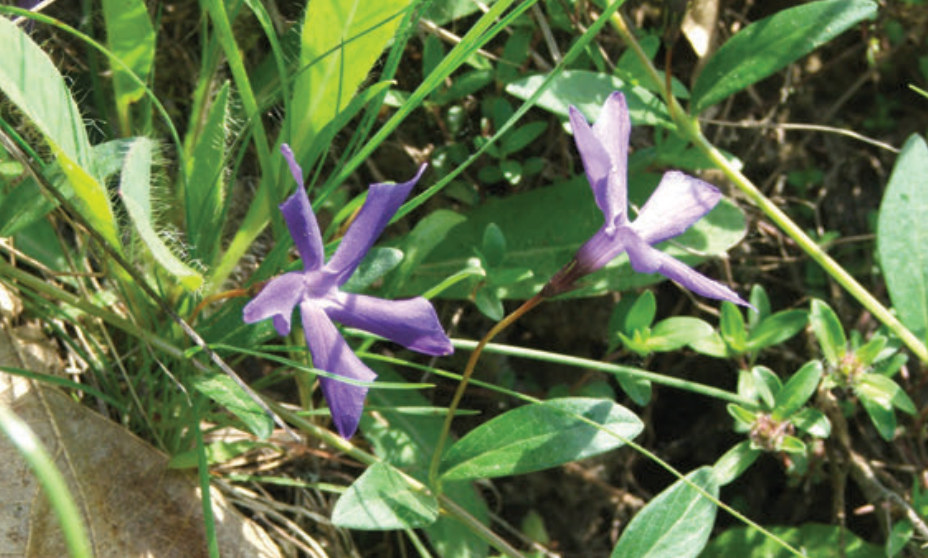
Plant name
Herbaceous
Latin name
Vinca herbacea Waldst
Common names
Herbaceous periwinkle, periwinkle
foreign names
Eng. Herbaceous periwinkle, Fr. Pervenche herbace’e
The group
The Apocrypha
Habitat and Geographic Distribution
Mediterranean and Iranian-Turanian, extending into the Euro-Siberian region
Botanical description
The stem is smooth and glabrous.
The stem is prostrate and ascending, spreading in all directions.
The leaves are simple, opposite, 40 cm long.
It is a perennial herb, semi-rub-marginated or smooth.
The flowers are solitary in the leaf axils, squamates, ovate to ellipsoid, acute.
The corolla has peduncles equal to or exceeding the length of the supporting leaves.
The calyx has linear lobes, and the tube is densely hairy.
The male has five stamens, suprapetalized.
The fruit is composed of two follicular drupes, 35 cm in diameter, and curved. The seeds are smooth. Flowering occurs from March to May.
Used part
Dried leaves and tender flowering plant: Latin name: Vinca herbacea Waldst. V. libanotica Zucc
chemical components
Hryvni herbain, hrybainni ervamycin, arvamyciniakuammin, aquamnnivincamin.
The plant contains the alkaloids vincamni.
It also contains rutin, organic acids, tannins, and phenols vincanin, vincanni, vincarin, vincarin, hervin. Simple
Properties and medical uses
The plant has neuro-cardiostatic, blood pressure-regulating, and smooth-bite effects.
It is used traditionally as an antispasmodic for digestive colic and spasms, and in the treatment of diabetes.
It is also used topically to treat dental and fungal skin infections.
Studies have shown that the aqueous and alcoholic extracts of *Anthracnose herb* have antioxidant activity due to their high rutin content.
Extracts of the plant *Anakia* inhibited the growth of Staphylococcus aureus in almost all concentrations by 60%.
It also exhibited antibacterial activity against E.
coli and inhibitory activity against *S. aureus*. Caution: High doses can cause generalized tremors.
Side effects and precautions
High doses cause general tremors
the environment
The plant tolerates both high and low temperatures, preferring a temperate climate and long photoperiods, which promote rapid vegetative growth and increase the percentage of active ingredients.
It can be grown in most soils, but light, well-drained, and aerated soils are best.
The presence of calcium in the soil enhances vegetative growth and increases the percentage of active ingredients.
Agriculture and productivity
The plant is propagated by seeds and stem or root cuttings.
Seeds are sown in early spring and transplanted to the permanent location after two months.
Planting is done in rows, with a spacing of 80 cm between rows and 70 cm between seedlings or cuttings within the same row.
Watering is done immediately after planting.
Planting can also be done in beds or raised beds.
Plant care consists of moderate irrigation during the growing season, nitrogen and phosphate fertilization in particular, and control of the numerous fungi and viruses that affect it.
The vegetative parts are cut before flowering in two stages, the first in summer and the second in autumn, and dried in the shade or in dryers with a temperature not exceeding 45°C.
Yield per hectare reaches 2.5–3 tons of dry grass and approximately 1.5–2 tons of dry roots.
Vinca major L.
Pervinca major (L.) Garsault., Vinca grandiflora Salisb., Vinca minor subsp. major (L.) Bonnier & Layens., Vinca ovatifolia Stokes
History and Heritage
This ancient Latin toxin of these species derives from the word vinca, a modern transliteration of the scientific name for the genus *herbacea*, meaning "to embrace" or "to bind," referring to the climbing stems of some species.
The species-descriptor *vincere* means "herbal." Interest in some species of the genus has recently increased due to the discovered effects of certain alkaloids they contain.
Medical note
This information is for educational purposes only and does not constitute medical advice.
Poisonous or potent plants should only be used under the supervision of a qualified physician or pharmacist.
Related images


