Phoenician Juniper | Medicinal Plant in the Akhdar Encyclopedia
Juniper oil possesses antibacterial and antifungal properties and is used to treat urinary tract infections. Some sources mention the properties of lignins in juniper oil in treating tumors. The oil is used topically to treat wounds and skin diseases. Juniper leaves are traditionally used as an inf…
Plant name
Phoenician juniper
Latin name
Juniperus phoenicea L
Common names
Phoenician juniper, Latin name: Juniperus phoenicea L
foreign names
Juniperus phoenicea L
The group
Cypress (Arabic names): Phoenician Juniper.
Habitat and Geographic Distribution
It is Mediterranean in origin and extends into the southwestern Arabian Peninsula. It is found in Libya, Tunisia, Morocco, Algeria, and eastern Jordan.
Botanical description
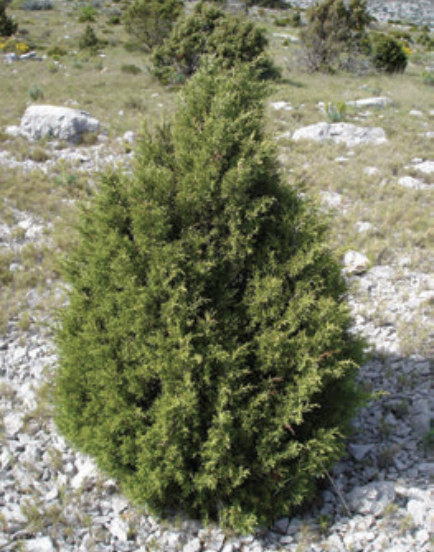
Branches are erect or ascending, dense, cylindrical when monoecious trees or shrubs are present, reaching up to 1 mm in height, semi-scaled, adhering to the stem, arranged every third in whorls or opposite and overlapping, 2 - young.
Leaves are rhomboid, dorsally convex, marked by a linear resin canal.
Male cones are terminal, ovate-oblong, with rounded scales.
Mature female cones - 1 mm, semi-squamous, papillary, spherical to subspherical, 8 - reddish to yellowish-brown, fleshy, composed of - texture, brown, free, oblong, maturing in summer from 8 - scales. Seeds are formed in the second year. Flowering is from March to April.
Used part
Leaves, fruits, and wood oil
chemical components
The percentage of volatile oil in plant parts ranges between 0.5-2%, depending on the plant's geographical origin and the drying and distillation method.
The wood contains 0.6% volatile oil, rich in sesquiterpene compounds (58%), the most important of which is cedrol (13%).
The leaves contain 7.1-8.0% volatile oil, rich in sesquiterpene compounds (87%).
Among the monoterpenes are α-pinene (48%), α-thujene (36%), δ-cadinene (6%), and caryophyllene (5%), in addition to some monoalcoholic compounds.
The fruit contains 0.7% volatile oil rich in monoterpene compounds (60%), the most important of which are alpha-pinene (13%), verbinone (6%), and the terpene alcohol sabinol.
It also contains 30% carbohydrates, 3-5% catechic tannins, flavonoids, and anthocyanin compounds such as leucanthocyanes.
Medicinal Properties and Uses: Juniper oil possesses antibacterial and antifungal properties and is used to treat urinary tract infections.
It is mentioned in some...
References mention the properties of lignins in tumor treatment.
The oil is used topically to treat wounds and skin diseases.
Juniper leaves are used traditionally as an infusion or decoction to relieve intestinal gas, treat pulmonary tuberculosis and asthma, treat diarrhea, promote urination, eliminate urinary tract stones, and treat renal colic.
They are also used topically to treat rheumatism and skin diseases such as eczema, pustules, and boils.
Juniper wood is distilled to obtain black tar, which is then filtered and used for various purposes.
Tar oil, called "Safwa," is used as a disinfectant and bactericide.
Roasted juniper berries are eaten as an appetite stimulant and digestive aid.
A decoction of the berries is used topically as a poultice to treat sores and skin lesions, and as a gargle to eliminate bad breath.
Alcoholic extracts of the aerial parts have shown antibacterial activity against both Gram-positive and Gram-negative bacteria.
Various juniper species have been widely used in traditional medicine for infectious and inflammatory diseases.
Various ailments, such as colds, diarrhea, fungal infections, hemorrhoids, diabetes, and wounds.
In Tunisian folk medicine, a decoction of the leaves was frequently used to regulate menstruation and alleviate its pain.
Properties and medical uses
Juniper oil possesses antibacterial and antifungal properties and is used to treat urinary tract infections.
Some sources mention the properties of lignins in juniper oil in treating tumors.
The oil is used topically to treat wounds and skin diseases.
Juniper leaves are traditionally used as an infusion or decoction to relieve intestinal gas, treat pulmonary tuberculosis and asthma, treat diarrhea, promote urination, eliminate urinary tract stones, and treat renal colic.
They are also used topically to treat rheumatism and skin diseases such as eczema, pimples, and boils.
Juniper wood is distilled to obtain black tar, which is then filtered to extract the tar oil, known as "Safwat." This oil is used as an antiseptic and bactericide.
Roasted juniper berries are eaten as an appetite stimulant and digestive aid.
A decoction of juniper berries is also used topically as a poultice to treat sores and skin blisters, and as a gargle to eliminate bad breath.
Alcoholic extracts of the aerial parts have demonstrated antibacterial activity against both gram-positive and gram-negative bacteria.
Juniper species have been widely used in traditional medicine against various infectious and inflammatory diseases, such as colds, diarrhea, fungal infections, hemorrhoids, diabetes, and wounds. In Tunisian folk medicine, a decoction of juniper has been used.
Side effects and precautions
The use of oil is not recommended.
Other uses
Tar oil is used in veterinary medicine to eliminate ticks on the hides of farm animals.
Juniper wood is used in carpentry in Algeria and Tunisia.
Furthermore, it is primarily used in the production of charcoal and fuel in Africa.
Precautions for use: The oil of the fruit of the juniper tree is not recommended due to the presence of the irritating compound sabinol, which may cause digestive, nervous, cardiac, respiratory, hepatic, and renal disorders. Bees visit the tree to collect the sap it secretes.
the environment
Phoenician juniper thrives in arid and semi-arid environments across various climatic zones, from the humid freshwater zone of the Canary Islands to the upper arid and lower semi-arid zones of southern Jordan.
It is resistant to scorching winds, photophilous, and can be found on a variety of soil types, including calcareous, stony, and sandy soils.
It prefers moderate to slightly acidic soils. It is relatively salt-tolerant and wind-resistant.
Agriculture and productivity
Juniperus oxycedrus is propagated by seed by treating the seeds with sand to remove the gummy layer and facilitate germination.
Alternatively, the seeds can be treated with 30% sulfuric acid for 20 minutes.
It is preferable to collect seeds from ripe, soft (not dry) fruits of middle-aged trees, which take two years to mature.
Other species include Juniperus oxycedrus L., Juniperus glauca Salisb., Juniperus oxycedrus subsp.
rufescens Debeaux, Juniperus oxycedrus var. rufescens Carrière, and Juniperus rufescens Link.
History and Heritage
The scientific name of the genus Juniperus is derived from the Latin word phoenicia, meaning "purple" in reference to the color of its fruits, or "Phoenician" in reference to the ancient Phoenicians who inhabited the Syrian coast and traded in purple dye, despite its absence in that region.
Phoenician juniper is mentioned in ancient Egyptian prescriptions in the Hearst and Ebers papyri, described as a remedy for pain relief, urinary tract infections, and renal colic.
The Greeks and Romans knew it and used it to treat their illnesses.
They also burned it to ward off bad thoughts and diseases.
Dioscorides said of it, "There are large and small varieties, and both warm, soothe, and promote urination." Ibn Sina also mentioned that juniper is good for chest pains, coughs, and stomach ailments.
Medical note
This information is for educational purposes only and does not constitute medical advice.
Poisonous or potent plants should only be used under the supervision of a qualified physician or pharmacist.
Related images