Common Juniper | Medicinal Plant in Akhdar Encyclopedia
It is a cyclooxygenase inhibitor, anti-inflammatory, antimicrobial, digestive, cholagogue, antispasmodic, diuretic, and expectorant. The essential oil is used internally to treat digestive disorders and externally to treat rheumatism. It is also used domestically as a diuretic and to treat prostati…
Plant name
common juniper
Latin name
Juniperus communis L
Common names
common juniper
foreign names
Eng. Common juniper, Fr. Genévrier commun, Peteron
The group
Cypress
Habitat and Geographic Distribution
Europe and North Africa in Algeria and Morocco
Botanical description
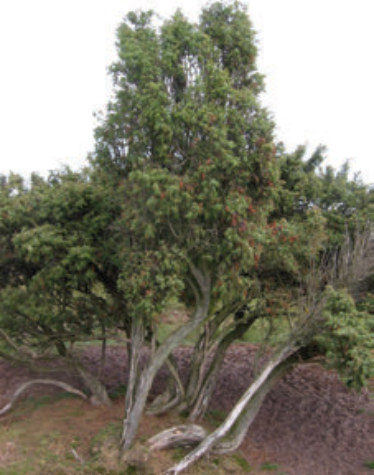
Dioecious shrubs or small trees, usually reaching up to 1 m in height (in some cases).
The stems are numerous, spreading along the ground (or even upright (rarely erect)).
The bark is brown, fibrous, and scale-like; the bark of young stems is smooth.
The twigs are erect.
The leaves are green (sometimes appearing silvery), reddish-brown, flat, pointed to rounded, and lanceolate.
The female cones take two years to mature; they are of a characteristic size, straight, spherical to ovate, and contain seeds.
The seeds are black, resinous, and bluish-tinged (6-13 mm). It flowers in spring.
Used part
Flowers, fruits, leaves, and market
chemical components
Rich in monoterpenes, the plant contains volatile oil, para-camphine, camphene, alpha-beta pinene, of which alpha and beta pinene are monoterpene hydrocarbons.
It also contains diterpene compounds such as sabinene, sabinene, myrcene, myrcene, para-cenole, cineole, flavonoids, catechin tannins.
In addition to the volatile oil, the fruits contain catechin tannins, diterpenes, proanthocyanidins, and proanthocyanidins (simple sugars).
Properties and medical uses
It is a cyclooxygenase inhibitor, anti-inflammatory, antimicrobial, digestive, cholagogue, antispasmodic, diuretic, and expectorant.
The essential oil is used internally to treat digestive disorders and externally to treat rheumatism.
It is used internally as a diuretic and to treat prostatitis, flatulence, and colitis.
Topically, it is used as a rubbing agent on the skin for rheumatism, as a pain reliever for disc pain, and to treat gout and peripheral ischemia.
It is also used as a wash for eczema and acne.
Traditionally, it is used to treat kidney failure, acute and chronic cystitis, bladder infections, proteinuria, hematuria, and amenorrhea.
It has antimicrobial, antioxidant, anticholesterol, and antilipid properties, and it has neuroprotective effects and is used to treat Parkinson's disease.
Other uses: The essential oil is used in the preparation of many cosmetic products.
Side effects, contraindications, and precautions: The oil should not be used in cases of kidney inflammation, and prolonged use can cause hypocalcemia.
Caution should be exercised when using this product by diabetic patients.
It should not be used in cases of congestive heart disease.
Topical application may cause irritation, skin injuries, wounds, and swelling.
Do not use on large or extensive skin wounds or in cases of acute skin diseases. Do not use during pregnancy or breastfeeding.
Side effects and precautions
Allergic reactions or drug interactions may occur; self-use should be avoided by pregnant and breastfeeding women, children, and patients with chronic diseases.
the environment
Common juniper grows in various climatic zones and different soil types, from stony to sandy, but it prefers well-drained soil.
It is also found on sandy areas in arid regions and may be encountered near fields and pastures.
It grows at elevations of up to 7 meters above sea level.
It is tolerant of wind and sun.
It prefers neutral soils but can tolerate some elevations. Juniper is susceptible to fire. It has a wide pH range.
Agriculture and productivity
Juniper is propagated by seeds (slow germination) at the beginning of autumn or spring.
The seeds are soaked in water for 24 hours before planting, then sown in bags at a rate of 2-3 seeds per bag, and then thinned out once they reach the appropriate height.
It is also propagated by cuttings, which are planted in well-drained soil in a sunny to partially shaded location.
The plant is susceptible to some diseases, such as rust and red spider mites.
(Juniperus phoenicea L., Juniperus terminalis Salisb., Juniperus tetragona Moench, Sabina phoenicea L.) Antoine, Sabinella phoenicea (L.) Nakai
History and Heritage
The scientific name of the genus Juniperus is derived from Latin, which was the Latin name for the tree among the Latin peoples of Europe.
Some sources suggest that the origin of the word is "astringent," referring to the taste of its fruit.
The species name communis means "common." The parts used are the flowers, fruit, leaves, and stem.
Medical note
This information is for educational purposes only and does not constitute medical advice.
Poisonous or potent plants should only be used under the supervision of a qualified physician or pharmacist.
Related images