Arar | A medicinal plant in the Akhdar encyclopedia
A popular aromatic medicinal plant in the Arabian Peninsula, widely used for its digestive and carminative properties. The powdered plant is also used as a snuff to relieve sneezing. Studies have shown the plant's antibacterial and antifungal properties against certain types of bacteria and fungi,…
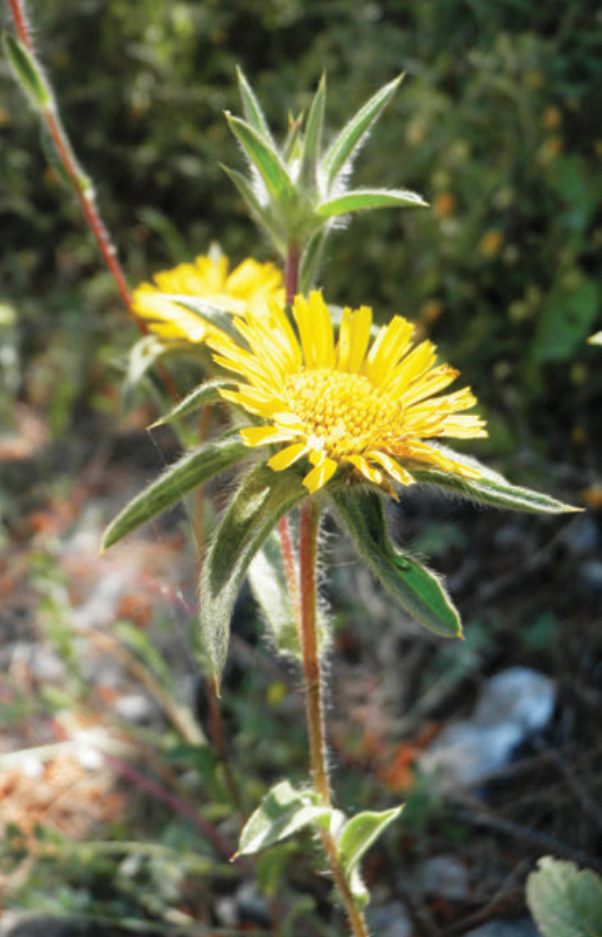
Plant name
Al-Arar
Latin name
Pulicaria arabica (L.) Cass
Common names
Al-Arar, Jathjath, Sabt
foreign names
Eng. Ladies' false fleabane. Fr. Pulicaire
The group
Star
Habitat and Geographic Distribution
The Rashki region of the Mediterranean and the western Turanian region. - Iranian
Botanical description
80 cm, downy to 80 cm - a nearly hairless perennial herb.
The stem is erect, branching dichotomously from the base or midrib.
The leaves are simple, matrilineal, entire or semi-matrile, oblong, and sessile, semi-periwinkle.
The leaves of the flowering branches are 2 cm or more wide.
The flower heads contain ligules and tubules, which are found singly at the branch ends.
The bracts are linear, reddish, and hairy; the outer ones are herbaceous.
The flowers are yellow; the ligules are slightly longer than the tubules.
The acinus bears stiff hairs.
The stamens are arranged in two rows; the outer row is short, composed of fused, saucer-like scales, toothed, and interlaced with the fruit.
The scales of the inner row are 12 times the length of the acinus.
Its length exceeds that of the flowering period, which is from April to September.
Used part
The plant is called Kamal.
chemical components
The plant contains a volatile oil rich in sesquiterpene compounds (quercetin, chrysosplenol, flavonoids).
Properties and medical uses
A popular aromatic medicinal plant in the Arabian Peninsula, widely used for its digestive and carminative properties.
The powdered plant is also used as a snuff to relieve sneezing.
Studies have shown the plant's antibacterial and antifungal properties against certain types of bacteria and fungi, such as yeast and Candida.
It has been observed to cause mild central nervous system depression and is a potent analgesic, antipyretic, and anti-inflammatory agent, with protective effects on the liver and kidneys due to its antioxidant activity.
Side effects and precautions
Allergic reactions or drug interactions may occur; self-use should be avoided by pregnant and breastfeeding women, children, and patients with chronic diseases.
Other uses
The essential oil of the juniper tree is used in perfumery.
There are several types: *Pulicaria glutinous*, the first type, is used as a vermifuge and strong laxative.
*Pulicaria orientalis*, the second type, is popular in Saudi Arabia and is used to stimulate appetite, treat digestive disorders, reduce fever, and as an antimalarial.
It is also used to treat hemorrhoids.
*Pulicaria undulate*, the third type, is known for its insecticidal properties and resistance to insects.
*Pulicaria dysenterica* is another type.
The fourth type is known as *Job's Juniper*, and its scientific name is *Job's Juniper*.
the environment
It is found in desert regions on rocky slopes and valleys.
It tolerates all harsh environmental conditions and lives on hard, saline sandy soils.
Agriculture and productivity
A wild, uncultivated plant, propagated by seeds and vegetatively by cuttings.
Silybum marianum L.
Gaertn., Carduus marianum L., Carduus lactifolius Stokes, Carduus versicolor Salisb., Mariana lactea Hill (Compositae) Asteraceae
History and Heritage
The word means flea, referring to the plant's use in repelling insects.
Pulex is believed to be the scientific name for the genus.
Most species of this genus are used in folk medicine, though camels and sheep rarely graze on them.
It is also used as an insect repellent; for example, it can be placed under and on top of dates before transporting and storing them, and also under pillows.
It has a pleasant aroma and has long been mentioned by Arab poets in their verses.
Medical note
This information is for educational purposes only and does not constitute medical advice.
Poisonous or potent plants should only be used under the supervision of a qualified physician or pharmacist.
Related images


