Moroccan camelthorn | Medicinal plant in the Akhdar encyclopedia
The alpha-fotenoids show effectiveness in treating gastric ulcers, and research indicates the plant's effectiveness as a dermatological antifungal. The fresh juice or decoction of the plant is used traditionally as a cough suppressant, digestive cleanser, blood sugar reducer, diuretic, and to help…
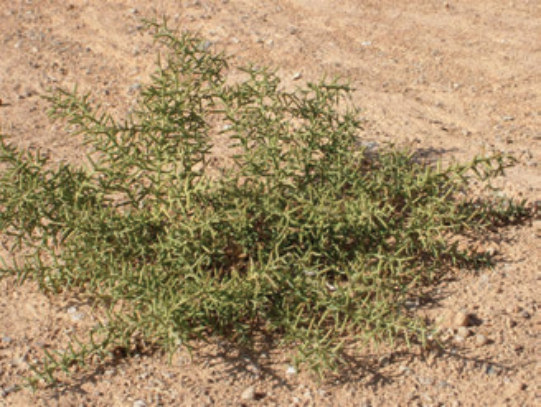
Plant name
Moroccan camel
Latin name
Alhagi maurorum Medik
Common names
Moroccan camelthorn, camelthorn
foreign names
Eng. Manna tree, Camelthorn
The group
Pea beans
Habitat and Geographic Distribution
Originally from the Mediterranean and Sudanese regions, it is now widespread in most Arab countries and the Sahara - Arab Iran
Botanical description
100 cm - A small, hairless or semi-hairless shrub with erect to ascending stems, highly branched, notched, bearing short, flat branches, the tips of which form a pricking thorn.
The leaves are 1 cm long, oblong to obovate, dull, simple, long or pointed at the apex, with entire margins.
The stipules are small and reddish-brown.
The petioles are short.
The flowers are hermaphroditic, solitary, axillary, and arranged on short, thorny branches.
Their inflorescences are the length of the calyx or longer, consisting of a tube ending in five teeth.
The calyx is pteridophytic, pink to trefoil, triangular to ovoid.
The corolla is crimson, about three times the length of the calyx, with an obovate ovate, its apex notched and retracted upwards.
The female is solitary in carpel, the ovary is superior, silky-hairy, and contains numerous seeds.
1+9 (Dichotomous stamens, cylindrical, narrowing, brown, glabrous or semi-glabrous.
Seeds - linear, 8-mm, comprising 4-3 x 30-12 mm pods, kidney-shaped, brown, smooth. Flowering from April to September)
Used part
All parts of the plant, including the roots.
The chemical constituents of the plant include kae-, isorhamnetin, chrysoeriol-7-O-xylosoid, chrysoeriol, kaempferol, favonoids, the most important of which is mpferol-3-galactorhamnoside, anthraquinone and saponin glycosides, tannins and resins, coumarin, organic acids, unsaturated sterols, reducing sugars, vitamins, and volatile oil, although the roots do not contain volatile oil.
The plant also contains a wide range of pharmacologically active secondary metabolites such as flavonoids, alkaloids (alhacidin and alhacin), stimulants, pseudalhagin A, and phospholipids.
During the flowering period (summer), the leaves and branches secrete a honeydew called mannitol (manna) in the form of small, light brown, sugary granules. The pods secrete another type of manna with laxative properties.
chemical components
The plant contains flavonoids, including kaempferol-3-galactorhamnoside, isorhamnetin, chrysoeriol-7-O-xylosoid, chrysoeriol, and kaempferol.
It also contains anthracchinone and saponin glycosides, tannins, resins, coumarins, organic acids, unsaturated sterols, saccharin, vitamins, and volatile oil.
The roots contain the volatile oil.
The leaves and branches secrete a honey-like liquid called manna (also known as saccharin exudence) during the summer flowering period.
The pods secrete another type of mannitol in the form of small, brown, pungent grains with a sweet taste and laxative properties.
Properties and medical uses
The flavonoids show effectiveness in treating gastric ulcers, and research indicates the plant's effectiveness as a dermatological antifungal.
The fresh juice or decoction of the plant is used traditionally as a cough suppressant, digestive cleanser, blood sugar reducer, diuretic, and to help eliminate kidney and bladder stones.
The powder of the plant, especially its flowers, is used topically to prepare a paste or ointment used to stop bleeding, dry and disinfect wounds (anti-inflammatory), and treat hemorrhoids.
The oil extracted from the leaves is used in compresses to treat rheumatism, arthritis, and eye inflammation, especially in children.
The manna is also used to increase vitality and sexual activity, strengthen the heart, and improve digestion.
The manna secreted by the pods is used by mixing it with milk or water.
Hot or lightly applied.
There is a lack of scientific research on this plant, and studies are currently underway on its effects on the kidneys.
Recent studies have shown that the plant has antioxidant uses and nutritional value, along with various medicinal properties.
It is a rich source of digestible proteins and trace minerals.
The plant is used to treat cardiovascular diseases, as a fever reducer, anti-ulcer agent, and for liver diseases, spasms, diarrhea, pain, rheumatism, and antibacterial and antifungal agents.
Side effects and precautions
Allergic reactions or drug interactions may occur; self-use should be avoided by pregnant and breastfeeding women, children, and patients with chronic diseases.
the environment
A deep-rooted plant, it spreads across hills, steppes, valleys, and along the edges of fields and roads in semi-arid and arid environments.
It thrives in heavy, loamy soils with a high water table, is salt-tolerant, and is found on saline soils (sabkhas).
Agriculture and productivity
It is considered an invasive species in pastures around salt marshes and valleys, and is rarely cultivated.
It is propagated by seeds, which must be soaked in lukewarm water for 12 hours, then sown in plastic bags in a nursery, and transplanted to the permanent field after at least one year.
It can also be propagated by young cuttings.
It flowers in the summer, fruits in the middle and end of the season, and enters a winter dormancy.
Astragalus gummifer Labill. Astracantha gummifera (Labill.) Podlech, Tragacantha gummifera (Labill.) Kuntze
History and Heritage
It means Moroccan.
The Sumerians used maurorum from Arabic, meaning pilgrim, and the species name Alhagi is the scientific name for the genus to improve the rank, and it was also used as a medicinal plant.
Al-Antaki wrote about the camel thorn: “It is the camel thorn, and it is a plant with many thorns and its fruit is round.
All parts of the plant cure hemorrhoids when used as a spray, incense, or ointment, even if only its ash is used.”
Medical note
This information is for educational purposes only and does not constitute medical advice.
Poisonous or potent plants should only be used under the supervision of a qualified physician or pharmacist.
Related images


