Pine | A medicinal plant in the Akhdar encyclopedia
The essential oil possesses antiseptic, mucolytic, hyperemic, and circulatory-stimulating properties. Turpentine oil is purified before medicinal use and must contain at least 90% pinenes and less than 0.5% delta-3-carene. The essential oil is used topically to treat rheumatism and neuralgia. Pine…
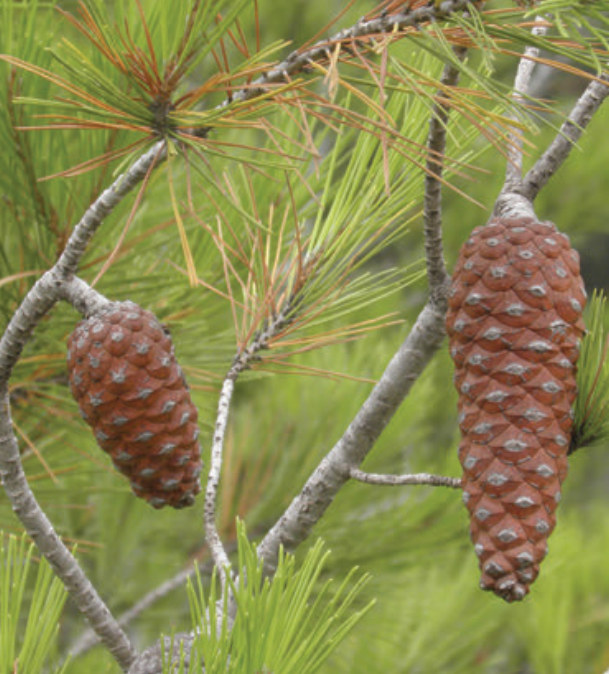
Plant name
pine
Latin name
Pinus spp
Common names
pine
foreign names
Eng. Pines, Fr. Pin
The group
Pine
Habitat and Geographic Distribution
The Mediterranean basin, with the Aleppo pine in the eastern Mediterranean (Turkey, Syria, Lebanon, Cyprus, and Greece), and the Aleppo pine in the western part of the Mediterranean basin (North Africa and Southern Europe), and to a lesser extent in the eastern Mediterranean.
Botanical description
Evergreen trees, 25-6 meters tall.
The buds are covered with scales (overlapping).
The branches are long and bear small, deciduous, semi-scaled, woody-base, and short leaves that develop from the axils of the semi-scaled leaves.
They bear a cluster of green, needle-like leaves, 3 or 15 cm long, surrounded at their base by a dry, membranous sheath.
The male cones are axillary, clustered at the bases of young branches.
The male cone consists of spirally arranged scales, each bearing a pollen sac.
The pollen grains are contained within an air sac.
The female cones are lateral or terminal, located at the top of the tree.
They take two years to mature and are found singly, in pairs, or in clusters.
They are either slender or have short hairs, and their dimensions vary from species to species, ranging from 10 cm to 4 x 15 cm – which is within the range of the species we have.
The scales that will bear the ovules Spiralized: The fruit is leathery or woody; the seeds are pinnate, cotyledonous.
Flowering occurs from March to April.
The most important species found in the Arab region with Mediterranean environments are: P.
halepensis, P. brutia (robust pine), P. pinea (pine), and P. halepensis (Aleppo stone pine).
Used part
Volatile oil (turpentine oil) extracted from the leaves, branch tips, and pine buds
chemical components
It contains several compounds, the proportions of which vary (0.2-1%).
A volatile oil is extracted from the needle-like leaves or buds.
Phellandrene, elta-3-carene, bornyl acetate, limonene, cadinene, and pinene are among the most important, depending on the species.
Vitamin C, ascorbic acid (vitamin C), and pinicrin are also present, in addition to resinous substances. Bitter essences are among them.
Properties and medical uses
The essential oil possesses antiseptic, mucolytic, hyperemic, and circulatory-stimulating properties.
Turpentine oil must be purified before medicinal use and should contain at least 90% pinenes and less than 0.5% delta-3-carene.
The essential oil is used topically in the treatment of rheumatism and neuralgia.
Pine bud preparations are used to treat upper and lower respiratory tract diseases (colds, coughs, bronchitis, fever, and catarrh), and high blood pressure.
They are applied topically as poultices to treat muscular and neuralgia pain and rheumatism, or as gargles for inflammation of the mouth and pharynx.
Pine bud preparations are used traditionally to treat coughs and acute bronchial diseases, and topically to treat nasal congestion and hoarseness, chronic rheumatism, eczema, and urticaria (an allergic disease).
The oil is used traditionally to treat bladder catarrh, gallstones, and phosphorus poisoning.
It is also used topically to treat scabies, burns, frostbite, and skin wounds.
Studies have confirmed that pine bark powder is effective in improving skin appearance, reducing menstrual cramps, and alleviating tinnitus.
Its antioxidant content helps treat and relieve inflammation, which in turn helps regulate nitric oxide production. It improves blood flow and healing processes.
pharmaceutical forms
Pine buds are available for internal use in teas, syrups, and tinctures.
Alcoholic solutions, oil, and ointments prepared from them are used topically.
Pine leaf oil is available as an alcoholic solution, ointments, gels, emulsions, and snuff.
It is used topically as an additive to baths.
Purified turpentine oil is available as ointments, gels, emulsions, oils, pastes, and snuff.
Side effects and precautions
The drug should not be used in cases of bronchial asthma and whooping cough.
No adverse health events have been reported with proper administration of the prescribed dose.
The oil should not be used topically by adding it to baths in patients with extensive skin wounds, or in cases of acute skin diseases, infectious diseases, or heart failure.
Common skin and mucous membrane irritation may occur, and bronchospasm may worsen.
Toxic effects occur with high doses, and symptoms include urinary retention.
Albuminemia, diarrhea, indigestion, dysuria, dizziness, hematuria, intestinal cramps, nausea, facial flushing, rash, sore throat, unsteady gait, thirst, tremors, and vomiting. Poisoning can also occur through inhalation of vapors or skin contact.
the environment
Yes, it can be planted in areas where the annual rainfall is not less than in areas that receive less rain, and irrigation is recommended in the first years of its growth in this case.
It tolerates drought and is a light-loving species, living on various types of soils, such as those that form on green rocks.
It can live on rocky, poor soils and is afraid of saline and impermeable soils.
As for the Aleppo pine, it is a heat-loving species, tolerating cold, but it is not recommended to plant it in areas where the average minimum temperature of the coldest month falls below zero, and it tolerates continental climates well.
It is a light-loving species, as its seeds need light to germinate well.
It is an arid species, requiring 500-500 mm of rainfall annually, while the optimal amount is 250 mm.
It can live on various types of soils, even rocky and very poor soils, but is afraid of saline soils.
As for the stone pine, it loves light, tolerates heat, prefers light, deep, well-drained soils in areas with annual rainfall, is wary of waterlogged soils, is resistant to sea winds, and can be used in afforestation to obtain more than the sandy silt.
Agriculture and productivity
The seeds are sown in forest nurseries within perforated plastic bags and provided with appropriate care including irrigation, fertilization, and weeding.
The seeds undergo a dormancy period of three months, and their germination rate ranges between 70-90%.
The germination rate can be increased by layering them in moist sand at a temperature of -4°C for 45 days.
Although seedlings need light, it is recommended to provide them with light lateral shading for a short period at the beginning of their life, then gradually remove the shading.
Watering should also be gradually reduced to obtain hardy, robust seedlings capable of withstanding the harsh conditions in which they will be planted.
Seedlings are transplanted to their permanent location in winter when they are one to two years old, and sometimes three.
The Aleppo pine begins to bear fruit early, at approximately 7-8 years of age.
The cones ripen in the autumn of the second year, turning a light brown to dark brown color when mature.
They begin to open on the tree in the spring of the third year, and each cone can yield 2.6-2.8 grams of seeds.
One kilogram of seeds contains an average of 2,000 seeds for the Aleppo pine, 40,000 seeds for the stone pine, and 1,500 seeds for the stone pine.
An average yield per hectare is between 230-250 kg of seeds. Plantago afra L. Plantago indica L
History and Heritage
The word "pine" (Pinus) refers to the cone-shaped shape of the fruit, and from it comes the Celtic word "pinus," the scientific name for the genus denoting the fruit cone of pine species.
The Latin word "pinea" indicates that its fruits contain edible seeds, although all pine species bear fruit and have cones.
The name "pine" has been common for a long time, but it was first used in Italy, where it was described by the scientist Brutus, after the island of Brutia, whose origin is unknown.
The descriptive name for the species is halepensis, derived from a tree cultivated there in Aleppo, Syria.
The pine tree has been known since ancient times, and the ancient Romans made a significant contribution to spreading its cultivation in the Mediterranean region. Its benefits were mentioned by Antiochus, Ibn Sina, and Al-Razi.
Medical note
This information is for educational purposes only and does not constitute medical advice.
Poisonous or potent plants should only be used under the supervision of a qualified physician or pharmacist.
Related images


