Asafoetida | A medicinal plant in the Akhdar encyclopedia
The rhizomes possess diuretic properties (alcoholic acids, potassium salts) and anti-inflammatory properties (roscogenin). The saponins (roscogenin, neuroscogenin) have astringent and vascular-strengthening properties, improving blood circulation and making the preparations a supportive treatment f…
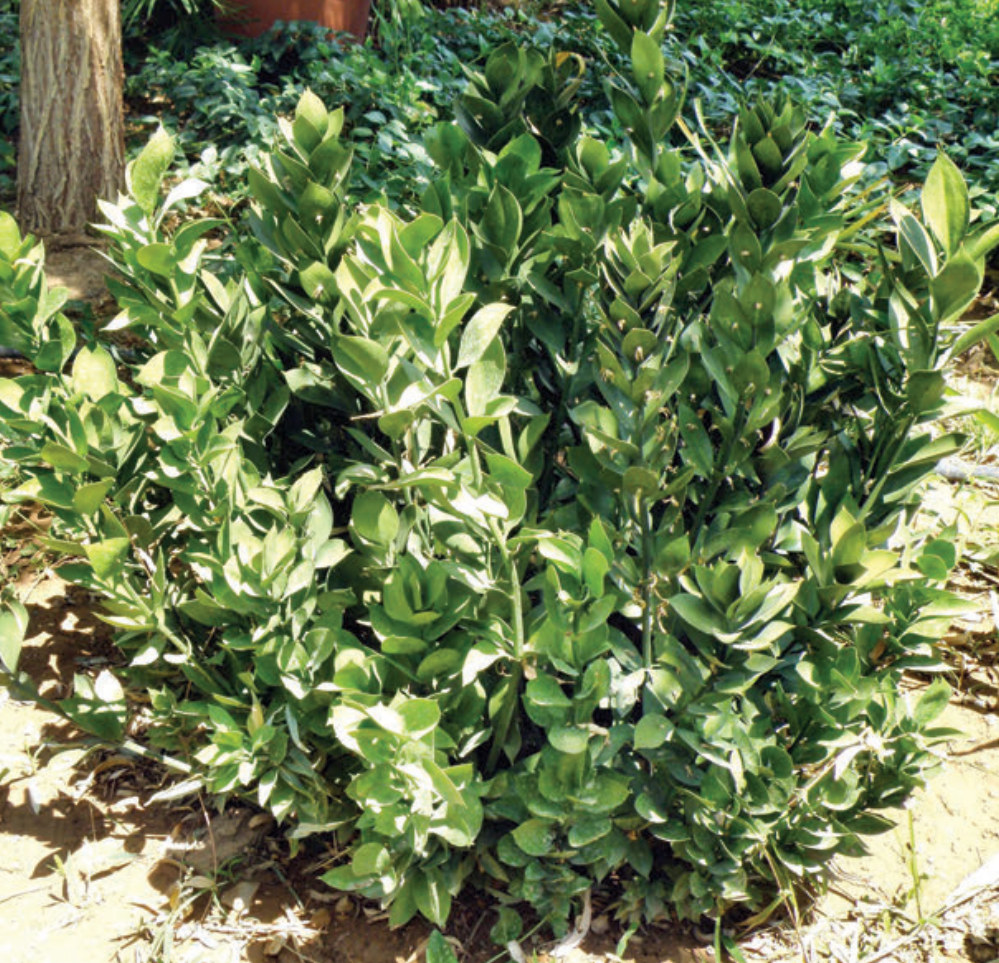
Plant name
Safander
Latin name
Ruscus aculeatus L
Common names
Asafard, Asafard, Prickly Myrtle, Rooster's Head
foreign names
Eng. Butcher's Broom, Fr. Thorny Broom
The group
Safandariyya
Habitat and Geographic Distribution
The Mediterranean region, extending into the Euro-Siberian and western Irano-Turanian regions.
The plant's native habitat is the Mediterranean basin, the Caucasus, North Africa, and western Asia.
Botanical description
The stem is rigid, branching, and erect.
The true leaves are 60.
This perennial, dioecious shrub is green, short in length, membranous, semi-scaled, uterine, or triangular, and acuminate.
The terminal stems emerging from the axils of the true leaves are flat, leaf-like, and are called "leaf stems." These stems are green, rigid, ovate to 1 cm, and gradually taper to form a spiny tip.
The flowers are unisexual, 4-1.5 cm long, uterine, leathery, and borne in the middle of the midrib on either the lower or upper surface of the leaf stem, supported by a bract.
The segments are free, flat, and unequal.
The internal rotator segments are narrower than the external ones.
The meristem is composed of stamens, whose filaments are joined into a tube.
The female flowers are 3 mm long, the male flowers 2.5 mm long, the calyx reaches a length of 1 cm, spherical, with fused filaments, but it does not terminate in anthers, and surrounds a single stigma-like ovary.
The fruit is a berry, about the diameter of a nearly spherical seed. 2 - Red, flowering occurs from March to May
Used part
The part used varies depending on the type and preparation; a reliable or competent reference should be consulted before use.
chemical components
Steroidal saponins (4-6%), the most important of which are ruscine, ruscoside, and aglycones, including ruscogenin and neoruscogenin.
It also contains glycolic and glyceric acids, potassium salts, euparone, and ruscodibenzofurane, including benzofuranes.
Nine phenolic compounds were detected in all properties.
Apigenin-C-hexoside-C-pentosideisomer III was the main compound in the aqueous extract, and in the hydroethanol extract, quercetin-O-de-oxyhexoside-hexoside was followed by the apigenin-C-hexoside-C-pentoside isomer.
III Medicinal Properties and Uses: The rhizomes possess diuretic properties (alcoholic acids, potassium salts) and anti-inflammatory properties (roscogenin).
The saponin compounds (roscogenin, neuroscogenin) have astringent and vascular-strengthening properties, which improve It improves blood circulation, making the drug's preparations a supportive treatment for chronic venous insufficiency and for associated problems such as edema, venous stasis, cramps and slowed movement of the lower extremities, and varicose veins and ulcers of the lower extremities.
The drug is available as a powder in capsules or as an oral liquid extract, and as a cream (Ruscorectal) and suppositories for external use in cases of itchy and burning hemorrhoids.
The plant's roots are used in pharmaceutical and cosmetic preparations due to their effectiveness.
Anti-inflammatory, anti-phlebitis, and anti-thyroid.
Reduces edema around the lower legs and ankles in adults with HIV/AIDS (CVII).
Primarily used as a diuretic, the rhizomes are used to treat urinary disorders and as a laxative.
All properties have revealed antioxidant activity.
The roots have not shown toxic effects on non-tumor cells.
Used medicinally to relieve the symptoms of mild venous insufficiency (heaviness in the legs).
Precautions: It is preferable to use it under medical supervision, as the drug is a venous vasoconstrictor.
Its use can cause an increase in blood pressure in some individuals, as well as digestive disturbances, allergies, and vomiting. Not to be used by pregnant women.
Properties and medical uses
The rhizomes possess diuretic properties (alcoholic acids, potassium salts) and anti-inflammatory properties (roscogenin).
The saponins (roscogenin, neuroroscogenin) have astringent and vascular-strengthening properties, improving blood circulation.
This makes the preparations an effective treatment for chronic venous insufficiency and associated problems such as edema, venous stasis, lower limb spasms and sluggishness, and varicose veins and ulcers of the lower extremities.
The drug is available as a powder in capsules or as an oral liquid extract, and as Ruscorectal cream and suppositories for external use in cases of itchy and burning hemorrhoids.
The plant's roots are used in pharmaceutical and cosmetic preparations for their anti-inflammatory, anti-phlebitis, and anti-thyroid activity.
It reduces edema around the lower legs and ankles in adults with HIV/AIDS.
(CVII is primarily used as a diuretic, and the rhizomes are used to treat urinary disorders and as a laxative.
All properties have revealed antioxidant activity.
The roots have not shown toxic effects on non-tumor cells.
It is used medicinally to relieve the symptoms of mild venous insufficiency, such as heaviness in the legs.) (Precautions: It is preferable to use it under medical supervision, as the drug is a venous vasoconstrictor.
Its use can cause an increase in blood pressure in some individuals, as well as digestive disorders, allergic reactions, and vomiting. It should not be used by pregnant women.)
Side effects and precautions
Allergic reactions or drug interactions may occur; self-use should be avoided by pregnant and breastfeeding women, children, and patients with chronic diseases.
Other uses
The tender shoots contain no toxic substances and can be eaten raw or cooked, as in the case of wild asparagus.
The fruits are poisonous due to their saponin content. In warm climates, it is cultivated as a medicinal or ornamental plant.
the environment
A forest plant that grows on dry slopes.
It prefers temperate climates, and its behavior varies depending on the region.
It can tolerate drought and calcareous soils in Mediterranean areas.
It is flexible in its light tolerance, growing in closed, medium, or open environments alike.
The plant can be cultivated in various soil types except loose sand; it prefers heavy clay soils.
Agriculture and productivity
It is propagated by division, where the mother plant is divided into several sections, each containing a root and a stem.
These sections are then planted separately at intervals of 40-50 cm and watered thoroughly, as the plant loves water.
The roots then spread, and vertical stems emerge, filling the spaces between the sections, while lateral growth increases.
Division and planting can be carried out at any time of year, provided water is available.
The hollyhock is not typically cultivated as a field crop.
If a harvest is desired, it is planted in fields among trees to provide adequate shade, or along irrigation ditches and walls (in shaded areas).
Hollyhocks are not usually fertilized, especially in fertile soils, but when grown in poor soils, fertilization with a 2-2-1 compound fertilizer can be used.
To harvest, the plants are cut above the soil surface and then dried in the open air under direct sunlight.
The remaining roots are then watered.
In the ground to produce new plants. Urginea maritima (L.) Baker. Drimia maritima (L.) Stearn
History and Heritage
The scientific name of the genus is derived from the plant's Latin name, and the species name, aculeatus, is also Latin and means "thorny," referring to the plant's sharp, leafy stem.
It is a medicinal plant known since ancient times and is still sold by herbalists under the name "rooster's stomach," referring to its red, berry-like fruits. The part used is the rhizome (which is grayish in color).
Medical note
This information is for educational purposes only and does not constitute medical advice.
Poisonous or potent plants should only be used under the supervision of a qualified physician or pharmacist.
Related images


