Melon | A medicinal plant in the Akhdar encyclopedia
Dill is a poisonous and dangerous plant, especially seedlings and young plants, which contain high concentrations of xanthate, a compound with anti-division properties, potentially leading to the formation of toxic components. Research suggests that this compound may have an effect in reducing the…
Plant name
The Shabeth
Latin name
Xanthium strumarium L
Common names
The spit, the zero, the sticky
foreign names
Eng. Lesser burdock, Burrweed. Fr.Cachurrera
The group
Star
Habitat and Geographic Distribution
It is widespread throughout most of the world
Botanical description
cm, covered with short, layered hairs.
100 - A perennial herb with a thick, erect stem.
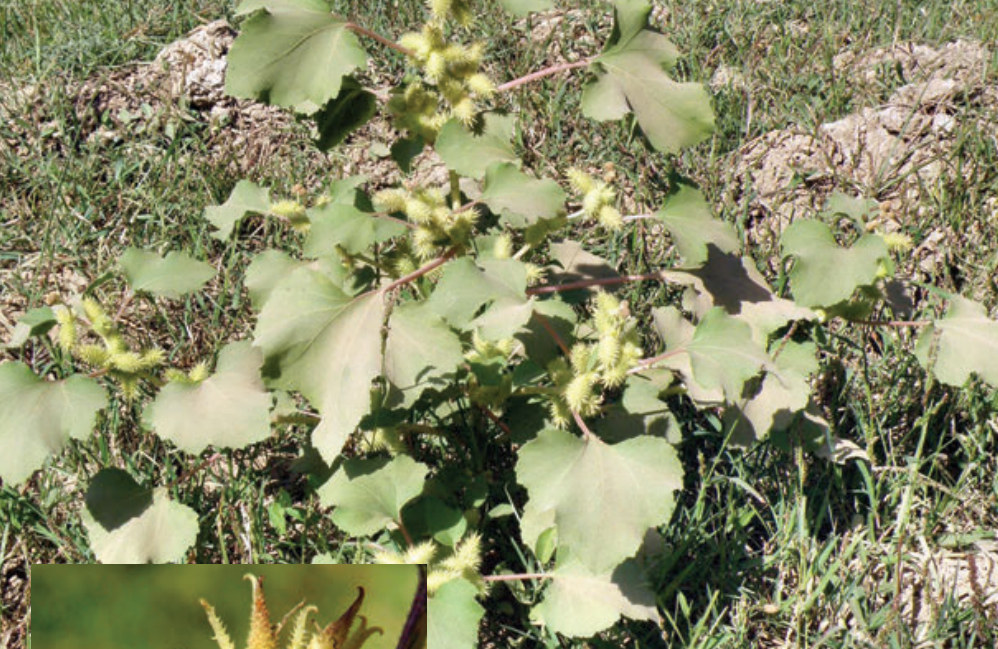
The leaves are simple, alternate, thornless, triangular in general shape, with irregularly lobed and toothed margins, and a heart- or pedicel base.
The petioles are approximately equal in length to the leaf blade.
The flowers are unisexual, clustered in monoecious, unisexual heads.
The male heads are spherical, with numerous tubular flowers, surrounded by free bracts, and are located at the ends of branches.
The female heads are located below the male heads in the axils of the upper leaves, singly or in small groups.
The head contains two flowers lacking calyx and corolla, each consisting only of a pistil.
Both flowers are surrounded by a leathery bract that fuses with the fruit, encircling it and ending in one or two straight, spiny teeth equal in length to the spines.
The fruit is a compact, seedless acinus, 1 cm in diameter, covered with hooked spines.
Each acinus is surrounded by a tough, ovate to oblong bract, the lower two-thirds of which are covered with stubby hairs and glands. Flowering occurs from May to September.
Used part
Leaves, fruits, and roots.
Latin name: Xanthium strumarium L., Xanthium natalense Widder, Xanthium pungens Wallr
chemical components
The fruits contain sterols (phytosterols).
The leaves contain tannins, including xanthan gum, and 36% zea (a toxic compound that lowers blood sugar).
The seeds contain proteins, atractyloside glycosides (comprising several unsaturated fatty acids, primarily oleic and linoleic acids), similar volatile glycosides, fatty oil similar to that found in the fruits, and resinous substances.
Properties and medical uses
Dill is a poisonous and dangerous plant, especially seedlings and young plants, which contain a high concentration of compounds with cell-division-inhibiting properties, and thus the potential for the formation of toxic components.
Research indicates that these compounds have an effect in reducing the proliferation of cancer cells.
Extracts of the fruit possess antiseptic and antifungal properties against some strains of bacteria and fungi, and references indicate their antispasmodic and hypoglycemic properties.
A decoction of the leaves and fruit is used traditionally for its analgesic, diaphoretic, and diuretic properties, and to treat inflammation of the nasal mucous membranes.
An infusion of the leaves is used topically to eliminate certain types of parasites and as an astringent in the treatment of wounds and rheumatism.
A decoction of the seeds is used internally to eliminate tapeworms, and the ground seeds (in the form of an ointment or alcoholic extract) are used topically as an anti-inflammatory and to treat ulcerated wounds.
A decoction of the roots is used for its emetic properties and to treat fever and scrofula.
Side effects and precautions
The plant is poisonous in all its parts; symptoms of poisoning manifest as irritation of the digestive system, respiratory and behavioral disturbances, and general weakness.
Other uses
A yellow dye is extracted from the leaves and used to dye cotton fabrics.
the environment
The plant grows along roadsides, rivers, canals, fields, and abandoned lands.
It prefers sunny locations.
It grows in most soil types and prefers dry, vertebrate soils. It tolerates low temperatures up to
Agriculture and productivity
The plant reproduces by seeds sown directly in the permanent soil in spring or autumn, and can regenerate itself later, as its seeds are dispersed by the wind.
It is considered a noxious weed in many parts of the world and has become an invasive species in many areas.
Its invasion can be controlled and eliminated by collecting, chopping, and mixing it with fresh manure, then aerobically fermenting it to produce compost.
However, adding it delays the compost's maturation, possibly due to its antibacterial properties. Berberis vulgaris L. Berberis racemosa Stokes
History and Heritage
The name means "yellow," referring to the use of the leaves and roots in the preparation of the plant.
The Latin name *xanthos* comes from the Greek *Glenus*, meaning "swine disease," due to its historical use in treating struma (a disease caused by the dye *strumarium*).
The plant was historically used to treat thyroid and urinary tract diseases, diarrhea, and cholera.
Medical note
This information is for educational purposes only and does not constitute medical advice.
Poisonous or potent plants should only be used under the supervision of a qualified physician or pharmacist.
Related images


