White Wormwood | A medicinal plant in the Akhdar Encyclopedia
The essential oil (thujone, santonin alcohol) possesses antibacterial and antifungal properties. Santonin has anthelmintic properties. Research has shown the antioxidant activity of aqueous wormwood extract and its effectiveness in treating cutaneous leishmaniasis. Research indicates the efficacy o…
Plant name
white herbaceous wormwood
Latin name
Artemisia herba-alba Asso
Common names
white herbaceous wormwood
foreign names
Eng. Arabian wormwood, Fr. White mugwort
The group
Star
Habitat and Geographic Distribution
Haw: The Mediterranean Sea, and it spreads in the Middle East and North Africa in particular
Botanical description
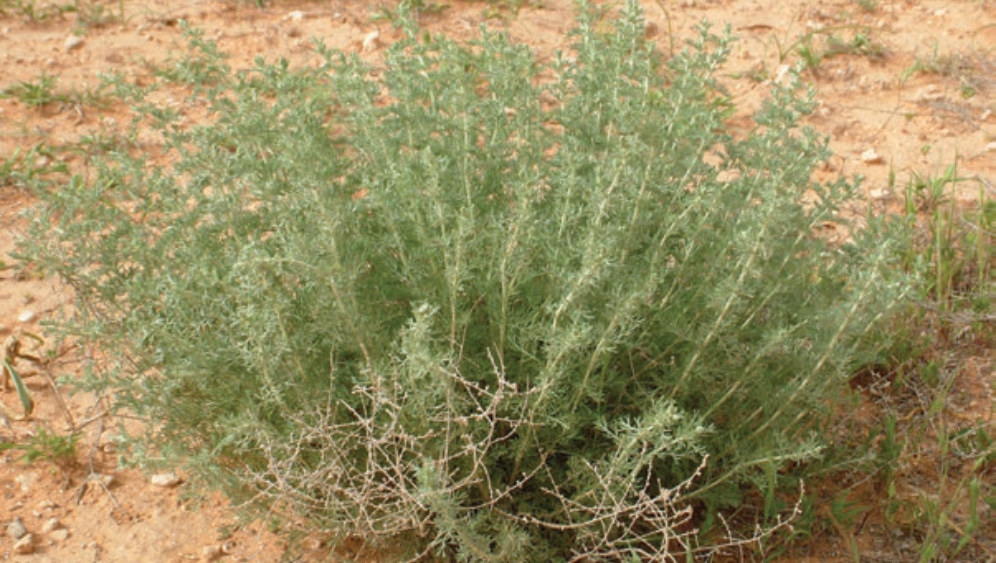
40 cm, fragrant - a small shrub, long and fragrant, densely hairy, becoming bare laterally, silvery in color, with numerous stems, its roots are shallow and gray.
The stems are erect and rigid, each ending in a branched, erect inflorescence.
The leaves of the sterile branches and lower stems are petiolate, ovate to round in general appearance, deeply divided more than once (or twice) into elongated segments.
The flowering stem leaves are shorter, with few lobes, and the leaves of the lower branches are grouped.
The heads are flat, oblong, gradually becoming pinnate.
The bracts are compound and layered; the outer ones are small and round (4 mm), with 4 mm at the base, long, herbaceous, and hairy in texture; the inner ones are longer, oblong, rounded at the apex, membranous, and glossy.
The fruit is an oblong, bare, and smooth acinus. Flowering occurs from September to December.
Used part
The flowering plant is complete except for the roots.
Latin name: Artemisia herba-alba Asso. Artemisia sieberi Besser, Seriphidium herba-album (Asso) Soják
chemical components
Yellow in color, its chemical composition varies significantly.
The flowering vegetative parts contain: volatile oil, depending on the plant's geographical origin and chemical type, generally consisting of monoterpene compounds, especially oxygenated ones, and alcohols up to α-β thujones, camphor, and 1,8-cineole.
Among its components are cineole (approximately 12%), artemisia ketone, and santolina alcohol (13%).
This explains why livestock prefer grazing on it in autumn and are less receptive to it in spring.
Other components include sesquiterpene ketones such as artemisinin, cirsilineol, and hispidulin, as well as valphenates, including santonin. Bitter substances include santonin.
Properties and medical uses
The volatile oil (thujone, santonin alcohol) possesses antibacterial and antifungal properties.
Santonin has anthelmintic properties.
Research has shown the antioxidant activity of aqueous wormwood extract and its effectiveness in treating cutaneous leishmaniasis.
Studies indicate the efficacy of aqueous leaf extract in lowering blood sugar levels, and there is evidence of its importance in treating certain neurological diseases (Alzheimer's).
It is used in the manufacture of malaria drugs.
Artemisinin is an ingredient in wormwood.
Wormwood, with its volatile oil and santonin, is an important plant used in traditional medicine.
A decoction of the plant is used to treat coughs, phlegm, stomach cramps, digestive disorders, flatulence, worms, liver insufficiency, and diarrhea.
An infusion is used to alleviate diabetes.
An infusion of the flowers is used topically as a poultice as an antiseptic, antibacterial, antifungal, and for the ripening of boils, skin ulcers, and eczema.
White wormwood volatile oil is used in veterinary medicine as an external antiseptic for animals and as a repellent.
Side effects and precautions
It should not be used excessively or continuously due to its content of the toxic compound santonin. It should not be used by pregnant women.
the environment
It is found in dry and semi-dry bioclimatic zones on sandy and loamy steppes and calcareous loamy plateaus.
It has a rainfall of mm/year, and sometimes the temperature decreases.
It is drought-tolerant and lives on rainfall above which may be high in winter, which affects its existence within the bioclimatic zone in which it lives.
Agriculture and productivity
Wormwood propagates naturally by seeds collected after ripening, and can be sown later.
It can also be propagated by semi-hardwood cuttings or by division.
Other species include: *Artemisia scoparia* (Waldst.
& Kit.) *Oligosporus scoparius* (Waldst.
& Kit.) *Less.*, *Artemisia gracilis* (L'Hér.
ex DC.), *Artemisia capillaris* (var. scoparia) *Pamp.*, and *Draconia scoparia* (Waldst. & Kit.) *Soják*.
History and Heritage
It means white grass. The genus name, herba-alba, was mentioned previously, but the species name...
Medical note
This information is for educational purposes only and does not constitute medical advice.
Poisonous or potent plants should only be used under the supervision of a qualified physician or pharmacist.
Related images


