Hemlock | A medicinal plant in the Akhdar encyclopedia
A highly toxic plant, no longer used, even small doses can cause a drop in blood pressure and rapid breathing. It was formerly used in folk medicine as a sedative, antispasmodic, and cough suppressant. It was also used topically to treat back pain, bruises, and poor circulation. Traditionally, it i…
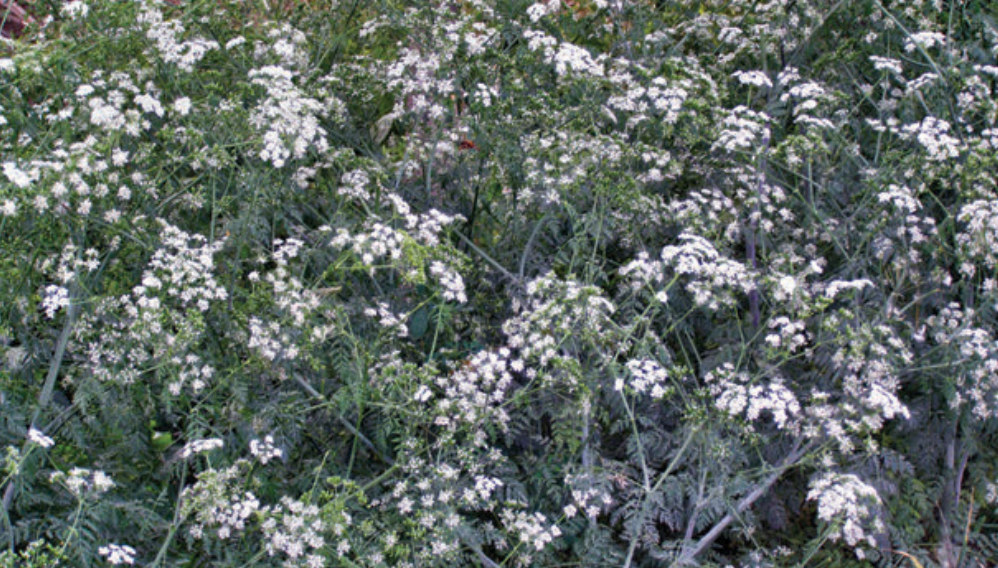
Plant name
Hemlock
Latin name
Conium maculatum L
Common names
Hemlock, a poisonous parsley-like plant
foreign names
Eng. Hemlock, Fr. Cigue d’Athenes
The group
celery
Habitat and Geographic Distribution
Turanian. - Siberian and Mediterranean, extending into the Iranian-European region
Botanical description
Poisonous and sometimes more so, bare.
The roots are spindle-shaped.
The stem is erect, branching.
150 - Biennial or perennial herb, 40 cm long - The sema is hollow, notched, mottled, the branches are often opposite or perian.
Lower leaves are 2-4 cm long, with long petioles, generally triangular in shape, and lobed more than once.
The upper leaves are oblong or ovate.
Upper leaves are semi-plying, bipinnately compound, with linear lobes.
The inflorescence is a compound umbel, deciduous, uterine, and apical.
The bracts are opposite the leaves, terminal, long-stalked, and composed of 3 mm, more discreet than the fruit stalks, solitary, and 6-rayed.
The simple umbels are 3 mm long, broadly ovate, and the fruit segments become curved at the 2-4 x 2.5 cm side.
The fruit is a double acinus, and its dimensions at maturity are: strongly ribbed and wavy. Flowering occurs from April to June.
Used part
Herbaceous plants, flowering tops, and fruits
chemical components
The entire plant contains alkaloids belonging to the piperidine group, comprising up to 2% of its content.
The most important of these are coniine (cicutine), methylconiine, coniceine, and conhydrine (all toxic alkaloids).
It also contains polynes, primarily falcarinol, and furanocoumarins, including bergapten.
Additionally, it contains phavonoids, such as diosmin.
The fresh leaves and flowers contain a transparent, yellowish aromatic oil with an unpleasant odor.
The main component of The flower and leaf oils contain germacrene (D) at 27.2% and 41.0%, respectively.
The leaf oil contains β-ocimene, while the flower oil contains β-ocimene (Z) at 14.3% and β-myrcene (β-myrcene) at 9.3%.
Both the green leaf and flower oils are characterized by the presence of volatile compounds composed of unsaturated fatty acids, similar to those found in the flower oil.
These volatile alkaloids, which may act as an attractant for insect pollinators, are similar to those found in the flower oil.
Coniine, in its chemical structure, is what makes hemlock known for its toxicity.
Properties and medical uses
A highly toxic plant, no longer used, even small doses can cause a drop in blood pressure and rapid breathing.
It was formerly used in folk medicine as a sedative, antispasmodic, and cough suppressant.
Topically, it was used to treat back pain, bruises, and ischemia.
Traditionally, it is used to treat mild rheumatic pain, stomach aches, peptic ulcer pain, nervousness, and insomnia.
Topically, it was used to treat back pain, bruises, and chronic peripheral ischemia.
Conium maculatum extract is traditionally used to treat cervical cancer.
The alkaloid part of the plant has shown analgesic efficacy at a dose of 200 mg/kg and anti-inflammatory efficacy at a dose of 200 mg/kg.
Hemlock essential oil can be used as a general antimicrobial.
Side effects and precautions: Do not use during pregnancy.
High doses cause respiratory depression, back pain, and anxiety, leading to paralysis.
Toxic doses cause burning mouth, excessive salivation, visual disturbances, muscle weakness, and other symptoms that can lead to death.
Side effects and precautions
It should not be used during pregnancy.
High doses cause respiratory depression, back pain, anxiety, and subsequently paralysis.
Toxic doses cause burning in the mouth, excessive salivation, visual disturbances, weakened bites, and other symptoms that can lead to death.
the environment
It grows wild in meadows and wet places, and on: riverbanks, canals and streams, roadsides, agricultural fields and heavy soils in general.
Agriculture and productivity
It is propagated by seed, which is sown broadcast in beds after mixing it with soil or sand at a ratio of 1:4 to regulate its distribution, or in rows at a spacing of 60 cm between rows and 15-20 cm between plants.
Thinning is carried out when the seedlings reach a height of 5 cm.
The plant requires regular watering during its growth period and responds well to fertilization.
Coriandrum sativum L., Coriandrum majus Gouan., Coriandrum sativum subsp. indicum Stolet., Bifora loureiroi Kostel., Coriandropsis syriaca H. Wolff
History and Heritage
Hemlock maculatum is the ancient Greek and Latin name for poison hemlock, while the species name Conium means "red-stained." The plant's toxicity has been known since ancient times, and the Greeks used it to execute criminals.
It is said that the philosopher Socrates died in 399 BC after ingesting hemlock sap.
The parts used are the herbaceous plant, flowering tops, and fruits. Latin name: Conium maculatum L.
Medical note
This information is for educational purposes only and does not constitute medical advice.
Poisonous or potent plants should only be used under the supervision of a qualified physician or pharmacist.
Related images


