Fennel | A medicinal plant in the Akhdar encyclopedia
Fennel is used in traditional medicine for a wide range of ailments related to the digestive, endocrine, reproductive, and respiratory systems. It is also commonly used as a galactagogue (milk-producing agent) in lactating mothers. Results based on traditional uses and scientific evaluation indicat…
Plant name
fennel
Latin name
Foeniculum vulgare Mill
Common names
Fennel, sweet fennel, aniseed, bitter fennel, aniseed
foreign names
Eng. Fennel, Fr. Fenouil
The group
celery
Habitat and Geographic Distribution
The Mediterranean basin and southern Europe are the plant's native habitat.
It is cultivated in France, Britain, Germany, the United States, southern Argentina, and in Asia, including India, China, and Iran. Egypt and Syria are among the largest producers of high-quality sweet fennel.
Botanical description
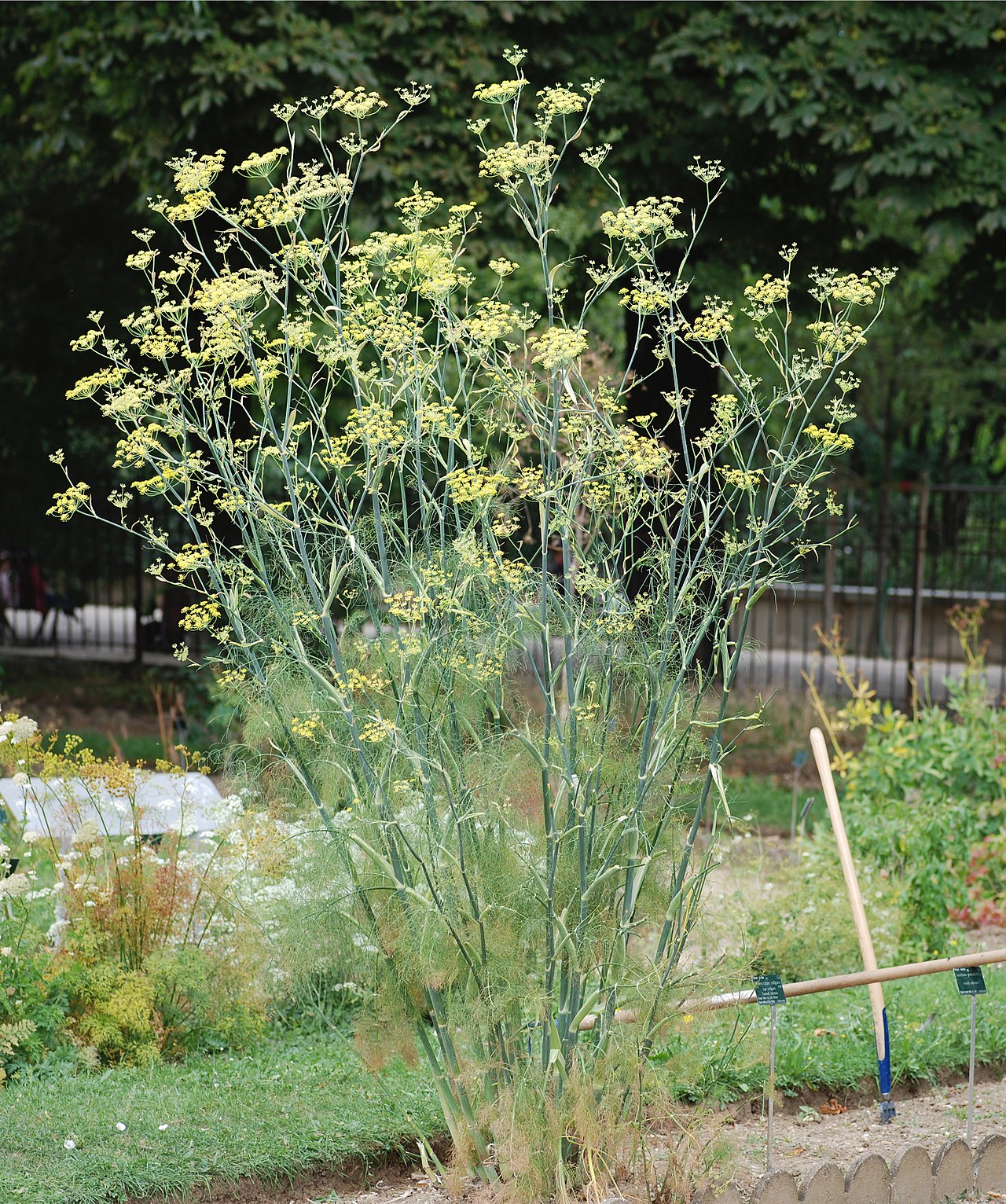
0.8 Aromatic herb, biennial to perennial, m tall.
Stems are erect, branching, rigid, smooth, and hairless.
1.5 Lower leaves are petiolate, divided into very thin, thread-like lobes; upper leaves have a long, broad sheath.
The inflorescence is a compound umbel, consisting of 1 cm, radiating rays of equal length, about 10 cm in diameter.
Bracts are absent.
Flowers are small, yellow, and hermaphroditic.
The calyx is reduced to a circular ring.
Petals are curled outwards.
Male flowers are stamens; female flowers are bicarpels; the ovary is inferior.
The fruit is a double acinus, yellowish-brown, elliptical, ribbed to cylindrical, with a prominent surface, 3-8 mm long, and strongly aromatic when ripe.
Several varieties of fennel have been developed from the species *Foeniculum vulgare*, the most important being *Bitter fennel* (Foeniculum vulgare subsp.
vulgare var.).
vulgare: Bitter fennel (Sweet fennel) Foeniculum vulgare subsp. vulgare var. dulce: Sweet fennel
Used part
The fruits, seeds, and essential oil extracted from them
chemical components
Fennel fruits contain a volatile oil whose proportions and components vary depending on the variety and geographical origin.
The most important components of the volatile oil are: estragole (2-5%), fenchone (12-33%), trans-anethole (50-75%), myrcene (p-cymene), paracymene, alpha-beta phellandrene, a-pinine, limonene (2%), and myrcene (10-90%).
The percentage of anethole increases in sweet fennel oil, while fenchone decreases in sweet fennel oil.
Both sweet and bitter fennel seeds contain a volatile oil with the same composition as the fruit oil in both varieties.
In addition to traces...
And traces of furanoumbelliferone, scopoletine, osthenol, scoparin: hydroxycoumarins of hydroxycoumarins and flavonoids.
Pyranocoumarins: bergapten, psoralen, columbianetin, xanthotoxin: furocoumarins, 22% oleic acid, 60% petroselinic acid.
It consists of 18% oleic acid.
It also contains fixed oils and minerals A, B, C, and phosphorus, calcium, sulfate, iron, and potassium.
In addition, it contains vitamins A, B, and C, as well as 4% palmitic acid, 14% palmitic acid, linoleic acid, phosphorus, calcium, sulfate, iron, and potassium.
Properties and medical uses
Fennel is used in traditional medicine for a wide range of ailments related to the digestive, endocrine, reproductive, and respiratory systems.
It is also commonly used as a galactagogue (milk-producing agent) in lactating mothers.
Results based on traditional uses and scientific evaluation indicate that fennel remains one of the most widely used herbal plants, having been used for more than forty different disorders.
Fennel essential oil possesses properties that stimulate the stomach and intestines, and is antispasmodic in cases of indigestion.
The compound anethole has a carminative effect, while anethole and fenchone have expectorant and mucolytic effects on the respiratory tract.
Studies have demonstrated that fennel essential oil has antibacterial activity against some types of bacteria and is used to stop bacterial diarrhea.
Estragole has been shown to have effects similar to female hormones in stimulating milk production in nursing mothers, inducing menstruation, and enhancing female libido.
Sweet fennel oil is added to some laxatives to improve their effectiveness and taste.
A decoction of powdered fennel seeds is popularly used as an appetite stimulant, diuretic, and stomach colic reliever.
It is given to children to help them get rid of gas and indigestion, and as an expectorant that is beneficial for colds, coughs, and flu.
The volatile oil, sweetened with honey, is used in cases of laryngitis, bronchitis, and asthma.
A decoction of the powdered plant, including the roots, is used topically as a gargle for mouth and gum inflammation and to wash the eyes in cases of conjunctivitis (pink eye).
Fresh fennel leaves are used to treat chafing of the breasts and genitals by placing them on the affected area and securing them with a bandage.
Boiled leaves, applied warm to the abdomen, are used to expel gas and relieve colic in children.
Precautions: Concentrated fennel oil, both bitter and sweet varieties, should not be used by children.
It is contraindicated in pregnant women and should be used with caution in individuals with peptic ulcers and diabetes.
High doses of the oil can cause congestion and heart palpitations, as well as dizziness, nausea, vomiting, and skin rashes. It may also trigger a seizure resembling an epileptic seizure.
Side effects and precautions
Concentrated fennel oil, both bitter and sweet varieties, should not be used by dreamers, and should be used with caution by individuals with intestinal ulcers and diabetes.
High doses of the oil can cause congestion and heart palpitations, as well as seizures, dizziness, nausea, vomiting, and skin rashes. It may also trigger a convulsive seizure resembling an epileptic seizure.
the environment
It is sensitive to salinity.
Fennel prefers light, fertile, well-aerated soils with a moderate pH.
For flowering and fruiting, the plant grows vigorously at temperatures ranging from 15°C to 20°C, accompanied by moderate rainfall and humidity during the growth and development periods.
For high fruit production, temperatures ranging from 20°C to 25°C require frost-free weather during the vegetative growth period, moderate temperatures, and long days to encourage flowering, fruit set, and fruiting.
Dry, hot weather leads to the formation of underdeveloped, low-weight fruits with a lower oil content.
Agriculture and productivity
Fennel is propagated by seeds sown in the autumn in temperate regions, and after the last frost in colder regions.
Sowing is done at a spacing of 75 x 15 cm, with several seeds placed in each hole if the goal is to obtain fruit.
If the goal is to obtain green leaves, the seeds are first sown in beds, then transplanted to the permanent field after about 6 weeks, at a spacing of 70 x 20 cm.
Irrigation and fertilization with essential and trace elements improve fruit and essential oil production.
Irrigation should be stopped once the seeds have formed but before the fruit has ripened.
It is preferable to harvest the plants and fruits while they are green and tender, before they are fully ripe and dry, as the oil content is higher at this time.
The plants should be cut before sunrise, then dried, threshed, and sifted.
One hectare yields approximately 80-95 tons of fresh, milky-stage grass and 5-7 tons of fruit.
Additionally, one hectare produces 120-140 kg of essential oil from the distillation of the vegetative parts.
One ton of dried fruit yields 10-15 kg of essential oil.
(Petroselinum sativum Hoffm., Petroselinum crispum (Mill.) Fuss., Petroselinum crispum subsp. Crispum)
History and Heritage
The scientific name of the genus is derived from Greek and means "short hair." Fennel and fennel are common names, and have similar forms in Aramaic, Hebrew, and Assyrian.
The scientific name of the genus, Foeniculum, is derived from the Latin "Fenum," meaning "fodder," due to the softness of its leaves.
Fennel is a common and well-known word in the Levant.
The descriptive name for the species, vulgure, means "common." Fennel (Annoot) has been used for thousands of years to treat many diseases.
The ancient Egyptians used it under the name "Shamari," and its seeds have been found in their tombs.
It is mentioned in the Harris Papyrus under the name "Shamarn," and its ancient Coptic name is "Shamarhout." It is also mentioned in another papyrus as "Basbas," a name retained by the Arabs and later modified to "Basbasa." The ancient Chinese, Hindus, and Romans cultivated it and ate its fragrant roots and leaves.
Annoot was among Among the best medicinal substances used in the Middle Ages, its fresh leaves were added to fish and vegetable dishes by the wealthy, while the poor ate its leaves as an appetite stimulant during fasting periods.
Ancient medicine mentions two types of fennel: wild and cultivated, and further subdivided into two varieties: Nabataean and Roman.
Arab and other physicians praised its benefits.
Ibn al-Baytar, al-Antaki, and Abu al-Qasim al-Ghassani mentioned it as an antispasmodic, digestive aid, appetite stimulant, stomach tonic, milk-promoter, and expellant. For worms, and as an aid in wound healing
Medical note
This information is for educational purposes only and does not constitute medical advice.
Poisonous or potent plants should only be used under the supervision of a qualified physician or pharmacist.
Related images