Stored thyme | Medicinal plant in the Akhdar encyclopedia
This drug possesses antispasmodic properties, particularly in the upper gastrointestinal tract, and is used to treat disorders related to the gallbladder, bile ducts, and liver. It is traditionally used to treat obstructive liver diseases, stimulate the digestive system and bowel movements, and tre…
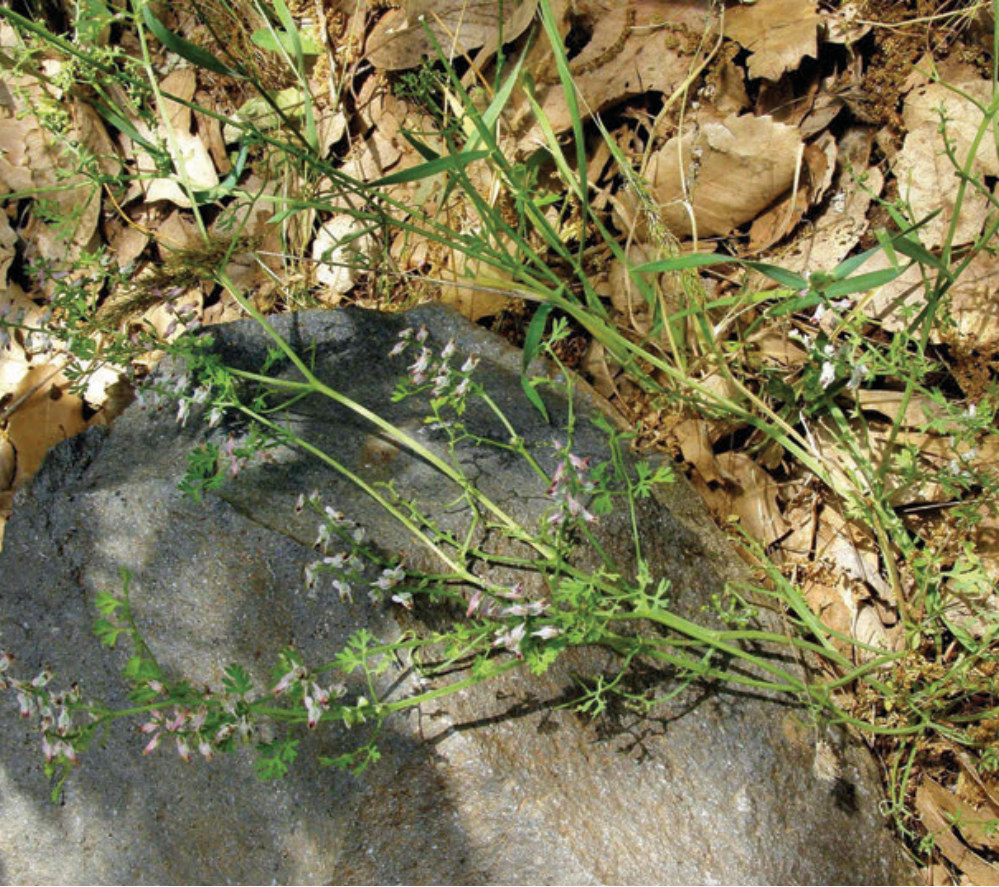
Plant name
The stored product
Latin name
Fumaria officinalis L
Common names
Stored herb, royal herb, earth smoke
foreign names
Eng. Fumitory, Fr. Fumeterre
The group
The Shahrjiya
Habitat and Geographic Distribution
Europe and the countries surrounding the Mediterranean: Its natural spread extends as far as Iran.
Botanical description
The stem is slender, semi-prostrate, angular, branching, and glabrous.
It is a perennial herb, gray in length.
The leaves are alternate, pinnately compound, and deeply divided with thread-like lobes.
The peduncle is short, gray, and arching.
The bracts are equal in length to 9 cm.
The inflorescence is terminal and racemose.
The flowers are tubular, petal-length, in two whorls, luminous, pink, or, with a width less than the width of the petals.
The corolla is 2 cm long.
The sepals are purple, with red tips.
The upper petal in the outer whorl is semi-cylindrical, slanted at the top, with a spur-like base.
The lower petal in the outer whorl is narrow and channel-shaped.
The two petals in the inner whorls are spoon-shaped.
The male has two stamens.
The ovary is unilobed, with a single ovule.
The fruit is a small, gray, notched apex, 2.5 mm in diameter, open, spherical, and contains a single seed.
Flowering occurs from February to June.
Another species is *Fomaria squamata*, which spreads in Mediterranean countries. *Parviflora*
Used part
The aerial flowering parts are odorless, and the taste is bitter and salty.
chemical components
Examples include protoberberine, of which protoberberine derivatives (1.25%), rutin (rutin valphenoid), protopine, scoulerine, fumariline, fumaricine (spirobenzylisoquinoline alkaloids), fumarofine, fumaritine (indenobenzenzazepine alkaloids), and caffeoylmalic acid. Other organic acids include tannins, potassium, and vitamins.
Properties and medical uses
The drug possesses antispasmodic properties, particularly in the upper gastrointestinal tract, and is used to treat disorders related to the gallbladder, bile ducts, and liver.
It is traditionally used to treat obstructive liver diseases, stimulate the digestive system and intestinal motility, and treat cystitis.
Topically, it is used to treat skin diseases, cleanse the skin, and eliminate pimples.
In Italy, it is used to treat atherosclerosis, rheumatism, and to purify the blood.
In Bulgaria, after being purified of alkaloids, it is used as a hypotensive, hypoglycemic, antiseptic, tonic, and antispasmodic.
It is important in traditional medicine in many countries for treating certain skin diseases such as cradle cap (milkworm in newborns), eczema, scabies, and others, or as a diuretic or laxative.
Alcoholic extracts of the plant have a toxic effect on leukemia cells and multiple myeloma cells.
pharmaceutical forms
The plant is available as dried herbal extracts, liquid purees, and tinctures.
Side effects, interactions, and precautions: Possible side effects include symptoms of low blood pressure such as dizziness, weakness, and slow pulse.
At high doses, it can cause seizures and may increase intraocular pressure, leading to glaucoma (which can cause blindness).
King gooseberry should not be used in conjunction with any medications used to lower blood pressure, including heart medications such as calcium channel blockers (e.g., Inderal), beta-blockers (e.g., Inderal), and other drugs that slow the heart rate.
It should be avoided in patients with glaucoma or other conditions that make them prone to seizures.
A doctor should be informed if dizziness, weakness, shortness of breath, or changes in pulse rate are observed.
Side effects and precautions
Possible side effects include symptoms of low blood pressure such as dizziness, weakness, and a slow pulse.
At high doses, purslane can cause seizures and can increase intraocular pressure, leading to glaucoma (which can cause vision loss).
Purslane should not be taken with medications used to lower blood pressure, heart medications called beta-blockers (such as Inderal), heart medications called calcium channel blockers (such as Calan Procardia and Lanoxin), or other drugs that slow the heart rate.
It should be avoided by pregnant or breastfeeding women, and by those with glaucoma or any condition that makes them prone to seizures.
A doctor should be notified immediately if dizziness, weakness, shortness of breath, or a change in pulse rate occurs.
the environment
This plant grows wild in neglected lands, orchards, and along old walls.
It is sometimes classified as a weed: a harmful weed that competes with crops for water and nutrients. It prefers light, well-drained soils and sunny locations.
Agriculture and productivity
It is propagated by seeds sown directly in the permanent ground at the beginning of spring in beds or raised beds isolated from agricultural fields. Papaver rhoeas L. Papaver rhoeas var. vulgare Roth
History and Heritage
The genus name *fumus* is derived from the Latin *smoke*, referring to the smoky gray color of the leaves, their smoky aroma, or their tear-inducing effect, similar to smoke.
The poison is a pharmaceutical substance.
*Fumus officinalis*, the species descriptor, notes that the plant has long been known for its medicinal properties, particularly for skin diseases.
It was mentioned by Dioscorides, as well as by Ibn Sina, al-Antaki, and al-Ghassan.
Medical note
This information is for educational purposes only and does not constitute medical advice.
Poisonous or potent plants should only be used under the supervision of a qualified physician or pharmacist.
Related images


