Amlaine | Medicinal plant in the Akhdar Encyclopedia
Iris rhizome has expectorant properties and is used to treat bronchitis, asthma, and whooping cough. Flavonoids have an inhibitory effect on the c-AMP phosphodiesterase enzyme. Studies have shown that oral use of irisolidone induces the formation of T lymphocytes, T-cells, and Th1 cytokines. irisol…
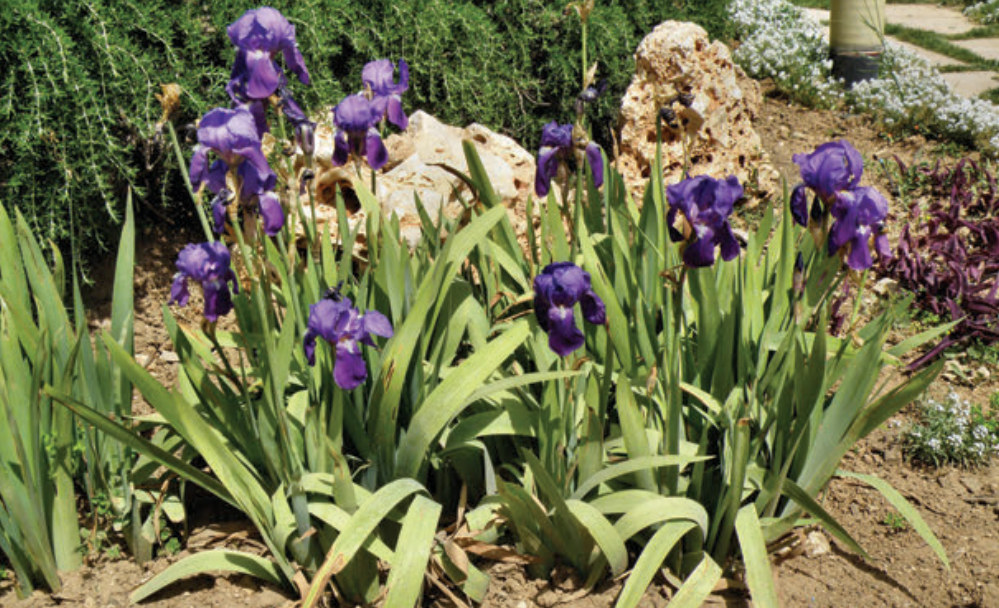
Plant name
Iris amlayne
Latin name
Iris germanica L
Common names
Iris amlayne, eraq al-nut
foreign names
Eng. German Iris, Fr. Allmagnd Iris
The group
iris
Habitat and Geographic Distribution
Its varieties are cultivated in southern Europe, the Mediterranean basin, and North Africa, and in most parts of the world.
Botanical description
The leaves are basal, bluish-green, and sword-shaped.
100 cm - a perennial herb propagated by a thick rhizome.
The flower stalk is simple or branched into several stems.
The flowers are large and fragrant, varying in color from variety to variety (often blue, yellow, purple, white, etc.).
Each spathe is surrounded by two stamens arranged in two whorls.
The outer spathes are flattened or downward-curving and bear two membranous bracts.
The calyx is usually composed of stamens with a line of multicolored (often yellow) hairs.
The inner spathes are erect and lack hairs.
The male is a fused carpel; the ovary is trilobed and inferior, surmounted by a style ending in a third stigma with a free-form appearance.
The female is the stamen. The fruit is an oval capsule. Flowering occurs from March to May.
Used part
Rhizome. Latin name: Iris germanica L
chemical components
0.1-0.3% yellow volatile oil, with a brownish tint (aromatic scent resembling iron; the main compound is iridon, known as iris oil; the most important scent is violet).
Fixed oil.
Myristic acid.
Its components are nutmeg acid and its glycosides.
Irisolone, irisolone, irilon, iridale (50-20%). Starch, magniferine, iris xanthones (such as iris xanthones).
Properties and medical uses
Iris rhizome has expectorant properties and is used to treat bronchitis, asthma, and whooping cough.
Flavonoids have an inhibitory effect on the c-AMP phosphodiesterase enzyme.
Studies have shown that oral use of irisolidone induces the formation of T lymphocytes, T-cells, and Th1 cytokines.
irilone is an immunosuppressant.
The plant has many biological and therapeutic effects, including neuroprotective, blood sugar-lowering, and lipid-lowering effects.
It has antimicrobial, oxidative, anti-inflammatory, anti-intestinal spasm, and antifungal activity, in addition to its immune-boosting and cytotoxic effects.
The rhizome is popularly used to treat ulcers and spasms; it has an antiserotonin effect, helps detoxify the body, increases urination and bile production, and has a mild laxative effect.
This combination of effects makes it useful for treating chronic skin diseases such as acne and eczema.
Side effects and precautions
There are no known risks if the required therapeutic dose is followed.
High doses can cause vomiting, abdominal pain, bloody diarrhea, and severe inflammation of the mucous membranes. It should not be used during pregnancy.
Other uses
Dried aromatic rhizome powder (Ironate) is used in the manufacture of cosmetics such as perfumes, toothpastes, and various scented and antiseptic soaps.
Precautions: No known risks exist when the required therapeutic dose is followed.
High doses can cause vomiting, abdominal pain, bloody diarrhea, and severe inflammation of the mucous membranes. Do not use during pregnancy.
the environment
The iris thrives in diverse environmental conditions, tolerating both high and low temperatures during its growth and flowering.
It is suitable for most soil types, particularly light, sandy, fertile, well-drained, and aerated loamy soils.
It tolerates slightly high acidity and prefers neutral or slightly alkaline soils.
Agriculture and productivity
Irises are propagated vegetatively by dividing rhizomes taken from second-year plants two to three days before planting.
The divisions should be 5 cm long and have well-developed roots.
The rhizomes are placed in rows 65-70 cm apart, with 25-30 cm between plants, at a depth of 10-12 cm.
Approximately 50,000 rhizomes are required per hectare.
Other species include Juglans regia L., Juglans duclouxiana Dode, Juglans fallax Dode, Juglans fertilis hort.
ex Dippel, and Juglans frutescens hort.
ex Dippel, juglans fruticosa short.
ex Dippel, Juglans kamaonia Dode, Juglans orientis Dode, Juglans quercifolia N.Pierce, Juglans regia subsp.
fallax Popov, Juglans regia subsp. sinensis (C.DC.) Ohle, Juglans regia var. kamaonia C. DC.
History and Heritage
The scientific name for the genus comes from Greek mythology, where it is said that Iris was the winged messenger chosen by the gods, whose seven-colored handkerchief was likened to a rainbow, alluding to the diversity and intensity of the colors of the flowers in this genus.
The name means "Iris." The iris, also known as Germanicus, has been considered a symbol of power and magic since ancient times.
It was the name of the Roman god of heaven, and the ancient Egyptians placed it on the cymbals of their kings.
The third petals of its flowers were considered to represent faith, wisdom, and courage. The Arabs used its roots for medicinal purposes.
Medical note
This information is for educational purposes only and does not constitute medical advice.
Poisonous or potent plants should only be used under the supervision of a qualified physician or pharmacist.
Related images


