Salsola | A medicinal plant in the Akhdar encyclopedia
The essential oil possesses antibacterial (against both Gram-negative and Gram-positive bacteria) and antiseptic properties. It lowers blood cholesterol, acts as a diuretic, and dilates blood vessels. Recent studies have demonstrated its diverse biological activities, particularly its hepatoprotect…
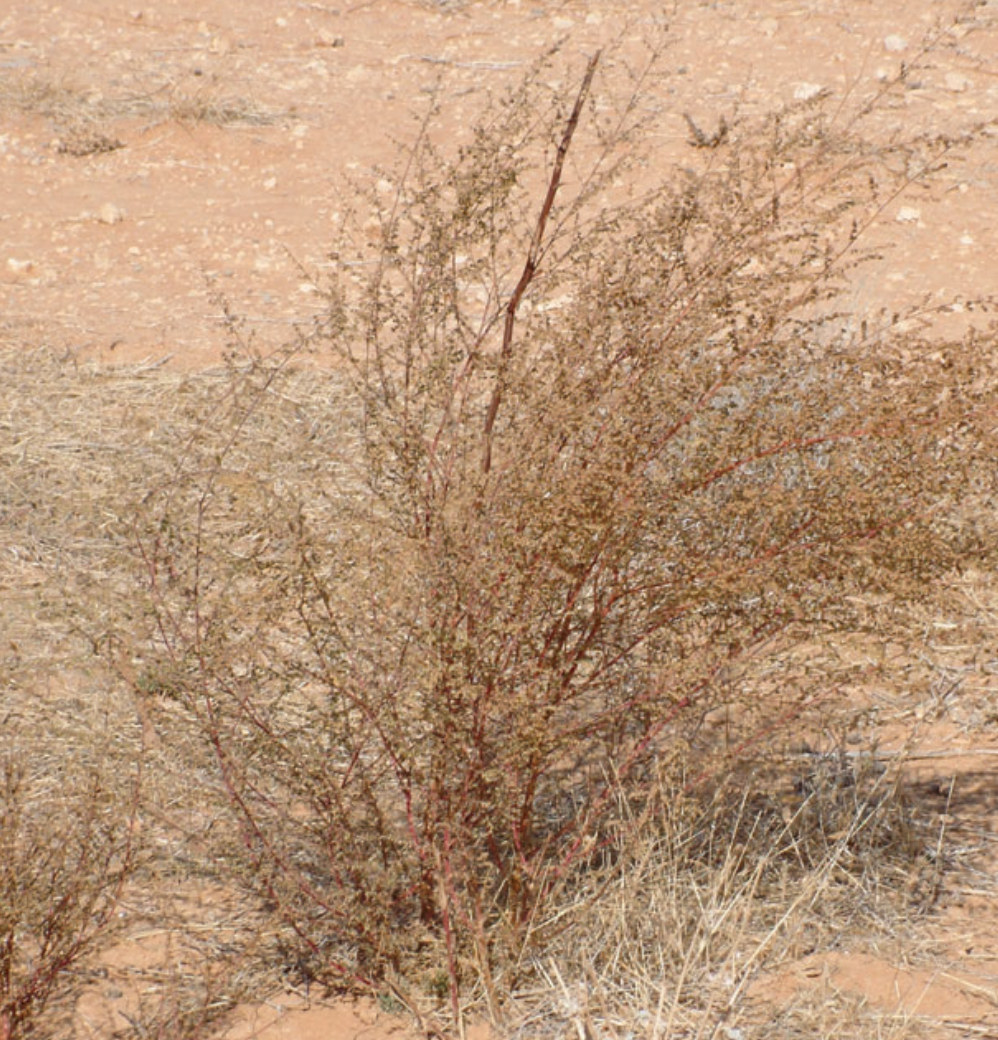
Plant name
Salmas
Latin name
Artemisia scoparia Waldst. Et Kit
Common names
Salmas
foreign names
Eng.Red stem worm wood, Fr.Armoise
The group
Star
Habitat and Geographic Distribution
Haw: The Mediterranean Sea, and it spreads across northern Africa
Botanical description
The stem is smooth and glabrous except for the basal leaves, which are covered with a fine, grayish down.
The stem is a biennial herb with an erect, branching stem that forms broad, flattened clusters.
The basal leaves are petiolate, ovate or rounded in general shape, deeply divided into oblong, spoon-shaped lobes with dull apex.
The leaflets are narrow and stiff, deeply divided into lobes.
The inflorescences are numerous, ovate, small, and spherical in diameter, borne by peduncles, surrounded by bracts of equal size.
The outer bracts are peduncles and ovate, while the inner ones are oblong with relatively broad, dry, membranous margins.
The peripheral flowers are female and arranged in a single row, with a reduced, ligulate, three-toothed corolla.
The central flowers are tubular and hermaphroditic.
The fruit is an obovate, smooth acinus. Flowering from September 7th to November
Used part
The part used varies depending on the type and preparation; a reliable or competent reference should be consulted before use.
chemical components
Scoparone, its main component, comprises 0.75% of the flowering stem and seeds, and contains a volatile oil with a percentage reaching [amount missing].
Properties and medical uses
The essential oil possesses antibacterial properties (against both Gram-negative and Gram-positive bacteria) and is antiseptic.
It lowers blood cholesterol, acts as a diuretic, and dilates blood vessels.
Recent studies have demonstrated its diverse biological activities, particularly its hepatoprotective and anti-inflammatory properties.
The flavonoid compounds extracted from it exhibit inhibitory activity against several influenza virus strains.
Salmas is traditionally used to treat jaundice, hepatitis and gallbladder inflammation (stimulating bile secretion), urinary retention, itchy weeping sores, jaundiced hepatitis, influenza, and as a general antiseptic.
Side effects and precautions
Allergic reactions or drug interactions may occur; self-use should be avoided by pregnant and breastfeeding women, children, and patients with chronic diseases.
the environment
It grows in steppe regions, prefers light, well-drained, sunny areas, and prefers warm, dry places.
Agriculture and productivity
It reproduces by seeds collected after ripening, and can be sown later.
It can also be propagated vegetatively.
Other names include: Calendula officinalis L., Caltha officinalis (L.) Moench, Calendula aurantiaca Kotschy ex Boiss., Calendula eriocarpa DC., and Calendula hydruntina Lanza.
History and Heritage
It means "broom-like" (i.e., its shape resembles a broom).
The genus name was mentioned previously, while the species name, the Latin name, is: Artemisia scoparia Waldst. Et Kit. Oligosporus scoparius (Waldst. & Kit.) Less
Medical note
This information is for educational purposes only and does not constitute medical advice.
Poisonous or potent plants should only be used under the supervision of a qualified physician or pharmacist.
Related images


