Stinking Rue | Medicinal Plant in Akhdar Encyclopedia
The plant's alkaloids are anti-exudative, chalpensine is a fertility inhibitor, and coumarin derivatives and alkaloids are antispasmodic. It is also antifungal, abortifacient, and photosensitizing. The leaves were historically used in folk medicine to reduce libido in men…
Plant name
stinking rue
Latin name
Ruta graveolens L
Common names
stinking rue
foreign names
Common street (Eng.), fetid street (Fr.).
The group
Rue
Habitat and Geographic Distribution
Native to eastern and southeastern Europe
Botanical description
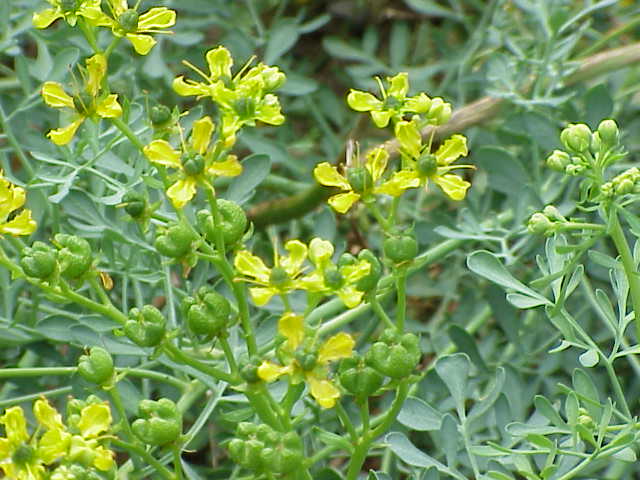
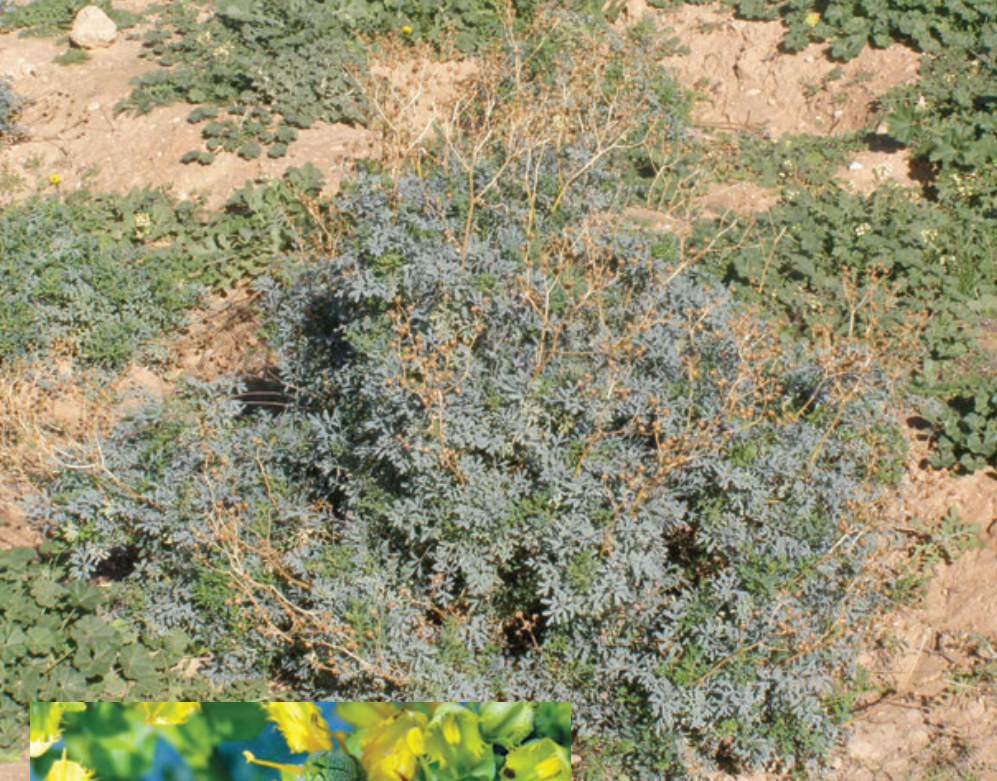
A shrub with a sharp, strong odor, bare, bearing dotted glandular stamens, 1 m long.
The stem is woody at the base, reaching about 1 cm in length, 10 - ascending, highly branched.
The leaves are alternate, bare, deeply divided into 1 mm segments, ellipsoidal, 15 - equal in length, toothed margin, downward curled - sometimes wavy, reddish-grey in color, 1 mm, stalked.
The calyx is four-lobed to ovate-uterine.
The flowers are - mm, stamens, heart-shaped - 8 - inflorescence, bracts 1 cm, oblong, fringed.
The male flowers are ovate, acute at the apex.
The petals are four, yellow, about - 10 - lobes, heart-shaped, 10 - lobes, style simple.
The fruit is a capsule, 4 mm long, with stamens.
The ovary is four-lobed, deeply divided into 8 lobes, the lobes bearing furrows on the dorsal side.
The seeds are numerous in each lobe, angular, 4 mm long, consisting of 1 mm. Towards flowering from May to June
Used part
The flowering aerial parts and the oil extracted from the plant
chemical components
The plant contains several types of alkaloids, including: gamma-skimmianin (of which skimmianin is mentioned), furoquinoline alkaloids (0.4%), kokusaginine, ptelein, dictamnin, gamma-fagarine, graveolineine, graveoline (of which graveolin is mentioned), quinoline alkaloids (of which quinoline alkaloids are mentioned), arborinine-2-arylquinoline, acridine alkaloids, arborine (of which quinazoline alkaloids are mentioned), 2-undecanone, methyl-nonyl-cetone (especially in the leaves), the most important components of which are 0.5-3% volatile oil, quercetin, and 2-5% rutin (of which rutin is mentioned), and flavonoids.
Xanthotoxin, bergapten, pregaptin, chalepensin (including chalepensin), furocoumarins (furocoumarin compounds), xanthyletine (including pyranocoumarins, pryanocoumarin compounds), savinin, helioxanthine (including lignans)
Properties and medical uses
The alkaloids of the plant are anti-exudative, chalpensine is a fertility inhibitor, and coumarin derivatives and alkaloids are antispasmodic.
The plant is antifungal, abortifacient, and photosensitizing.
The plant's leaves were traditionally used in folk medicine to reduce male libido, treat delayed menstruation, as an abortifacient and contraceptive, and to treat hepatitis, eczema, toothache, earache, indigestion, and diarrhea.
The essential oil is used topically to treat rheumatism and joint pain.
Studies have shown that the plant extract and its compound rutin significantly improve learning and spatial memory, and have also significantly increased serum antioxidant capacity.
The brain, as well as the level of TBARS in serum and brain tissue.
The results also showed that rue has a significant free radical scavenging effect.
The plant extract contains biologically active compounds that effectively inhibit the proliferation of cancer cells.
The aqueous-alcoholic extract of rue showed relaxing activity on the tracheal rings of rats.
The results indicate that the effect in relaxing the trachea is mediated by a non-competitive antagonistic mechanism.
Orally administered rue extract (200 mg/kg) showed an analgesic effect.
Precautions for use: [Not specified] It is used by pregnant women as an abortifacient.
Taking high doses of the plant for the purpose of abortion can cause serious consequences (vomiting, liver damage, sleep disturbances, dizziness, delirium, and fainting).
Using the plant or touching its tender leaves to the skin may cause photosensitivity due to the presence of furocoumarine and furoquinoline alkaloids.
Side effects and precautions
Allergic reactions or drug interactions may occur; self-use should be avoided by pregnant and breastfeeding women, children, and patients with chronic diseases.
the environment
The plant thrives in various soil types in sunny areas.
It tolerates lime in some soil types but not in saline soil types. It can withstand temperatures up to 10°C and low temperatures.
Agriculture and productivity
The plant is propagated by seeds sown in late winter and early spring, and vegetatively by semi-hardwood cuttings from October to November. (Populus nigra L., Aigiros nigra L.)
History and Heritage
The scientific name of the genus is the ancient Greek and Latin name for these plants.
The plant has been used medicinally for a long time, and in Al-Antaki's treatise on rue, it is stated: "One dirham of it cures paralysis and facial palsy, resolves colic and colitis, flatulence, jaundice, spleen problems, and difficulty urinating.
It expels worms and stones, and cures all diseases of the uterus, chest, hemorrhoids, and asthma when taken orally." Women used to cultivate it near their homes because they believed it had the power to ward off evil spirits.
Among the things mentioned in ancient medical books is that it suppresses sexual desire, stops ejaculation, expels bodily waste through urine, strengthens the stomach, and is beneficial for paralysis, tremors, and colitis.
It is good and has been proven effective when used as incense, oil, or perfume by someone possessed by a jinn.
Medical note
This information is for educational purposes only and does not constitute medical advice.
Poisonous or potent plants should only be used under the supervision of a qualified physician or pharmacist.
Related images