Hyssop | A medicinal plant in the Akhdar encyclopedia
Hyssop varieties possess expectorant and anti-inflammatory properties and are used in preparations for treating respiratory diseases. They also have digestive, diuretic, carminative, emmenagogue, and wound-healing effects. The volatile oil has also been observed to have antibacterial and antifungal…
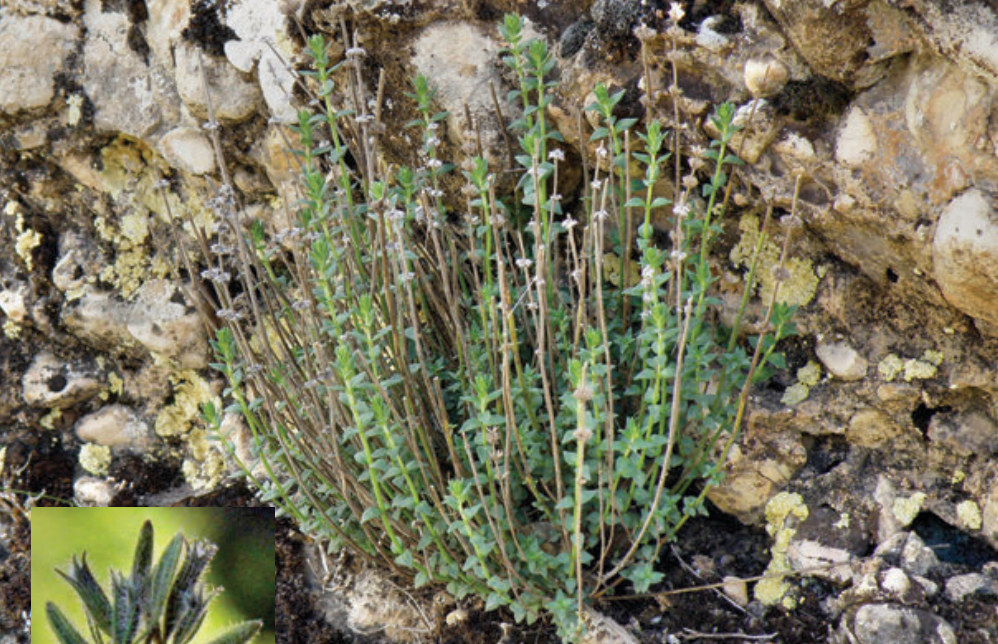
Plant name
Hyssop
Latin name
Micromeria nervosa (Desf.) Benth
Common names
Hyssop, tea herb
foreign names
Eng. Micromerie, Fr. Micromie
The group
oral
Habitat and Geographic Distribution
Middle East
Botanical description
40 cm, sparsely hairy except for the basal part - a perennial herb, branching from the base, its upper length covered with flat hairs.
The stem is rigid, ascending, simple (single) or sparsely branched, purplish in color, and arises from a semi-woody rhizome.
The leaves are short-stemmed to semi-petioled, with slightly downward-curved margins, prominent veins on the underside, semi-heart-shaped at the base, ovate, and semi-acute at the apex.
The flowering leaves are equal in length to or slightly longer than the flowers.
The primary inflorescence is cymose, spike-like, covered with abundant stiff hairs, and contains numerous flowers, which are clustered in secondary inflorescences resembling short spikes, with the lower rhizomes widely spaced and the upper ones closely packed.
The bracts are reddish-brown in shape.
The flowers have a spur, covered with bracts; the calyx is tubular, lobed, violet-tinged, and about [length missing] long; the corolla has long hairs, erect teeth, sparsely hairy, and the corolla tube is almost embedded in the calyx.
It is violet and about [length missing] long.
The small, oval florets are [number missing].
The fruit is formed from the inflorescence, which develops from February to May.
Micromeria myrtifolia and M. fruticosa are other species and are widespread in the Mediterranean region.
Used part
Flowering plant. Latin name: Micromeria nervosa (Desf.) Benth. Satureja nervosa Desf
chemical components
Hyssop varieties contain volatile oil, the proportions and components of which vary.
The most important component is beta-caryophyllene, which reaches 0.5% in some species.
In M.
myrtifolia, the oil content reaches 81%, while in M.
fruticosa, it reaches 44%.
The most important component of this oil is pulegone, and its most important component is pulegone.
Properties and medical uses
Hyssop varieties possess expectorant and anti-inflammatory properties and are used in preparations for treating respiratory illnesses.
They also have digestive, diuretic, carminative, emmenagogue, and wound-healing effects.
The volatile oil has also been observed to have antibacterial and antifungal activity.
Hyssop varieties are traditionally used as a medicinal tea to treat coughs, asthma, and digestive disorders. A decoction or oil is also used topically to treat certain skin conditions.
Side effects and precautions
The presence of polygon in the essential oil causes abortion in pregnant women, therefore it should not be given during pregnancy.
the environment
Hyssop species grow wild in rocky, degraded soils on mountain slopes and hillsides, and are successfully cultivated in semi-humid and semi-arid environments with moderate temperatures. They also thrive in fertile soils.
Agriculture and productivity
The seeds are sown in autumn, broadcast in shallow beds.
One hectare requires 4-5 kg of seeds.
Basic mineral fertilizers are added in autumn before planting, and another quantity of nitrogen is added after cutting.
The plants are harvested during the flowering stage by cutting their stems at a height of 5-10 cm.
The yield of green fodder in the first year is estimated at 2-2.3 tons/ha, reaching up to 8-9 tons/ha in subsequent years.
The plants remain in the ground for 5-6 years.
Origanum syriacum L., Majorana syriaca (L.) Rafin., Schizocalyx syriacus (L.) Scheele
History and Heritage
Hyssop has long been used to treat coughs in the eastern Mediterranean, and it is found in almost every home in that region.
A decoction of the plant is used as a hot compress, both preventatively and therapeutically, during the winter months.
Hippocrates prescribed hyssop for treating pleurisy, and Dioscorides recommended it, along with cultivated rue, for treating asthma and catarrh.
Antiochus stated, "Nothing is comparable to hyssop for diseases of the chest and lungs, asthma, coughs, and wheezing, especially when mixed with figs, rue, and honey..." It was also mentioned by Ibn Sina and Ibn al-Baytar.
Medical note
This information is for educational purposes only and does not constitute medical advice.
Poisonous or potent plants should only be used under the supervision of a qualified physician or pharmacist.
Related images


