Hawthorn (Atriplex hawthorn) | Medicinal plant in the Akhdar Encyclopedia
The drug possesses antioxidant, antiviral, lipid-lowering, and blood pressure-lowering properties. It stimulates myocardial contractions, reduces peripheral vascular resistance, and leads to increased coronary blood flow and increased myocardial resistance to oxygen deficiency. Some companies are s…
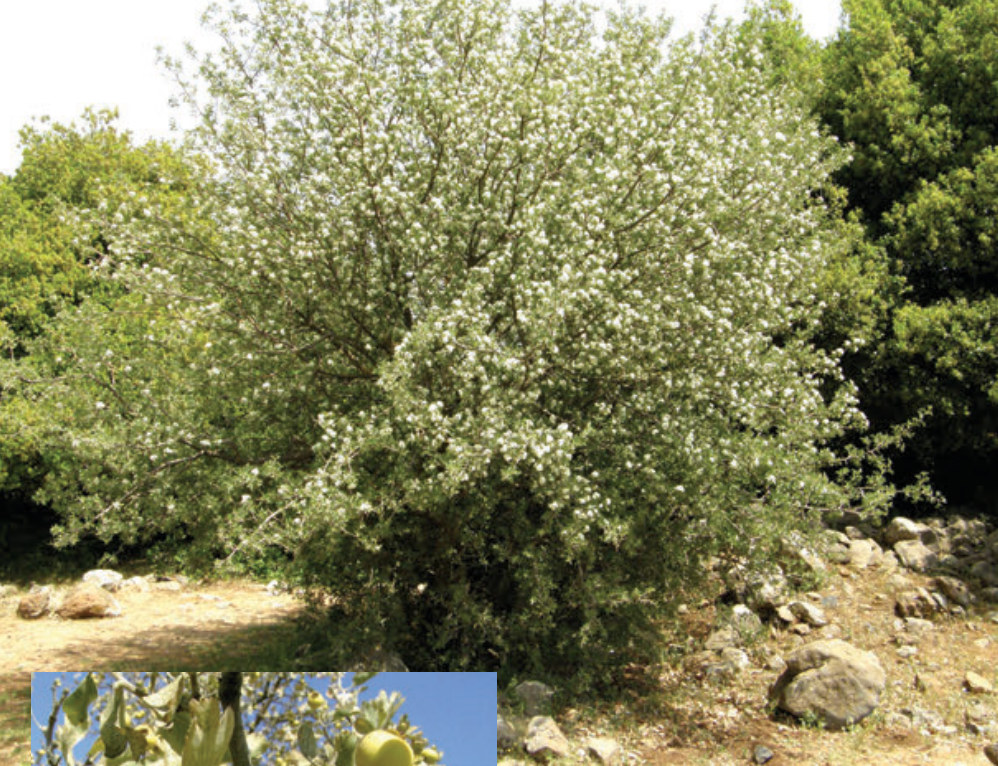
Plant name
hawthorn
Latin name
Crataegus azarolus L.
Common names
Hawthorn, wild hawthorn
foreign names
Eng. Hawthorn, Fr. Aubépine
The group
Pink
Habitat and Geographic Distribution
Turanian.- Rashkian states surrounding: the Mediterranean, Africa, and the Iranian region
Botanical description
A deciduous tree or shrub, reaching height (rarely taller), with few thorns and slow growth.
Young branches are hairy and brownish in color.
Leaves are alternate, somewhat leathery, ovate, obovate, pedicel-shaped, with toothed margins, and are downy, with a glossy upper surface and a grayish underside.
Patina is short.
The inflorescence is a raceme, with sepals fused into a hairy tube.
The calyx is 10 cm long, and the peduncle is 1.5 flowers.
The flowers are white and hairy, about sessile in diameter, free, and nearly round.
The male flowers have many stamens.
The corolla is 2 mm long, with curved lobes, about 4 cm long, and includes 2 petals.
The fruit is yellow, nearly spherical, 3-3 cm in diameter, with an inferior ovary ending in a 3-mm kernel.
It is hairy when young and ripens at the end of summer and the beginning of autumn.
Flowering occurs from March to April.
Other similar species, *C.
monogyna*, are found in the eastern Mediterranean and northern Africa, including: *Hawthorn monogyna* (the two species are similar in their chemical composition and uses), *Hawthorn sinaica*, and *Hawthorn sinaica*.
Used part
Flowers or leaves with flowers, fruits (harvested at the end of autumn)
chemical components
Orientine, iso-vitexine, iso-vitexine, free flavonoids or glycosides including: vitexine, luteoline, rutine, hyproside, quersetin, iso-orientine, and iso-orientin.
C.
monogyna, C.
sinaica, catechin and epicatechin dipolymers, epicatechin, catechin, flavan derivatives: catechin.
Anthocyanins and anthocyaninides, crataegolic acid including: triterpene acid, triterpene compounds
Properties and medical uses
The drug possesses antioxidant, antiviral, lipid-lowering, and blood pressure-lowering properties.
It stimulates cardiac muscle contractions, reduces peripheral vascular resistance, and leads to increased cardiac perfusion and enhanced myocardial resistance to oxygen deficiency.
Some companies still prepare hawthorn fruit as a dietary supplement to nourish and revitalize the heart and circulatory system.
It is generally used to treat early-stage heart failure that does not require digitalis, and in cases of palpitations, depression in the pericardium, bradycardia, and cardiac arrhythmias.
The ethanolic leaf extract has shown free radical scavenging activity.
It has also demonstrated antimicrobial activity against Escherichia coli, Pseudomonas aeruginosa, Staphylococcus aureus, and Candida albicans.
Oral administration of ethanolic leaf extract or β-O3 acetylursolic acid to mice resulted in a decrease in blood glucose levels.
The ethanolic leaf extract significantly reduced LDL-C, VLDL-C, and TG, and increased HDL-C.
Both the ethanolic leaf extract and β-O3 acetylursolic acid also reduced pancreatic lipase activity and inhibited genotoxicity caused by 2H2O.
This extract revealed significant cellular antioxidant activity against reactive oxygen species in cells.
It was also used to treat diarrhea, sore throat, internal bleeding, dizziness, convulsions, hypertension, arteriosclerosis, and heart disease.
A decoction of the bark or roots was used to treat hypertension.
Hawthorn is traditionally used to treat arteriosclerosis, Burger's disease (a condition of blood vessel blockage and inflammation), heart failure, high blood pressure, and rapid heartbeat.
pharmaceutical forms
Hawthorn (Hawthorn Berry, Cradi plant) is available in the form of berries, pods, leaves, and fruits, sold under names such as Hawthorne Heart.
Side effects, interactions, and precautions include fatigue, nausea, and sweating.
High doses may cause a drop in blood pressure and irregular heartbeat.
Hawthorn should be used under strict medical supervision.
It should not be combined with alcohol, other central nervous system depressants such as cold and allergy medications, analgesics, sedatives, or in patients recovering from drug addiction.
It should also not be used with antihypertensive drugs or cardiac drugs called cardiac glycosides, such as Lanoxin.
The plant should be avoided in patients with diabetes and those with allergies.
Driving and other hazardous activities should be avoided until further notice.
Hawthorn is not consumed by individuals with allergies.
Other members of the Rosaceae family should be consulted for further information.
Side effects and precautions
Fatigue, nausea, and sweating are possible side effects.
High doses may cause low blood pressure and irregular heartbeat.
Hawthorn should only be used under medical supervision.
It should not be combined with alcohol or other central nervous system depressants, such as cold and allergy medications, analgesics, and sedatives.
It is also contraindicated in patients recovering from drug addiction, with blood pressure-lowering medications, and with cardiac medications called cardiac glycosides, such as Lanoxin.
The plant should be avoided by pregnant and breastfeeding women, and hawthorn should not be taken by those allergic to any of its components.
the environment
Hawthorn is an environmentally resilient species, tolerating heat, frost, and coastal environments.
It requires full sun (tolerance to partial shade) and is wind-resistant.
It thrives in various soil types, though it prefers fertile soils (S), and is tolerant of alkalinity and drought. It prefers well-drained loamy soils with a loamy base.
Agriculture and productivity
A slow-growing plant with a long lifespan (500 years).
It propagates by seed and grafting.
It tolerates pruning to remove tangled branches and suckers in winter.
The trees are fertilized with organic fertilizer in autumn.
Hawthorn is susceptible to several insects, such as aphids and scale insects, and is also affected by fire blight.
Fire blight is treated by pruning and removing infected branches 30 cm from healthy parts, burning them immediately, and then spraying the trees with appropriate pesticides.
(Fragaria vesca L., Fragaria abnormis Tratt., Fragaria aliena Weihe, Potentilla vesca L. (Scop
History and Heritage
The word "cratos" means "strong" or "strong," referring to the ancient Greek name for the tree.
It derives from the genus Crataegus, which is the common hawthorn.
It is said to have been derived from the word "azarolus," meaning "strong" or "hard." The plant has been known since ancient times by various civilizations.
The ancient Chinese used it to treat cardiovascular diseases.
In Athens, a man marrying was required to carry a hawthorn branch to bring him happiness and ensure the longevity of his marriage.
In ancient Rome, a groom would carry a hawthorn branch and shake it for his bride as he led her to their new home.
It was also hung on children's cradles to protect them from harm and various illnesses.
It is said that Crusader knights carried a hawthorn branch to their wives when they left the Holy Land to preserve the sacred marital bond during their long absence.
And, as a symbol of loyalty, French women would carry their sick children to the Bourgogne forest.
Even today, mothers in the Burgundy region still believe that their prayers for healing will ascend swiftly with the fragrance of the flowers.
Al-Antaki and Ibn al-Baytar mentioned it as "al-Kildar," noting that its fruits cause severe constipation.
Medical note
This information is for educational purposes only and does not constitute medical advice.
Poisonous or potent plants should only be used under the supervision of a qualified physician or pharmacist.
Related images


