Common thyme | Medicinal plant in the Akhdar Encyclopedia
Common thyme possesses antioxidant, bronchodilator, expectorant, antibacterial, antiviral, antifungal, and antiparasitic properties. It is used to treat coughs and bronchitis. A decoction of the plant is used as a bronchodilator, respiratory antiseptic, and to treat whooping cough and asthma. [Furt…
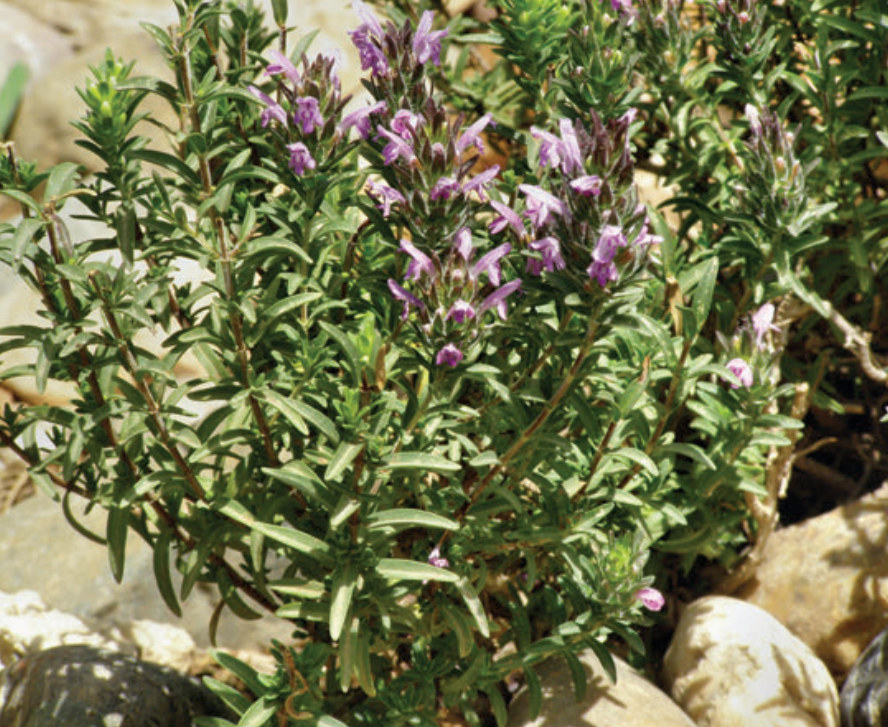
Plant name
Common thyme
Latin name
Thymus vulgaris L
Common names
Common thyme
foreign names
Eng. Common thyme, Fr. Thyme
The group
oral
Habitat and Geographic Distribution
Southern Europe and North Africa.
Botanical description
A perennial herb, highly branched, with an upright, woody, downy stem, reddish-gray in color, bearing 40 - a perennial herb, with leaves and inflorescences long and abundant stamens.
The leaves are aromatic, small, linear or elliptical, entire, with short petioles, their upper surface covered with gray hairs and the lower surface with a rough, stubby surface; their width is about 12 - or stamens, gray in color, with grayish down and some secretory hairs, the blade is leathery, its edges curling towards the base.
The flowers are purple or blue, clustered in bundles around the stem, which in turn form spikes or terminal heads with few flowers; the corolla is slightly bilabial.
The male bracts are small.
The calyx is tubular, downy, bilabial, bearing sacs.
The carpel is superior, the ovary is four-lobed. The fruit is stamens. Female 4. Flowering from May to September
Used part
flowering plant
chemical components
The proportion and type of compounds vary.
It should be noted that there are many chemical strains of this type (the compounds present in the volatile oil) depending on the strain studied.
The most important strains are those dominated by phenolic compounds (carvacrol and thymol) and alcohols (linalool, p-cymene, borneol, p-cymene, carvacrol, thymol, the most important of which is thymol, 2.5% - volatile oil, and others).
Other components include linalool, borneol, 1.35-0.15% rosmarinic acid, caffeic acid derivatives, thymusine, naringenin, apigenin, luteolin, 0.6% oleanolic acid, 2% ursolic acid, and triterpenes.
Properties and medical uses
Common thyme possesses antioxidant, bronchodilator, expectorant, antibacterial, antiviral, antifungal, and antiparasitic properties.
It is used to treat coughs and bronchitis.
A decoction of the plant is used as a bronchodilator, a respiratory antiseptic, and a treatment for whooping cough and asthma.
It is also used as an intestinal antiseptic, immediately for intestinal spasms, as a carminative, as a liver tonic, and in the treatment of urinary tract and bladder infections, and as an expellant of intestinal worms and parasites.
The essential oil shows antimicrobial activity against Streptococcus pyogenes, Staphylococcus aureus, Candida albicans, Salmonella thyphimurium, Escherichia coli, and Pseudomonas aeruginosa, without affecting the intestinal flora.
It is used to reduce spasms of the colon and intestines as it helps to relax the smooth intestinal muscles.
The decoction of the aerial parts is used topically as a gargle to treat gingivitis, and its oil is used for massage to treat back pain, sciatica, rheumatic pains, and to cleanse and treat wounds, acne, and eczema.
It is an antioxidant and antimicrobial agent used in the food industry to increase the shelf life of food products.
Side effects and precautions
Allergic reactions or drug interactions may occur; self-use should be avoided by pregnant and breastfeeding women, children, and patients with chronic diseases.
the environment
Many types of thyme grow wild in abandoned and rocky areas, meadows, the edges of forests, and on sunny slopes in mountainous regions.
It thrives in warm, semi-humid and semi-arid environments and tolerates low temperatures (70-75°C) and winter frosts.
However, moderate to high temperatures and suitable humidity are optimal for commercial production.
Thyme is a light-loving species and is therefore cultivated on southern slopes with long periods of sunshine.
It grows well in all soil types, but well-drained, aerated soils rich in organic matter are ideal. It also flourishes in calcareous soils.
Agriculture and productivity
Fresh seeds, stored for no more than three years, are sown at the end of summer in special nurseries.
Seedlings emerge 15 days after sowing and are transplanted to their permanent location the following spring, planted in rows spaced 45-60 cm apart.
It can also be propagated by stem cuttings.
Thyme is drought-tolerant but requires irrigation if grown as a commercial crop.
The plant responds well to mineral fertilization with essential elements.
The plant blooms from early summer until early autumn.
The foliage is harvested once during the flowering stage and again two months later.
It is then dried in the shade for a week before being packaged.
The economically productive lifespan of thyme is five years, after which replanting is recommended.
One hectare of common thyme yields 0.5-2.5 tons of fresh thyme and approximately 0.1-0.5 tons of dried thyme.
Vitex agnus - castus L.
Agnus-castus alba Carrière, Agnus-castus macrostachya Carrière, Agnus-castus robusta (Lebas) Carrière, Agnus-castus vulgaris Carrière
History and Heritage
The scientific name of the genus is male, as mentioned in the previous section.
The descriptive name for the species is vulgaris, meaning "common." Thyme oil has been used medicinally worldwide since ancient times.
Medical note
This information is for educational purposes only and does not constitute medical advice.
Poisonous or potent plants should only be used under the supervision of a qualified physician or pharmacist.
Related images


