Syrian thyme | A medicinal plant in the Akhdar encyclopedia
The flowering plant possesses antioxidant, antiseptic, and antibacterial properties, particularly against gram-negative bacteria and fungi. Experiments have demonstrated its antiseptic effect on the intestines, eliminating parasites, worms, and E. coli bacteria. A decoction of the leaves and flower…
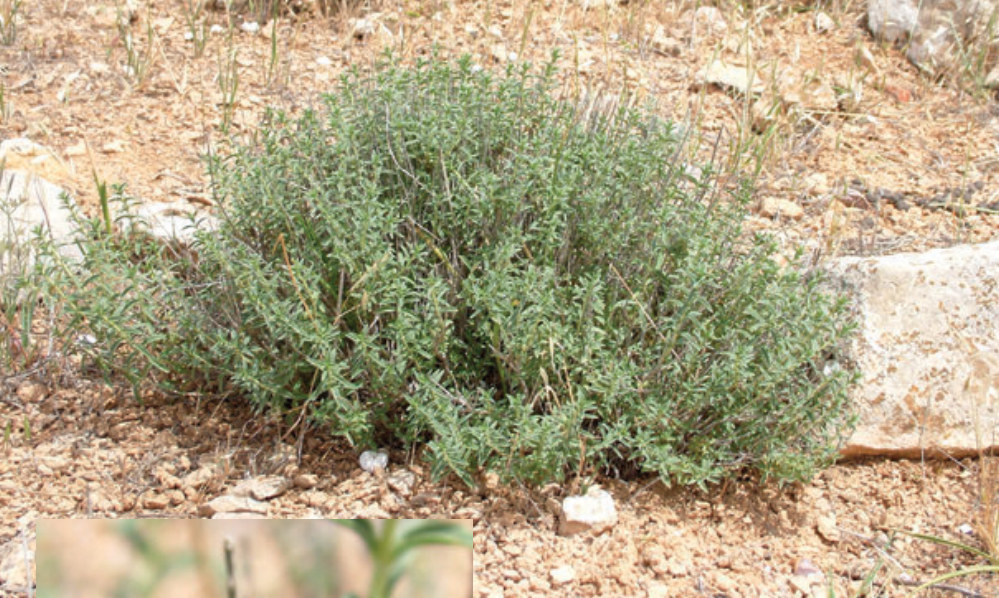
Plant name
Syrian thyme
Latin name
Thymus syriacus Boiss
Common names
Syrian thyme
foreign names
Eng. Thyme, Fr. Thyme de Syrie
The group
oral
Habitat and Geographic Distribution
The eastern Mediterranean regions, mainly spread across Syria, Lebanon, and Jordan.
Botanical description
50 cm - A small shrub, varying in size, with erect, woody branches of varying degrees, rigid, leafy, and white with down.
The leaves are smooth, rigid, erect-flattened, uterine, and acutely apex, abundantly covered with characteristic linear secretory glands.
The flowers are gathered in 3 cm - volatile oils, their dimensions from dense terminal head inflorescences, ovate to subcylindrical.
The bracts are ovate-oblong, bearing 3 mm, 7 - veins, equal in length to the calyx.
The calyx is bilipped and slightly hairy.
The corolla is white, consisting of a tube that protrudes slightly beyond the calyx and divides into two lips; the upper lip is oblong, broad, and tridentate.
The fruit is an ovoid acinus, or the lower lip is toothed.
The stamens are oblong and squamous. Flowering occurs from June to early October.
Used part
The flowering plant's chemical constituents: The flowering aerial parts contain a volatile oil (1.3–1.7%) rich in phenolic compounds, which may reach up to 70%, including thymol, carvacrol (13%), p-cymene, terpinene, caryophyllene, dihydrocarphone, linalool, flavonoids, and tannins.
chemical components
(70%) Rich in phenolic compounds, which may reach 1.3-1.7%.
The flowering aerial parts contain volatile oil (p-cymene), flavonoid compounds, and tannins. (13%)
Properties and medical uses
The flowering plant possesses antioxidant, antiseptic, and antibacterial properties, particularly against Gram-negative bacteria and fungi.
Experiments have demonstrated its antiseptic effect on the intestines, eliminating parasites, worms, and E.
coli bacteria.
A decoction of the leaves and flowers is used colloquially as a laxative and expectorant, beneficial in treating dry coughs, bronchitis, asthma, digestive disorders (as an antispasmodic and carminative, and for treating gastritis and peptic ulcers), and urinary tract and bladder infections.
A decoction of the plant is used topically as a gargle to treat inflamed gums and inflammation of the mucous membranes of the mouth and throat.
The essential oil is used for massage to reduce rheumatic pains, gout, arthritis, and to disinfect wounds.
(Food Uses) Syrian thyme is used as an appetite stimulant and is frequently used in Syrian, Jordanian, and Lebanese cuisine.
It is added to many dishes and pastries to give them a distinctive flavor.
Young, tender shoots are added to pickled olives, and a mixture of dried and ground green shoots is prepared with sesame, sumac, and other ingredients. This mixture is eaten with olive oil as part of a breakfast in Syrian cuisine.
Side effects and precautions
Allergic reactions or drug interactions may occur; self-use should be avoided by pregnant and breastfeeding women, children, and patients with chronic diseases.
the environment
It spreads on sunny, stony, and calcareous highlands in arid, semi-arid to semi-humid regions.
Agriculture and productivity
Thyme is propagated by seed.
Seedlings are then planted in rows, spaced 45-60 cm apart.
It can also be propagated by stem cuttings.
Irrigation is necessary if grown as an economic crop.
The plant responds well to mineral fertilization with essential elements.
The foliage is harvested once during the flowering stage and again two months later.
It is then dried in the shade for a week before being packaged.
If the purpose is nutritional, the foliage is harvested fresh and tender before flowering. Thymus vulgaris L. Origanum Thymus Kuntze, Thymus collinus Salisb
History and Heritage
The scientific name of the genus is the ancient Greek and Latin name for a number of small plants in the family Lamiaceae, and it derives from the ancient Egyptian word tham, which was the name of a plant used in the mummification process.
The descriptive name for the species syriacus means "Syrian".
Thyme varieties have been known and used since ancient times.
Dioscorides described them in his treatments, and thyme was used as an antidote for snake and marine venom.
The Romans burned it, believing its smoke repelled scorpions.
Pliny, in 77 AD, described a decoction of wild thyme as a treatment for headaches.
Thyme varieties have been incorporated into the pharmaceutical industry since the 16th century.
Medical note
This information is for educational purposes only and does not constitute medical advice.
Poisonous or potent plants should only be used under the supervision of a qualified physician or pharmacist.
Related images


