Rhamnus | A medicinal plant in the Akhdar encyclopedia
The plant, containing piperidine alkaloids, possesses anti-inflammatory properties. Research has shown the plant's positive effect in treating diabetes. Studies have also demonstrated the positive effect of a decoction of the plant on diabetic animals, explaining its traditional use in treating dia…
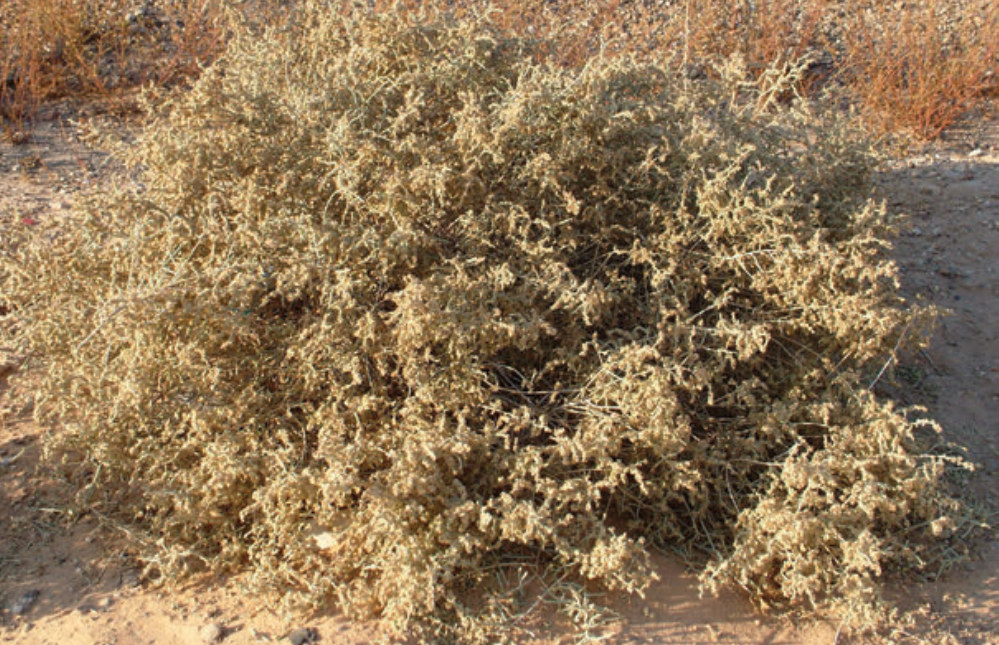
Plant name
The tamarisk
Latin name
Haloxylon salicornicum (Moq.) Bge. ex Boiss
Common names
The saltwort, the acid
foreign names
Eng. Saxoul, Fr. Saxaoul
The group
The official
Habitat and Geographic Distribution
Erain Torain, also known as the common squill, is found in many arid regions of the Arab world, including Kuwait, Qatar, the United Arab Emirates, northern Arabia, Iraq, Palestine, Syria, Algeria, Mauritania, Oman, Mars, Libya, and Tunisia. It is also found in southern Iran and Afghanistan.
Botanical description
The lower stem, 60 cm long, produces new branches each year in an irregular manner.
The branches are jointed, ascending, rigid, and pale to ivory in color, turning waxy yellow when dry.
The leaves are reduced to small, triangular scales, fused into a membranous, funnel-shaped structure with downy hairs on the underside.
The inflorescences are spread, consisting of scattered, short spikes, 6 cm long, mostly found at the ends of main or lateral green branches that form annually.
The flower is hermaphroditic, surrounded by two concave bracts with downy hairs on the underside.
The calyx is simple, consisting of free, alternating stamens with five sepals.
The male is ovate with a papillary apex.
The female is bicarpel-bound, with a superior ovary and two squamous styles ending in rounded linear stromals, directed towards 1 mm (including the length of the wings).
The wings are obovate, mesenteric, and papillary.
The uppermost fruit is large, unevenly arranged, and pale brown. The seeds are horizontal. Flowering occurs from September to November.
Used part
The aerial parts (taste sour and salty). Latin name: Chenopodium ambrosioides L.
chemical components
The aerobic parts contain several alkaloids from the piperidine group, the most important of which are haloxynine, anabasine, halosaline, and haloxine.
They also contain coumarins, saponins, sterols, cardiac glycosides, flavonoids, volatile oil, tannins, and anthraquinones.
Just before flowering, the tips of the plant's branches begin to secrete a sticky, sugary, white substance called "honeydew" or "honeydew." Chemical analysis of *H.
salicornicum* has shown that it contains the alkaloids methylisosalsoline, salsolidine, sosalsolidine, dehydrosalsolidine, N-methyltyramine, oxedrine, tyramine, carnegine, tryptoxine, and scordenripine, among other compounds.
Diterpene and coumarin compounds such as scopolitin, ombileferon, xanthotoxol, isoxyimpratorine, and esculentin
Properties and medical uses
The plant, containing piperidine alkaloids, possesses anti-inflammatory properties.
Research has demonstrated its positive effect in treating diabetes.
Studies have also shown the positive effect of a decoction of the plant on diabetic animals, explaining its traditional use in treating diabetes.
The ash of the plant is used traditionally to treat wounds, burns, and suppurating ulcers, while a powder made from the plant is used to treat colds, weakness, fever, and bone pain.
Steam from the water of the *Artemisia* plant is used to treat rheumatism.
It has antiseptic properties and is used to treat peptic ulcers.
The stem and leaves can be used as respiratory stimulants, vasoconstrictors, muscle relaxants, laxatives, analgesics, antioxidants, antipyretics, antimicrobials, hypotensives, anti-inflammatories, and anticancer agents, in addition to lowering high cholesterol.
Side effects and precautions
Allergic reactions or drug interactions may occur; self-use should be avoided by pregnant and breastfeeding women, children, and patients with chronic diseases.
Other uses
It is a grazing plant, and also a source of firewood, and was used as a substitute for soap.
the environment
The saltbush grows in hot, dry, and very dry regions.
It thrives on plateaus and valleys on sandy, gypsum-sandy, or medium-depth sandy loamy soils with a limestone layer underneath, as well as on silty soils.
It tolerates harsh conditions, particularly high salinity.
The plant accumulates sand around itself, forming mounds that can reach heights of more than half a meter.
Agriculture and productivity
It reproduces by seed.
Its fruits have a short shelf life (9 months to a year) when stored under laboratory conditions.
This period can be doubled when stored in a dry atmosphere at low temperatures (-2°C).
Storage at -5°C also extends the fruit's shelf life.
The optimal temperature for germination ranges between 15°C and 33°C, and germination ceases at 33°C.
Temperatures as low as 3°C do not prevent germination.
It was observed that removing The fruiting sheaths accelerate and increase the germination rate.
Most of the growth of the *Salsola kali* occurs between April and September, and it is preferable to avoid grazing the plant in late summer and early autumn, as this is the critical period for it.
*Salsola kali* L., *S.
acicularis* Salisb., *S.
decumbens* Lam., *S.
turgida* Dumort, *Kali soda* Moench, *Salsola kali* var. hirta* Ten., *Salsola kali* var. vulgaris* W.D.J.Koch
History and Heritage
Salicornicum means wood, while the species name xylon means salty, and halio is the scientific name for the genus, derived from the Greek word for beech. Salicornica means beech-like.
Medical note
This information is for educational purposes only and does not constitute medical advice.
Poisonous or potent plants should only be used under the supervision of a qualified physician or pharmacist.
Related images


