Pomegranate | A medicinal plant in the Akhdar encyclopedia
An infusion of the bark and root bark (tannins) possesses properties that expel parasites causing parasitic infections of the large intestine, such as those caused by the amoeba *Entamoeba histolyca* and the parasite *Escherichia invadens*. The bark of the stem and roots, rich in alkaloids (peltier…
Plant name
pomegranate
Latin name
Punica granatum L
Common names
Pomegranate, or gulnar.
foreign names
Eng. Pomegranate, Fr. The pomegranate
The group
pomegranate
Habitat and Geographic Distribution
The Mediterranean basin, Africa, and Asia. It is cultivated in most Arab countries, particularly in Iraq and the Levant.
Botanical description
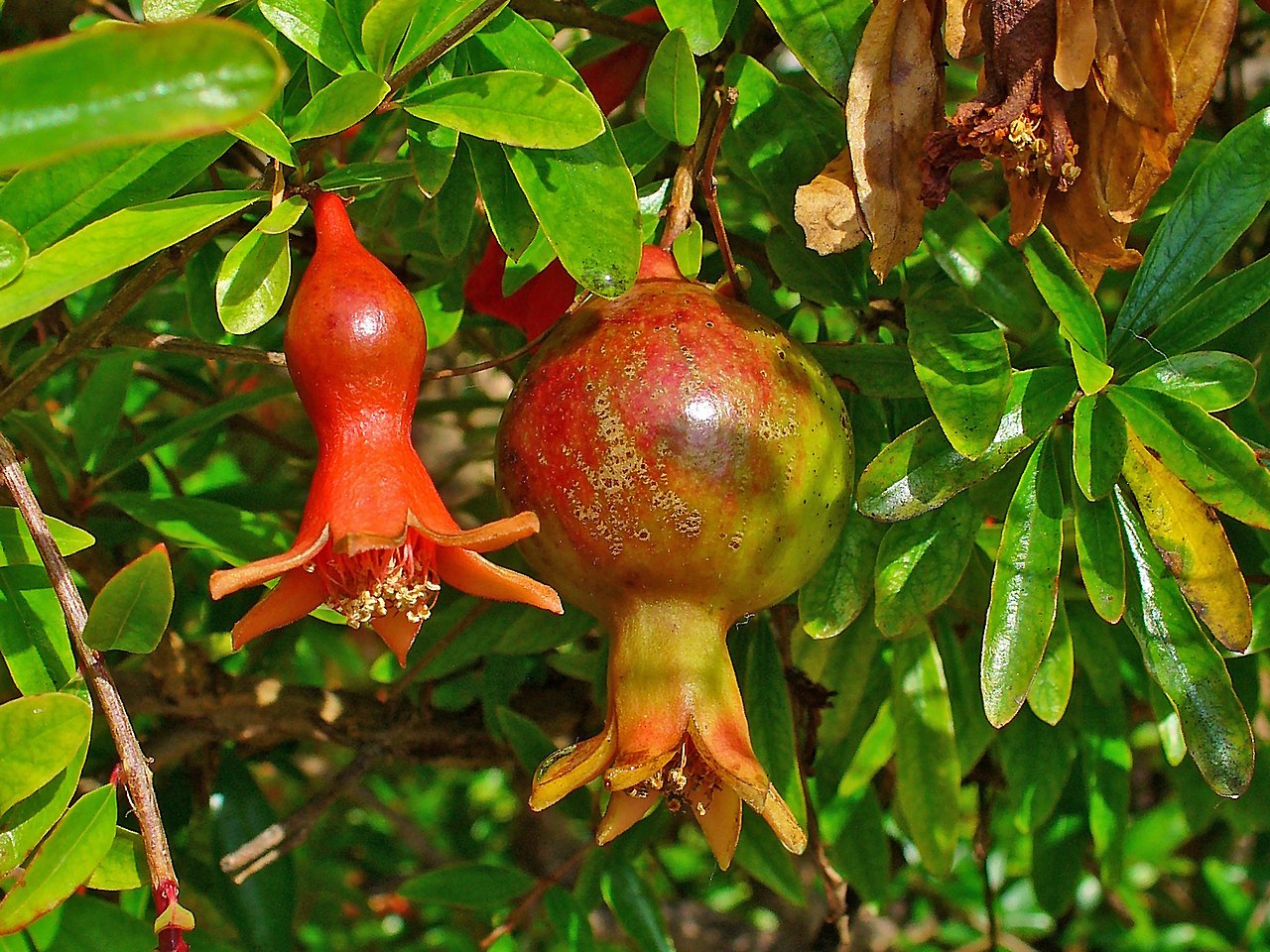
The branches are cylindrical, opposite, with spiny twig-like tips.
The leaves are simple, opposite, 1.5–5 mm long, oblong to ovate, 12–35 mm long, glabrous, stipule-like, smooth, and scalloped, ellipsoidal, semi-erect, entire, blunt-apexed, bell-shaped, pubescent, reddish, with lobes 35–35 cm or more.
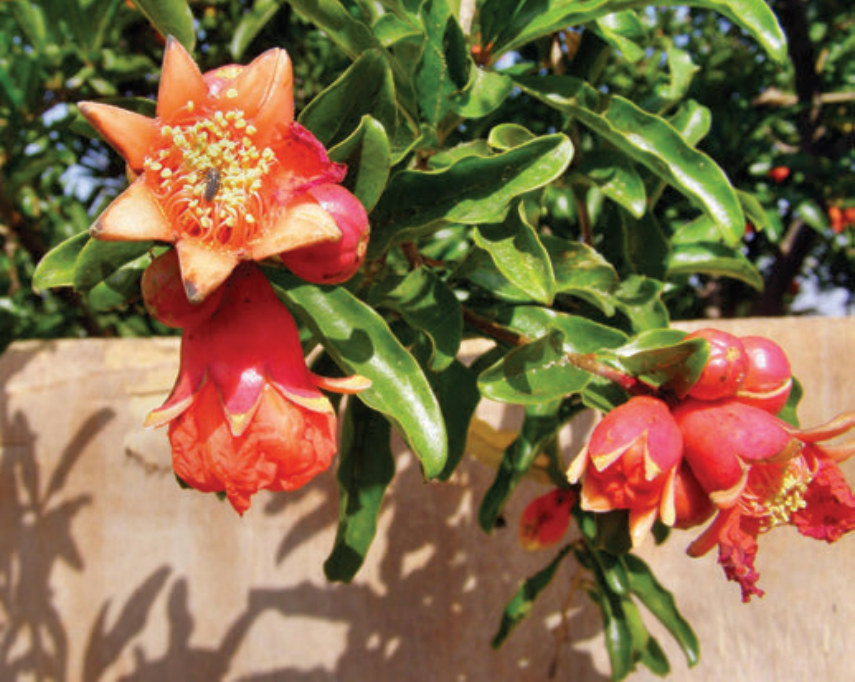
The calyx is solitary, axillary or terminal, free, compound, 12–10 × 20–16 mm, triangular, with the petals and stamens positioned at the rim of the calyx.
The petals are 5–8 mm long, wrinkled, bright red or white, broad obovate, alternating with the calyx lobes.
The stamens are numerous, arranged in several rings, nematocysts.
The ovary is nearly spherical, inferior, and multi-stoned.
The stone consists of two layers.
The placenta is reddish in the lower part and parietal in the upper part.
The fruit is a special type of berry, spherical, with varying diameters and colors.
The pericarp is thick and leathery, divided by a thin, yellowish, leathery septum (originating from the placenta).
The seeds are red or squamous, angular, nipple-shaped, and juicy.
The flowering period is from April to July, and the fruiting period is from September to December.
There are two types of pomegranate: the common pomegranate, whose fruit is eaten and is further divided into sour, sweet, and tart varieties; and a second type cultivated as an ornamental tree due to its beautiful red flowers.
Used part
Root bark and stem, fruits and their peels, and flowers
chemical components
The peel of the pomegranate fruit contains tannic compounds, including punicalin (punicalin), casuarin, and punicalin (granatine B, granatine A, punicalin C, and punicalin).
The most important of these is punicalin (20-25%).
The roots and stems of the pomegranate also contain tannic compounds (in the roots: 0.8%, in the stem: 0.4%), including piperidine alkaloids (punicacortein C, methylisopelletierine, methylisopelletierine, and pelletierine).
The transparent peel of the fruit and the brown membranes of the fruit contain methylgrantanin (pseudopelierine), 0.7g of fat, 0.8g of protein, and 0.8g of fat.
Per 100g of pomegranate arils (fatty septa) contains tannins.
It contains 0.9mg of fat, 0.02mg of riboflavin, 0.08mg of thiamine, 0.6mg of iron, phosphorus, calcium, and sugars (15%).
It also contains phenolic compounds (anthocyanidins and tannins) and 0.2-1mg of organic acids (vitamin C, niacin, and others).
The remainder of the pomegranate fruit's weight consists of the transparent peel and the brown membranes of the fruit and seeds.
Pomegranate arils contain what the fruit contains; they are a source of sugars, vitamins, ellagic acid, gallic acid, and phenolic compounds, including tannins.
Water-soluble (gallic acid C (vitamin C)).
Delphinidol, cyanidol, and pelargonidol give the plant its red color.
Anthocyanin pigments also contain anthocyanins, and the flowers contain tannins.
Properties and medical uses
An infusion of the peels and root bark (tannins) possesses properties that expel parasites causing parasitic infections of the large intestine, such as those caused by the amoeba *Entamoeba histolyca* and the parasite *Escherichia pancreas*.
The bark of the stem and roots, rich in alkaloids (pellethiol), is used to expel tapeworms and roundworms.
(Laxatives are preferred when using the bark for worm expulsion.) Powdered fruit, stem, and root bark (tannins) is used to treat diarrhea.
An infusion of pomegranate peel and pulp (the interstitial membranes), rich in tannins, is used to treat diarrhea.
It treats digestive ulcers and inflammation of the intestines and colon by coating the mucous membrane, depositing its proteins, forming a protective layer, and eliminating bacteria and fungi.
It is also beneficial in treating vaginal discharge and inflammation.
Pomegranate juice, with its tannins, especially ellagic acid, possesses antioxidant properties.
Elagic acid is metabolized by colon bacteria into urolithins, giving pomegranate juice its anti-inflammatory properties.
Research conducted on pomegranate juice or Its concentrate (pomegranate molasses) has an effect on slowing cholesterol deposition in the arteries, improving the condition of patients with mild diabetes, and preventing or slowing the development of cancers in the digestive and urinary systems (prostate cancer in particular), in addition to its effect on reducing inflammation in general, including rheumatism.
A pomegranate peel infusion is used topically to treat mouth ulcers, tonsillitis (gargles), and hemorrhoids.
Precautions: Excessive use of the drug may cause gastric irritation and respiratory spasms, and consuming more than 80 grams may lead to...
From the bark of the pomegranate stem or roots (alkaloids), it can cause blurred vision and general weakness, which may be followed by death.
In food, pomegranate fruit is used as a fruit or to make a refreshing, nutritious juice containing a large amount of sugars, minerals, and vitamins, especially vitamin C.
Pomegranate juice is included in dietary programs and is often concentrated to prepare pomegranate molasses, which is used to tang foods and is often used with fatty foods to aid their digestion.
Side effects and precautions
Excessive use of the drug may cause gastric irritation and respiratory spasms.
Consuming more than 80 grams of pomegranate stem or root bark (alkaloids) leads to blurred vision and general weakness, which may be followed by death.
In food, pomegranate fruits are used as is or to make a refreshing, nutritious juice containing a large amount of sugars, minerals, and vitamins, especially vitamin C.
Pomegranate juice is included in dietary programs and is often concentrated to prepare pomegranate molasses, which is used to tang foods and is frequently used with fatty foods to aid their digestion.
Other uses
Pomegranate peel is mixed with henna to dye hair black.
Rich in tanning agents, pomegranate peel is also used in leather tanning, ink production, and as a color fixative for dyes.
Pomegranate peel can also be used in the preparation of adhesives for manufacturing particleboard.
the environment
Its summer is 12°C - a semi-tropical, light-loving tree.
It grows in areas where winter temperatures do not fall below 500°C and where autumn temperatures are dry and warm.
The pomegranate resists spring frosts due to its late flowering, while the fruit is susceptible to autumn frosts.
However, the plant is relatively drought-resistant and thrives in areas with moderate annual rainfall.
In arid regions, moderate irrigation is preferred.
Pomegranate fruits ripen and acquire high quality during hot summers and warm autumns.
It tolerates salinity to a certain extent. Deep, well-drained clay and sandy loam soils are more suitable than dry soils.
Agriculture and productivity
The plant can be propagated by seeds, cuttings, offshoots, or layering, with propagation by cuttings being the most common.
Cuttings are prepared at the beginning of winter, 20-25 cm long and 0.5 cm in diameter, from one- or two-year-old branches of healthy, prolific trees, and are kept in moist sand until planting.
Planting takes place in the nursery at the end of winter in rows 60 cm apart, with a distance of 25 cm between the cuttings.
Care should be taken to ensure that the cuttings are slanted, and that one bud remains visible above the soil surface.
The necessary service operations are provided to them until they are transferred to the permanent ground after one or two years.
In the permanent field, maintenance operations include watering (especially in arid regions), fertilization, pruning, and pest control.
The plant flowers in late spring in two stages; the first flowering period is unsuccessful, with the flower dropping and failing to set fruit, while the second stage produces fruit.
The fruit requires 4-5 months to fully develop and ripen from flowering, beginning in early autumn and occurring in several stages.
Plants propagated from cuttings begin bearing fruit in their third year and produce a normal yield.
At 7-8 years of age, its production continues for 25-30 years.
Adonis vernalis L.
Adonanthe vernalis (L.) Spach, Adoniastrum vernale (L.) Schur Chrysocyathus vernalis (L.) Holub
History and Heritage
The scientific name for the genus is the Latin poison of this plant, derived from the Latin word *granatum*, meaning "apple of Carthage," and *mala*, meaning "multi-seeded." Historical documents indicate its use by the Sumerians, and the botanist Ducandel traces its cultivation back four thousand years, where it was used for food and medicine.
In ancient civilizations, it was considered a symbol of fertility; Homer wrote about it, and the pomegranate is mentioned in holy books.
Medical note
This information is for educational purposes only and does not constitute medical advice.
Poisonous or potent plants should only be used under the supervision of a qualified physician or pharmacist.
Related images